You signed up for your first Hyrox, or you're seriously thinking about it, and the real question isn't "what's the best exercise" but "where do I start." Good news: Hyrox is one of the most trainable endurance events out there, because the format never changes. You know exactly what's coming. This guide explains how to approach Hyrox training from scratch: the capacities that actually matter, how to assess where you are, and how to build a week that progresses in the right order.
This is a method guide, not a day-by-day program. When you want the week-by-week structure, our 12-week Hyrox training plan lays out the full split. Here we build the foundations that make that plan make sense.
- Hyrox rewards 4 capacities: aerobic base, strength endurance, station skill and pacing. Most beginners only train one of them.
- Running is 8km across 90 minutes, the biggest separator between finishers. If you come from strength, it's your #1 priority.
- Assess your starting point with numbers (5km, bench, pull-ups), not by feel. The right plan depends on your real base.
- 4 to 5 sessions per week, polarized: lots of easy, a little hard. Piling on hard sessions is the mistake that wrecks the most builds.
What training for Hyrox actually means
Hyrox is a fixed-format hybrid race: 8 × 1km runs alternated with 8 functional stations, in the same order at every event, in every city. Ski erg 1000m, sled push 50m, sled pull 50m, burpee broad jumps 80m, rowing 1000m, farmer's carries 200m, sandbag lunges 100m, then wall balls (75 reps men, 100 reps women in Open). The course doesn't change. That's exactly what makes Hyrox trainable: you can rehearse the race, station by station, until it holds no surprises.
So training for Hyrox isn't "being good at CrossFit" or "being a good runner." It's developing several qualities in parallel that together let you race the course instead of enduring it. Athletes who train only one of them finish, but they walk the last runs. If you want to see what real finish times look like by division, our average Hyrox finish times 2026 study breaks down ~50,000 public results.
The 4 capacities that decide your race
Every effective Hyrox training program develops these four capacities, in this order of priority for a beginner. Understand them and you can read any plan, and spot the ones that skip one.
| Capacity | Why it matters | How you build it |
|---|---|---|
| Aerobic base | 8km of running + recovery between stations | Easy zone-2 volume, 25-35 km/wk |
| Strength endurance | Hold the stations without spiking HR | 8-15 rep sets, density work |
| Station skill | Efficient technique = minutes saved | Specific drills 1-2x/wk |
| Pacing | Going out too hot = blowing up mid-race | Simulations + HR corridors |
The aerobic base is the foundation. Without it, every run empties you and you hit each station with your heart rate already at 90%. Strength endurance isn't max strength: nobody asks for a 1RM, they ask for 100 wall balls after 7km. Station skill is the most underrated lever: a badly executed sled push costs 2 minutes and an HR spike. And pacing turns the other three into a time: it's what separates the athlete who finishes strong from the one who walks run 8. To train pacing, our Hyrox pace calculator gives you station-by-station targets.
Assess your starting point
Before you pick a plan, measure where you are. The right program depends entirely on your real base, not your ambition. Run these five tests across a week, fresh and rested, not back-to-back. They tell you whether you're ready for a direct Hyrox block or need a general conditioning phase first.
| Test | Floor for a 12-week block |
|---|---|
| 5km time trial | < 27 min (< 30 min acceptable) |
| Bench press | Bodyweight × 5 reps |
| Deadlift | 100 kg × 3 reps |
| Strict push-ups | 10 |
| Strict pull-ups | 5 |
Above these floors, you can start a 12-week Hyrox plan directly. Below them (especially if your 5km is over 30 minutes), give yourself 4 to 6 weeks of general preparation first: easy run volume, compound lifts in the 5-8 rep range, and technique familiarization. That's not wasted time, it's what keeps the real block from turning into survival.
How many days and how to structure the week
Four to five sessions per week is the dose that works for a working athlete. The architecture that matters isn't the session count but the distribution: easy running dominates the volume, one genuinely hard session per week, and never two hard sessions back-to-back. This is the 80/20 polarized model validated on endurance athletes (Stöggl & Sperlich, 2014), and it holds up perfectly in Hyrox prep.
| Session | Focus | Intensity |
|---|---|---|
| Long easy run | Aerobic base | Easy (zone 2) |
| Full-body strength | Strength endurance | Moderate |
| Run intervals | Engine / VO2 | Hard |
| Strength + station finisher | Strength + skill | Moderate |
| Simulation / combos | Pacing + specific | Moderate to hard |
Space out your hard sessions. The interval day and the simulation never sit next to each other or beside a heavy leg day. If you only have 4 days, cut one of the two strength sessions and keep all the run volume: for Hyrox, running less hurts more than lifting less.
Training the 8 stations (without drowning in them)
You don't need to be elite at any single station. You need to be efficient at all 8, with no catastrophic weakness: the one that drops you to your knees and costs you 90 seconds. Here's the training focus for each.
- Ski erg & rower: legs drive first, arms last. Practice continuous 1000m efforts at controlled cadence (24-28 spm).
- Sled push & pull: straight arms, stay low, drive through the toes. One sled session per week is enough if you have access.
- Burpee broad jumps: short jumps, efficient landing. EMOM of 6 reps to force movement economy.
- Farmer's carries: it's a grip test. Add 3 sets of 60-second dead hangs per week.
- Sandbag lunges: bag high on the back, controlled descent, knee tracking. Drill form, not speed.
- Wall balls: plan your breaks before you start (e.g. 30-20-15-10). This is where the race is won in the last 200 meters of fatigue.
No sled or ski erg at home? Substitute smartly (heavy farmer's carries, thrusters, rows) but find a CrossFit affiliate 3 times during your block to touch the real equipment. To pick the app that logs all of it in one place, we compare the options in our best Hyrox app guide.
Balancing running and strength
The question that blocks every beginner: how do I improve running AND strength without one sabotaging the other? That's the interference effect. Wilson et al. (2012) research shows the quality trained first in a day captures most of the adaptation; the second is degraded by residual fatigue. The practical rule: on days when running and strength share a session, put your race-day weakness first.
Concretely: if you come from strength and running will be your weakness, run first. If you come from endurance and the stations scare you, lift first. We detail the templates and session ordering in our how to combine strength and running framework.
How long it takes
For a first-timer with a decent base, 12 weeks is enough to arrive at the start line ready to race. If you're starting from far back, add a conditioning phase first. The classic 12-week structure: 4 weeks of base (aerobic volume), 4 weeks of build (intervals + strength endurance + 2-station combos), 3 weeks of specific work (race simulations), 1 week of taper. The order is non-negotiable: each block sets up the next.
When you're ready to move from method to a day-by-day program, our 12-week Hyrox training plan gives the full weekly split, sample week and drills, and once race day is in sight, the race day checklist covers fueling, warm-up and logistics.
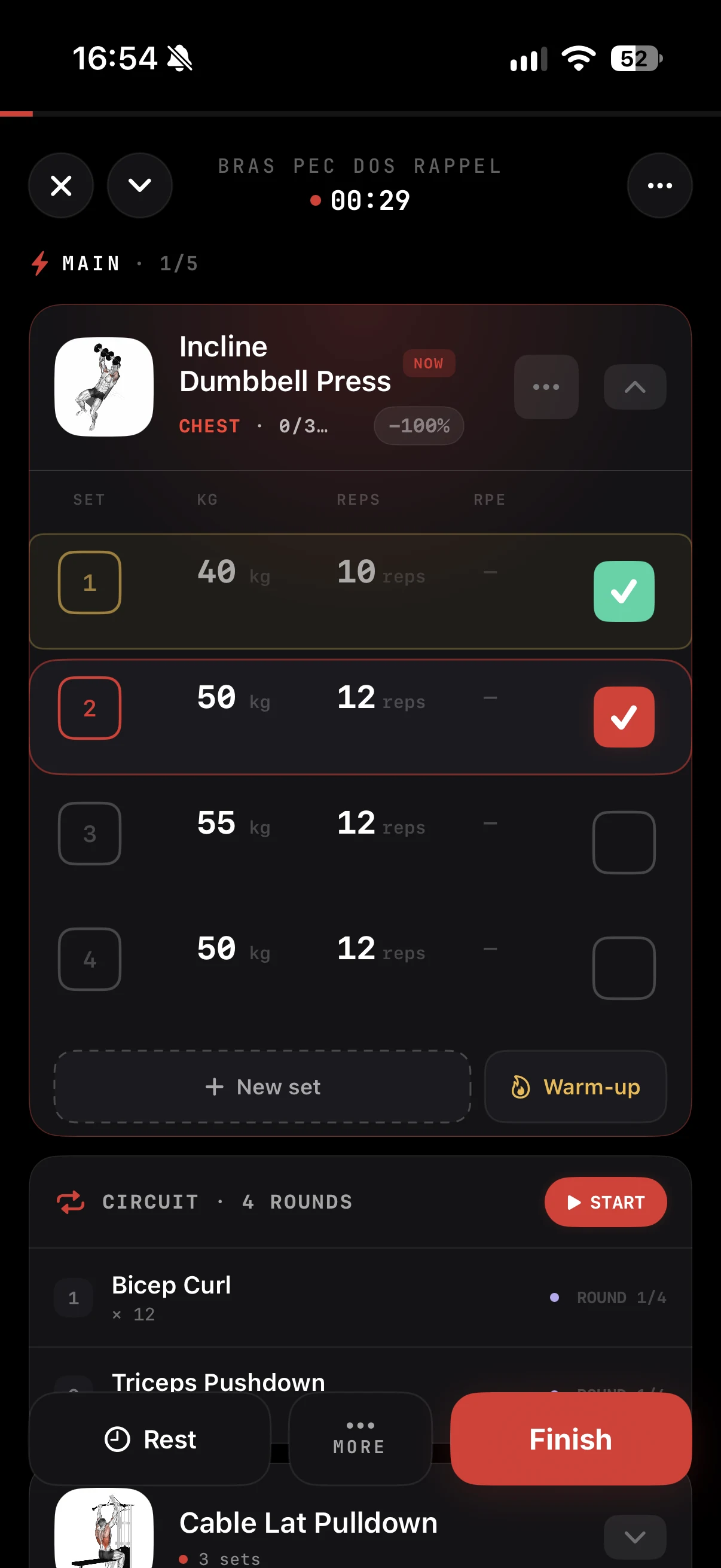
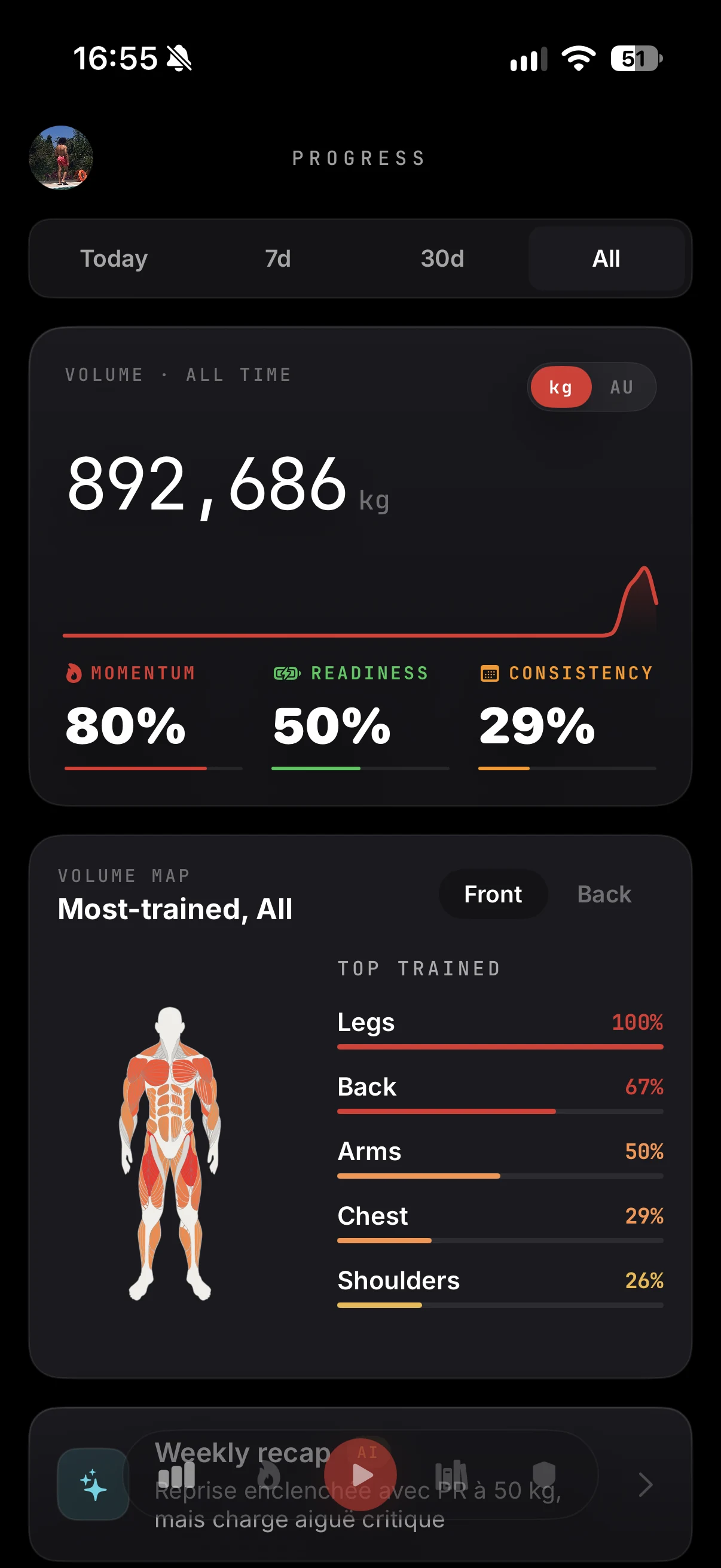
Log every run, lift and station in ZON
GPS running, lifting and Hyrox stations in one timeline. Simulations split automatically, you see your progression across 12 weeks, no spreadsheet to maintain. Free to download.
5 beginner mistakes to avoid
Training like a CrossFitter
Piling on intense metcons doesn't build the continuous aerobic base Hyrox rewards. You need easy run volume, not more WODs.
Neglecting the running
Running is 8km of the event. Strength-background athletes undertrain it and pay on runs 5 through 8. Aim for 25-35 km/wk in the base phase.
Running everything moderate-hard
Zone 2 "feels too easy," so you speed up, and accumulate fatigue without the adaptation. Respect the 80/20 split and wear a HR monitor.
Ignoring station technique
A badly executed sled push or wall ball costs minutes and HR spikes. Drill technique fresh before you add fatigue to it.
Going out too hot on race day
The #1 first-timer error: sprinting run 1 and blowing up on the first sled. Pacing is rehearsed in training, not on race day.
Closing
Training for Hyrox isn't about inflicting the hardest sessions on yourself: it's about developing four capacities in the right order, from a base you've honestly measured. Build your aerobic engine, add strength endurance, drill the stations, and rehearse pacing until it's automatic. Do that across 12 weeks and you'll cross the line having raced your race, not survived it.
The next step: run your five tests this week, pick your date, and start the 12-week plan. The plan only works if it's executed and tracked. We built ZON so the execution side gets out of your way, with EMOM and interval timers made for Hyrox blocks.
- Stöggl T., Sperlich B. (2014). Polarized training has greater impact on key endurance variables than threshold, high intensity or high volume training. Frontiers in Physiology, 5:33.
- Wilson J. M. et al. (2012). Concurrent training: a meta-analysis examining interference of aerobic and resistance exercises. Journal of Strength & Conditioning Research, 26(8), 2293-2307.
- Solli G. S., Tønnessen E., Sandbakk Ø. (2017). The training characteristics of the world's most successful female cross-country skier. Frontiers in Physiology, 8:1069.
- Hyrox official race format and station specifications, hyrox.com.