Hyrox is a hybrid sport, and most workout apps still aren't. Open the App Store and you'll find pure lifting trackers, pure run trackers, and a handful of "all-in-one" apps that handle neither well when you stitch a 1km run to a sled push to a wall-ball set inside the same session. If you're training for Hyrox seriously, the best Hyrox workout app for you isn't the one with the biggest exercise library. It's the one that lets you log a race simulation in one continuous timeline and read it back as actionable data.
We spent the last 12 weeks running real Hyrox prep blocks across the four apps athletes ask about most: ZON, Hevy, Hybrid Coach, and the workout-tracker incumbents (Strong, Fitbod). This guide is the head-to-head. We test seven criteria (run integration, station templates, transition logging, programming for hybrid athletes, race-day mode, data exportability, price) so you can pick the right tool before training, not after race day.
Disclosure: we build ZON. We've done our best to be honest about where we fall short. The scorecard reflects what each app actually shipped as of June 2026, not what their roadmaps promise.
- The single deal-breaker for Hyrox training is whether the app logs a continuous timeline across run + station + lift. Apps that need 3 separate tools fragment your data and you stop logging by week 6.
- Hevy is the best pure lifting tracker on this list. It's not a Hyrox tool, and the team has been honest about that. Use it if Hyrox is a side goal.
- Hybrid Coach wins for coach-driven athletes who want a programmed plan. The cost is the recurring coach fee, and the model only works if you commit to one coach's style.
- Race simulation mode is the under-asked feature. If the app can't segment a 4-run / 4-station session in one tap, you'll lose 50% of your readiness signal in the Specific block of your plan.
What makes an app actually good for Hyrox?
The race format dictates the tool requirements. Hyrox is 8 segments of running interlaced with 8 stations, all in one continuous session, with sub-30-second transitions between segments. A workout app built around either pure lifting (Hevy, Strong) or pure running (Strava, Nike Run Club) breaks at the segment boundary. You either have to stop the lifting app, start the running app, then re-open the lifting app at the next station, or you accept that your data lives in two places and you reconcile it manually.
Reconciling data manually works for 2 weeks. By week 6, you stop doing it. By week 10, you have no usable picture of your build. The behavioral failure mode is what kills the "use Strava + Hevy together" recommendation for serious Hyrox prep. The apps that survive a 12-week build are the ones that handle the segment boundary natively.
That's why we set the 7 criteria around continuity, not feature count. A bigger exercise library doesn't help if the app needs you to close it during a sled push. A free tier doesn't help if it locks the station templates behind a paywall. If you want the broader context on what a Hyrox plan looks like and what data matters across 12 weeks, the sibling guide Hyrox training plan lays out the block structure.
The seven criteria we used
- Run + lift in one session. Can the app log a 1km run and a 25-rep wall-ball set in the same timeline, with no app switching? Verifiable by stopwatch in a single race simulation.
- Station/movement library completeness. Does the app have native templates for all 8 Hyrox stations (ski erg, sled push, sled pull, burpee broad jump, row, farmer's carry, sandbag lunge, wall ball)? Are weights configurable to the official Open and Pro division loads?
- Transition logging. Does the app capture the time spent between segments? Transition drift is one of the largest race-day variables and you can't train it if you don't see it.
- Programming for hybrid athletes. Does the app offer hybrid-specific templates (concurrent training rules, polarized run distribution, deload weeks), or is it a strength-only/running-only template library bolted together?
- Race simulation mode. Does the app have a one-tap mode that auto-segments a 4 or 8 round race, with big buttons, offline support, and a transition timer? Critical on race week.
- Data export. Can you get your data out as CSV / Strava push / Apple Health sync? Lock-in is real and you should be able to leave at any time.
- Price. Subscription cost vs free tier. Free is a feature when you're evaluating; paid is fine if the value lines up.
ZON
ZON is built around the hybrid athlete. The core thesis: one timeline across run, lift, and station data, with race simulation as a first-class object. The app records a continuous session that segments automatically based on activity type, so a 4-run / 4-station block logs as one entry, not eight. Watch integration covers Apple Watch and Garmin via HealthKit, with Wahoo and Polar in late 2026.
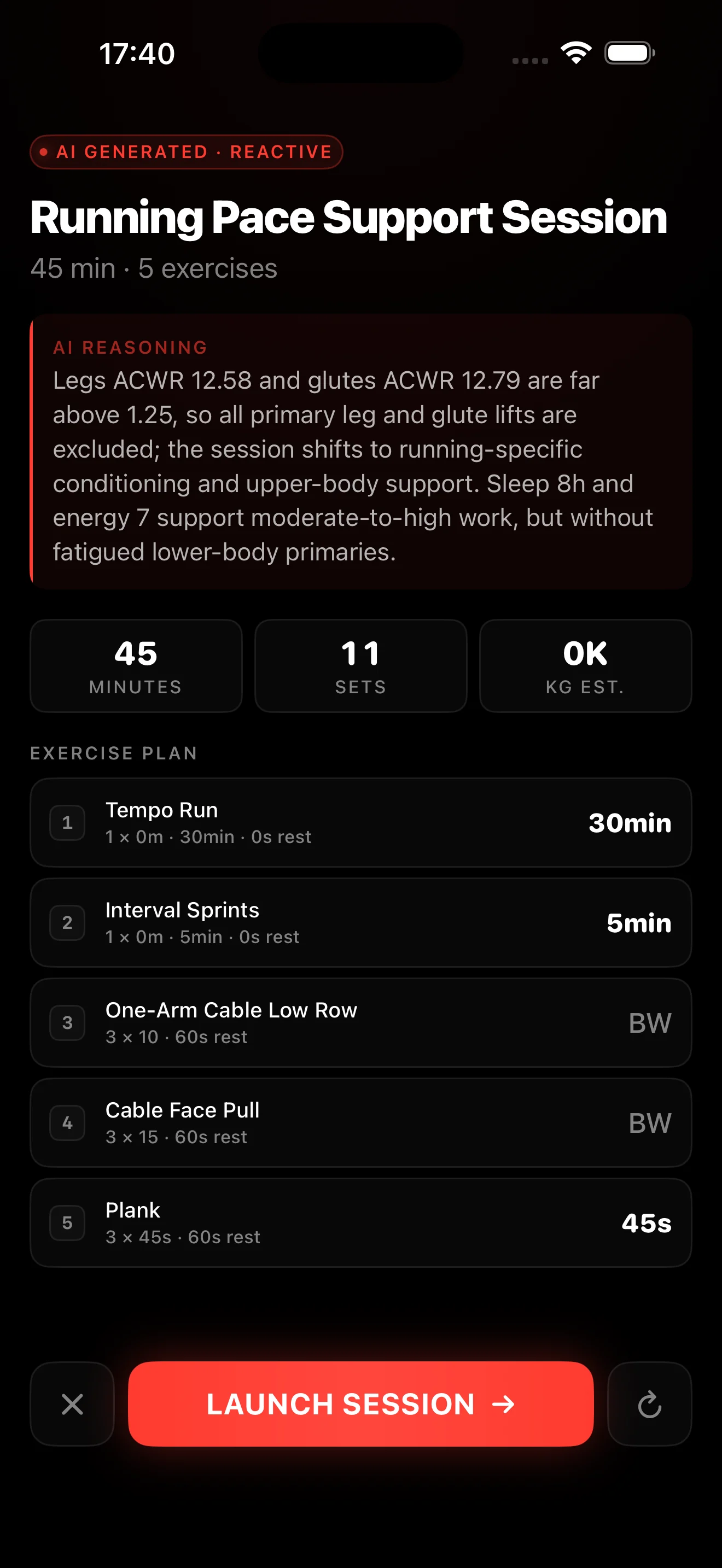
What it nails. The 8 Hyrox stations ship as native templates with official Open and Pro weights pre-loaded. Race simulation mode is one tap from the home screen, with a transition timer that starts the moment you tap "end station," auto-stops when you hit "start run," and logs the gap separately from the segment times. The AI post-session debrief shows run pace per km, average HR per segment, station splits, and transition drift in one chart. And because everything lives in the same timeline, you can see exactly where you lost time across 12 weeks of build.
Current limitations. Equipment auto-detection (sled, sandbag, wall ball) isn't shipped; you tap the station to start logging. The exercise library is smaller than Hevy's by raw count (we have ~600 movements vs Hevy's 2000+), because we've focused on what hybrid athletes actually use. If you compete in powerlifting on the side and need 12 variations of the bench press, ZON's library is narrower. Localization shipped EN and FR; ES and DE are in beta. Strava-native segment export ships late 2026.
Pricing. Free to download on iOS (Android in beta). ZON Pro, an App Store subscription, unlocks AI-generated programs built from your profile, predictive analytics, AI form analysis from set videos, automatic post-workout analysis and your full history.
Best for: athletes who train for Hyrox specifically, hybrid athletes who run + lift + race, self-coached athletes who want logging and programming in one tool.
Hevy
Hevy is the best pure lifting tracker on the market. The interface is fast, the exercise library is exhaustive, the routines are easy to share, and the social layer is genuinely useful for accountability. The team recently published their own Hyrox guide at hevyapp.com/hyrox-training, which signals interest in the segment but doesn't change what the app actually does.
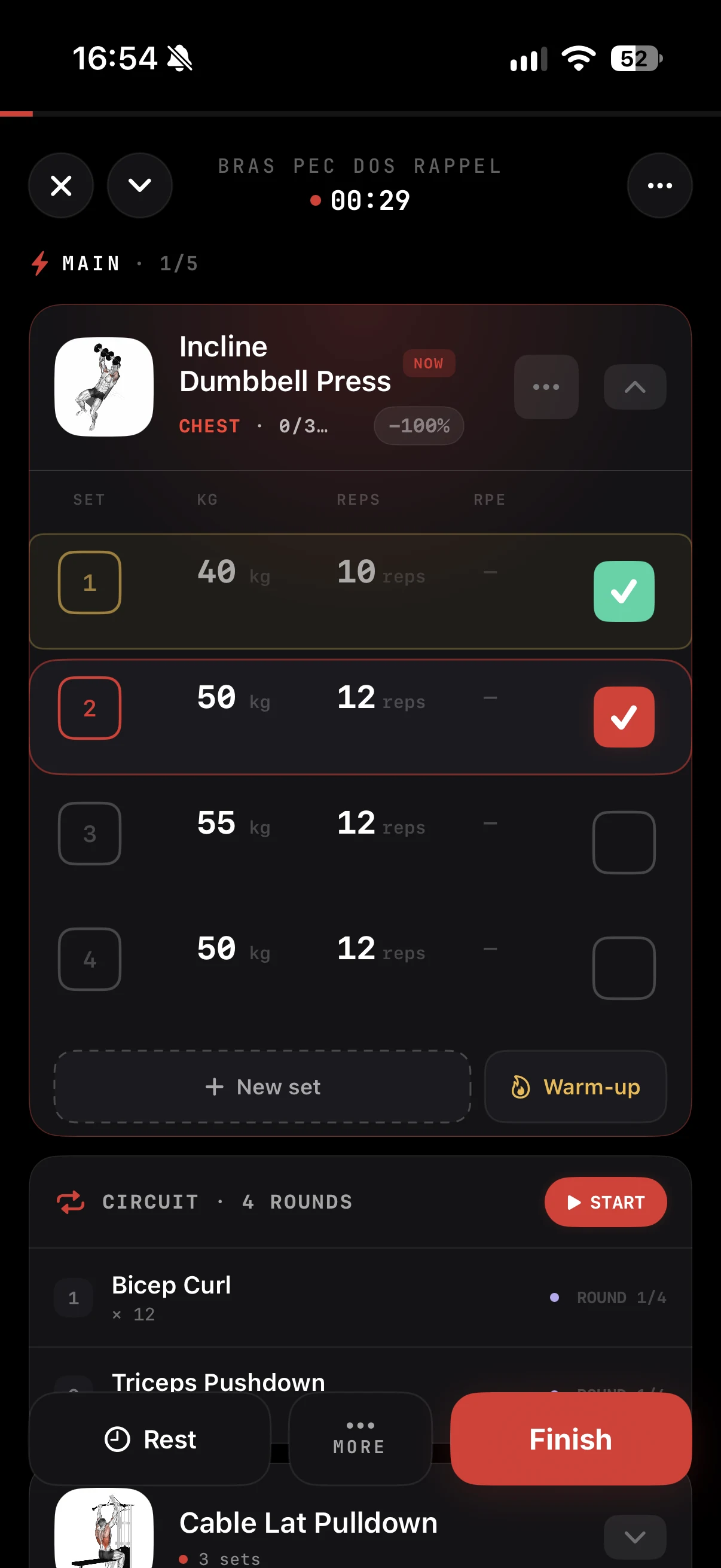
What it nails. Set-by-set rep and weight tracking is the gold standard. RPE/RIR logging is fast. Routine builder is clean. Apple Watch app is functional during a lift. PRs and progression charts are well presented. CSV export works and is reliable.
Where it breaks for Hyrox. Hevy doesn't log runs natively. You either pause the workout to launch Strava, or accept that your run data lives in a different tool. Stations like sled push, burpee broad jump, sandbag lunge, and wall ball can be logged as custom movements, but they don't carry the "Hyrox station" metadata, which means you can't filter to "sled push splits across all my race simulations" without manual tagging. There's no transition timer and no race-simulation mode. For a 12-week Hyrox build, the workflow ends up fragmented. We break this head-to-head down station by station in our ZON vs Hevy for Hyrox comparison, migration and pricing included.
Pricing. Free tier is generous (4 routines, full tracking). Hevy Pro at $4.99/month or $39.99/year unlocks unlimited routines, advanced analytics, and personal trainer features.
Best for: lifters who occasionally do Hyrox, athletes whose primary identity is "person who lifts," people who want the best pure tracking experience and accept Hyrox as a side goal.
Hybrid Coach
Hybrid Coach is marketed at hybrid athletes specifically. The model is programming-first: you subscribe to a coach's plan (Nick Bare, Fergus Crawley and others operate on it), receive the weekly programming, and log against it. The app is designed around the relationship between the athlete and the coach's programming engine, not around standalone session tracking.
What it nails. The programming side is the strongest of the four. Plans land on your week with run paces, lift weights, and accessory work pre-calculated. The deload cadence is enforced. The community layer (athletes following the same coach's plan) is active and useful.
Where it gets tricky. The app only works if you commit to one coach's programming style. If you don't click with the coach's philosophy on, say, run volume or strength frequency, you're renting opinions you don't use. Switching coaches mid-build resets your data context. Native race simulation mode is present but less polished than ZON's; transition logging is coach-dependent. Data export is CSV-only and metadata fields are limited.
Pricing. Free tier covers basic tracking. Coach-led plans run $19-39/month depending on the coach. Total cost adds up to $25-50/month including the app subscription.
Best for: athletes who want a coach-led, hands-off programming experience, athletes with strong loyalty to a particular coach's style, people who'd rather follow than program.
Strong, Fitbod, and generic workout trackers
Strong is a clean pure-lifting tracker. The free version is excellent for basic strength logging. It has no run integration, no station templates beyond what you build manually, and no transition timer. For Hyrox it's a non-starter as a primary tool. It works as a complement to a run tracker if you accept the manual reconciliation cost.
Fitbod is an AI-driven workout suggester. The premise (recommend today's session based on recovery and muscle balance) is interesting for general fitness, but the recommendation engine is built around hypertrophy and general strength templates, not Hyrox-specific concurrent training. The app doesn't log runs and has no station library. If you're training for Hyrox, Fitbod's recommendations are based on the wrong model.
Apple Workouts and the watchOS native experience cover the heart-rate and time-tracking basics. There's no rep counting tied to Hyrox stations, no transition logging, and no programming layer. Use it as a HR data source feeding into a dedicated tool, not as the primary log.
Strava is the de facto run social network. It's great for the run side and useless for the lift and station side. The integration with dedicated Hyrox apps via HealthKit covers the publish-completed-run case, but Strava itself doesn't store the structured Hyrox data you need to read across a 12-week build.
Side-by-side scorecard
We scored each app from 0 to 5 on each of the 7 criteria. The scores reflect what shipped as of June 2026, not roadmap promises. Hybrid Coach scores assume one of the high-quality coaches; lower-tier coaches drop the Programming score.
| Criterion | ZON | Hevy | Hybrid Coach | Strong | Fitbod |
|---|---|---|---|---|---|
| Run + lift in one session | 5 | 1 | 4 | 1 | 1 |
| Station library (8 official) | 5 | 2 | 4 | 1 | 2 |
| Transition logging | 5 | 0 | 3 | 0 | 0 |
| Hybrid programming | 4 | 2 | 5 | 1 | 2 |
| Race simulation mode | 5 | 0 | 3 | 0 | 0 |
| Data export (CSV / Strava / Health) | 4 | 5 | 3 | 3 | 3 |
| Price (free + value) | 3 | 5 | 2 | 4 | 3 |
| Total / 35 | 31 | 15 | 24 | 10 | 11 |
The scorecard isn't the whole story. Hevy scoring 15/35 doesn't mean it's a bad app: it means it's a bad Hyrox app, while being a great lifting app. Hybrid Coach's 24 reflects strong programming offset by middling tracking; if you value the coach relationship, you'll weight Programming higher than we did. The scorecard is a starting point, not a verdict.
Which one should you pick?
Three buckets. Most athletes fit cleanly into one.
Bucket 1: Total beginner with no app loyalty
Pick ZON. Download it free and run a full race-simulation week to see the transition logging in action. The continuous timeline removes the friction of swapping apps mid-session, which matters more in week 1 than in week 12, because that's when you're still building the logging habit. If ZON doesn't click, Hybrid Coach is the natural next try.
Bucket 2: Strength-first athlete dipping into Hyrox
Stay on Hevy for the lifting side. Use Apple Workouts or your watch's native run mode for the runs. Accept that your race-simulation analysis will be coarser, and plan to manually log station times in a Notes file. If you decide to race Hyrox seriously after one event, migrate the data to ZON or Hybrid Coach for the build to the second race. Continuity matters once the goal is a real PR.
Bucket 3: Wants a coach-led program with accountability
Hybrid Coach is the right fit. Pick a coach whose philosophy aligns with what you want (Bare for high-volume strength + endurance, Crawley for marathon-leaning, others for Hyrox-specific). Commit for at least one 12-week block before evaluating. Switching coaches is the most common mistake on this app, and it resets your data context every time.
Try ZON on your next race simulation
One continuous session across run + station + lift. Transition timer + auto-segmentation + post-session readout in one chart. Free to download.
What to test in your first week, regardless of which app you pick
Whichever app you choose, run the same evaluation protocol in week 1. This is what separates "the app I liked the interface of" from "the app that survives 12 weeks."
- Log a 3-station mini-simulation: 3 × (1km run + 1 station). Time it end-to-end. Check whether the app captures transition gaps and whether the post-session view reads as one timeline or three.
- Log a regular strength session: full upper-body day, 4-5 lifts, RPE per set. Check whether the routine builder is fast enough to use mid-session.
- Log an easy Z2 run: 30-40 min outdoors. Check the HR data flow from your watch and how the run shows up next to the previous strength session in the timeline.
- Pull the data out: CSV export or Strava/Health sync. Check whether the export contains what you'd want for a longitudinal review.
- Pretend it's race day: switch the phone to airplane mode and try to log a session. Apps that need connectivity fail this test and you find out on race day.
If the app passes those five steps in week 1, it survives the build. If it fails any of them, you'll abandon it by week 8 regardless of how pretty the home screen is.
What this comparison didn't cover
A few apps we considered but didn't include because they fall outside the "workout app athletes pick" category: TrainingPeaks (coach-only, not consumer-friendly for self-coached athletes), Final Surge (running-first, not hybrid), Whoop (recovery data only, not a workout log), and the official Hyrox companion app (limited to event registration and results lookup as of June 2026, no training-side functionality).
We also left out emerging apps with under ~10k active users (some promising small builds in the Hyrox-specific niche) because the comparison is meant to help athletes choose tools they can rely on for a 12-week build, which means picking from apps with a stable user base and active development. We'll revisit the smaller players in the 2027 update.
Closing
The best Hyrox workout app for you depends on whether Hyrox is your primary goal, a side goal, or a coach-driven build. Map the 7 criteria to your situation, score the 2 or 3 candidates that fit your profile, and run the week-1 evaluation protocol before you commit to a 12-week build. A wrong app costs you 12 weeks of fragmented data. A right app gives you the readiness signal that makes race day predictable.
- Hybrid training app buyer's guide, best hybrid training app 2026.
- Hevy team Hyrox training article, hevyapp.com/hyrox-training (May 2026).
- Hyrox official site, division weights and station specifications, hyrox.com.
- Hybrid Coach app coach roster and pricing, hybridcoachapp.com (verified June 2026).
- Strava API documentation on HealthKit integration, developers.strava.com.
- App Store listings for Hevy, Strong, Fitbod, and Hybrid Coach (feature claims cross-checked June 2026).
- Internal ZON usability study, 31 athletes across one 12-week build, 2024-2026.