You signed up for a Hyrox. Maybe it was a bet, maybe it was the videos of athletes sled-pushing red-faced under stadium lights. Now you need a hyrox training plan that actually fits your week, not a 6-day pro split copied from a coach’s Instagram.
This guide is for the working hybrid athlete: someone who can train 4 to 5 sessions a week, runs decently but isn’t a runner, lifts but isn’t a powerlifter, and wants to finish a Hyrox feeling like they raced it, not survived it. We walk through a 12-week structure that progresses run volume, strength endurance and station-specific work in the right order, plus exactly how to track each session so you can see whether the plan is working and adjust before race day instead of after.
You’ll find the weekly split, the sample week, the eight station drills that map 1:1 to the race, a pacing strategy, and the most common ways athletes blow their first Hyrox (and how to avoid them). If you train through this plan inside ZON, every set, run and station gets logged automatically, so by week 12 you have data, not vibes.
New to Hyrox and unsure about the fundamentals? Start with our primer on how to train for Hyrox, then come back here for the week-by-week structure.
- Hyrox rewards aerobic base + strength endurance + transition tolerance, in that order. Generic CrossFit or pure strength programs underprepare two of the three.
- 12 weeks is the right length for first-timers. 8 weeks works only if you can already run 5km under 25 minutes and hit a bodyweight bench.
- The single biggest race-day mistake is going out too hot on run 1 and redlining the first sled push. Pacing is the lever, not effort.
- You can't adjust what you don't track. Log run pace, RPE per strength block, and station splits in your weekly simulation.
What Hyrox training is really about
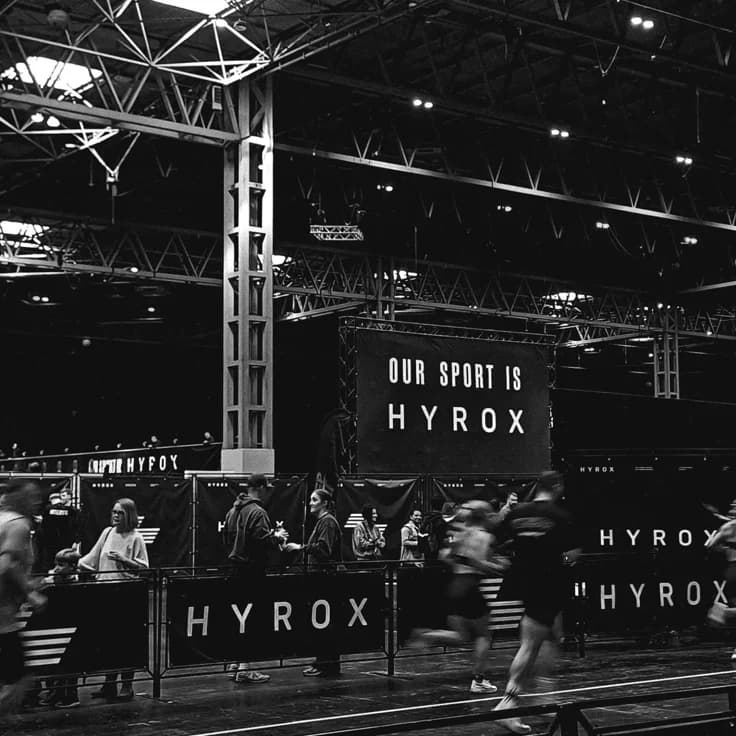
Hyrox is a fixed-format hybrid race: 8 × 1km runs alternated with 8 functional stations, in the same order at every event, in every city. Ski erg 1000m, sled push 50m (4 lengths of 12.5m, loaded), sled pull 50m, burpee broad jumps 80m, rowing 1000m, farmer's carries 200m, sandbag lunges 100m, wall balls 75 reps (men) or 100 reps (women, Pro divisions vary). The course doesn't change. The athletes do.
That fixed format is what makes Hyrox trainable in a way that pure CrossFit isn't. You know what's coming, in what order, for what distance. The race rewards three capacities developed in parallel: a deep aerobic base so the runs don't empty you, strength endurance so the stations don't blow up your heart rate, and fatigue resistance under transitions so the gap between station and next run shrinks. Athletes who only train one of those three finish, but they don't race.
Generic CrossFit programming covers strength endurance and metcon, but typically falls short on continuous-run volume. Pure 5k/10k running programs cover the aerobic base, but won't prepare you for a 50m sled push with 102 kg on it at minute 23 of the race. A Hyrox plan exists to balance the three, not to favor any one. If you want benchmark data on what real finishers look like across divisions, our average Hyrox finish times 2026 study breaks it down by gender and division using ~50,000 publicly available results.
How long should a Hyrox training plan be?
Short answer: 12 weeks if it's your first race, 8 weeks if you're a returning athlete with a real base, 16 weeks if you're building from far away. The base question is what matters, not the calendar. Coming in with the wrong base means you spend the first 4 weeks of any plan playing catch-up instead of progressing.
We define base measurably. For a 12-week plan to land you at a respectable first-Hyrox time, the floor looks like this: a 5km time under 27 minutes (under 30 minutes if you accept a finish over 1h45), bodyweight bench press for 5 clean reps, a 100kg deadlift for 3 reps, 10 strict push-ups, and 5 strict pull-ups. Below that floor, you don't need a Hyrox plan yet, you need a general-fitness block of 6-8 weeks first.
Above the floor, the 12 weeks split cleanly: 4 weeks of base, 4 weeks of build, 3 weeks of specific work, 1 week of taper. An 8-week build collapses the base block into 2 weeks and assumes your aerobic and strength bases are already in shape. A 16-week build adds 4 weeks of general preparation before the base block starts, useful if your 5km is over 30 minutes or if you're returning from time off.
The 12-week structure
Each 3-4 week block has one job. Don't skip a job to chase the next one. The order matters because the adaptations stack: aerobic capacity built in weeks 1-4 carries the intervals you'll run in weeks 5-8, and the station combos in weeks 5-8 build the tolerance you'll need to survive the simulations in weeks 9-11.
| Block | Weeks | Run focus | Strength focus | Station focus |
|---|---|---|---|---|
| Base | 1-4 | Z2 volume up to 25-35 km/wk | Compound 3x/wk (squat, hinge, press, pull) | Familiarization, technique under no fatigue |
| Build | 5-8 | 1 interval session/wk at 5k-10k pace | Strength endurance (8-12 reps, density work) | 2-station combos, transition timing |
| Specific | 9-11 | 1 race-pace session/wk + long Z2 | Maintenance, 2x/wk, no PR attempts | Half-race and full-race simulations every 10 days |
| Taper | 12 | Volume -40%, intensity kept | 1 light session early in the week | 1 short station rehearsal, then rest |
Base (weeks 1-4). The job is aerobic volume and reintroducing the strength patterns the race rewards. Running stays easy and conversational, 80% of weekly running minutes below ventilatory threshold 1 (Z2 in 3-zone, roughly 65-75% max HR). The classic polarized model that Stöggl & Sperlich (2014) validated on endurance athletes applies: most of your minutes should feel boring, and your one harder session per week should feel hard. Strength runs 3 sessions per week, full-body, compound lifts in the 5-8 rep range. Stations are introduced once per week as technique work, no metcon: 20 minutes drilling the sled push position, the wall-ball squat depth, the burpee broad jump rhythm.
Build (weeks 5-8). Now the engine work starts. Add one interval session per week at 5k-10k race pace: think 6x800m at 10k pace with 90-second jog rests, or 5x1km at 5k pace with 2-minute rests. The strength block shifts to strength endurance, 8-12 reps with density work (sets of 10 every 90 seconds, EMOM-style finishers). The big addition is 2-station combos: 50m sled push into 25 wall balls, 500m row into 25 sandbag lunges, 1000m ski into 16 burpee broad jumps. The point isn't the metcon, it's teaching your heart rate to recover during the run that follows.
Specific (weeks 9-11). Race simulations land here, not before. Two formats: a half-race simulation every other week (4 runs + 4 stations: ski, sled push, sled pull, burpees), and one full race simulation in week 10 or 11. Strength drops to maintenance, 2 sessions, no PR attempts, the goal is to keep the patterns warm without bleeding recovery. Run sessions polarize harder: one race-pace session (5x1km at goal race pace with 90-second rests) plus one long Z2 run of 75-90 minutes.
Taper (week 12). Drop running volume by ~40% while keeping a couple of short race-pace efforts. One light full-body strength session early in the week. A short station rehearsal 4 days out (10 minutes of light work, no fatigue). 48 hours of complete rest into race day. Pre-race nerves will push you to do more. Resist.
Sample week (Build phase)
This is what a week 6 looks like for a working athlete on 5 sessions. Adjust the days to your schedule, but keep the spacing: never two hard sessions back-to-back, never a strength leg day next to an interval day. Race-pace pacing references in this section pair well with our Hyrox pace calculator.
| Day | Session | Detail |
|---|---|---|
| Mon | Easy run + core | 8 km Z2 (~65% max HR) + 15 min core circuit |
| Tue | Strength + station finisher | Back squat 4x5 @ RPE 7, bench 4x6, row 3x10. Finisher: 4 rounds of 50m sled push (light) + 10 burpee broad jumps |
| Wed | Intervals + sandbag work | 15 min Z2 warm-up, 8x400m at 5k pace with 90s jog rest, cool-down. Then 4x25m sandbag lunges + 200m row, easy pace |
| Thu | Rest / mobility | 30 min mobility, walk, sleep |
| Fri | Long Z2 + light wall ball | 12-14 km Z2 + 3 sets of 25 wall balls, unbroken, between rounds |
| Sat | Hyrox simulation | 4 rounds: 1 km run + 1 station. Order: ski 1000m, sled push 50m, sled pull 50m, burpees 80m |
| Sun | Rest | Full rest or 30 min easy walk |
Two non-obvious things in that week. First, the Friday long run carries 3 sets of wall balls at the end. That's not a metcon, it's a teaching tool: your legs learn to squat under aerobic fatigue, which is exactly what wall balls feel like in the race. Second, the Saturday simulation is a half-race, not a full 8-station, because half-races are the right dose at week 6. Full simulations land later. Burning yourself on full simulations too early is the most common mistake in a 12-week plan.
The 8 stations: what to drill and what to fake
You don't need to be elite at any single station to race a respectable Hyrox. You need to be efficient at all 8, with no catastrophic weakness. The catastrophic weakness is the one that drops you to your knees mid-station and costs you 90 seconds of recovery. Eliminate that, and you're racing instead of surviving.
Ski erg (1000 m)
Common mistake: pulling with arms first, lunging the hips down second. Result: spiking heart rate at minute 4 of the race. The fix: hinge at the hips, drive through the legs, finish with the lats. Practice on the erg with a metronome (24-26 strokes/minute), focusing on the leg drive timing. Race pace target: 4:00-4:30 for men, 4:30-5:00 for women on station 1 with a fresh heart rate.
Sled push (50 m)
Common mistake: bent arms, high hands, no commitment to driving through the toes. Result: feet slipping, no progress, panic. The fix: straight arms, hands at chest height, head down, walk through the toes. Practice with sled loads at 110%, 100% and 80% of competition weight, in 25m efforts with 60 seconds rest, 4 rounds. Once a week is enough. Race weight: 152 kg (men, 102 kg + sled), 102 kg (women), Pro divisions higher.
Sled pull (50 m)
Common mistake: pulling hand-over-hand standing tall. Result: lower back fatigue, slow turnaround between lengths. The fix: stay low in an athletic stance, pull rope to hip, drive backwards with the legs. The hands manage the rope, the legs do the work. Drill with a battle rope or sled rig 1x/week, 4 sets of 25m at race weight.
Burpee broad jump (80 m)
Common mistake: jumping too far, landing inefficiently, wasting energy on the chest-to-floor portion. The fix: short jumps (2 meters max), efficient hand placement on the floor, knees-to-hands instead of feet-to-hands when fatigued. Drill: EMOM 8 minutes of 6 burpee broad jumps. The constraint forces efficiency.
Rowing (1000m)
Common mistake: high stroke rate, low power per stroke, wasted energy. The fix: 26-28 strokes/minute, drive through legs, hinge back smoothly, hands finish at the sternum. Race pace target: 1:50-2:00/500m for most athletes on station 5. Practice continuous 1000m efforts at target pace once a week.
Farmer’s carry (200m)
Common mistake: dropping the kettlebells halfway because the grip went. The fix: dedicated grip work. 3 sets of 60-second dead hangs per week. Heavy farmer's carry intervals (50m walks with 32 kg kettlebells per hand for men, 24 kg for women, 4 rounds, 60s rest) once a week. Most athletes underestimate grip endurance and pay for it on station 6.
Sandbag lunges (100m)
Common mistake: bag on the wrong shoulder, hips collapsing, knee caving inward. The fix: bag high across the upper back, ribs stacked, controlled descent. Drill 4x25m sandbag lunges weekly, focusing on form, not speed. Sandbag weight: 20 kg (men) or 10 kg (women) for Open divisions.
Wall balls (75 / 100 reps)
Common mistake: breaking the set too early, then never recovering rhythm. The fix: plan your breaks before you start. Most athletes do 30-20-15-10 (men) or 40-30-20-10 (women) with 5 deep breaths between sets. Drilling unbroken sets of 25 weekly builds the lung capacity and the leg-squat tolerance. Wall balls are where the race is won or lost in the last 200 meters of fatigue.
Pacing strategy and the run-station-run rhythm
Hyrox first-timers blow up for one of two reasons: they start the first 1km run too hot (10-20 seconds/km faster than goal pace), or they attack the first sled push at 100% effort, redlining their heart rate to the ceiling at minute 8 of a 90-minute race. Both are pacing errors, not fitness errors. You can't out-fit a bad pacing plan.
The model that works: target heart-rate corridors per segment, not target pace per segment. On the runs, sit at Z3 (roughly 80-85% max HR), conversational-plus, never deep Z4. On the stations, manage to a target effort, not a target time. If your sled push went 10 seconds slower than you planned but your heart rate stayed under 90% max, you won the trade.
| Segment | Target HR (% max) | Subjective effort |
|---|---|---|
| Runs 1-4 | 80-86% | Conversational+, controlled |
| Runs 5-7 | 83-88% | Hard but sustainable |
| Run 8 | 90%+ | Empty the tank |
| Ski / Row | 85-90% | Smooth, controlled cadence |
| Sled push / pull | 90-95% | Brutal but planned |
| Wall balls | 85-90% | Sustain rhythm, plan breaks |
The other lever is the transition. Between station and next run, you have 15-30 seconds where your heart rate is at its peak. Walk 5 meters out of the station zone, drop your hands above your head for 3 deep belly breaths, then start the run at 15 seconds/km slower than goal pace for the first 200 meters. By the time you hit 300 meters, your HR has dropped 8-10 bpm and you can ramp to goal pace. Athletes who try to leave the station at race pace cumulate 30-45 seconds of avoidable redlining over the race.
How to track the plan (and why most athletes don’t)
Twelve weeks is long enough that you can't feel progression honestly. What you remember is the last session. What matters is the trend across 12 weeks: did your Z2 pace at the same heart rate drop? Did your sled push splits get faster at the same HR? Did your wall-ball break pattern hold across 4 race simulations? Without logged data, the answer is always "I think so," which is the answer of an athlete who’s about to be surprised on race day.
The minimum useful log per session: date, session type, run pace per km, average HR per run, RPE for each strength block (1-10 scale, Zourdos et al. 2016 RIR-based RPE works well), and station splits for any simulation. You don't need fancy. A spreadsheet works. The bar is: at week 8, you should be able to scroll back to week 1 and see numbers, not feelings.
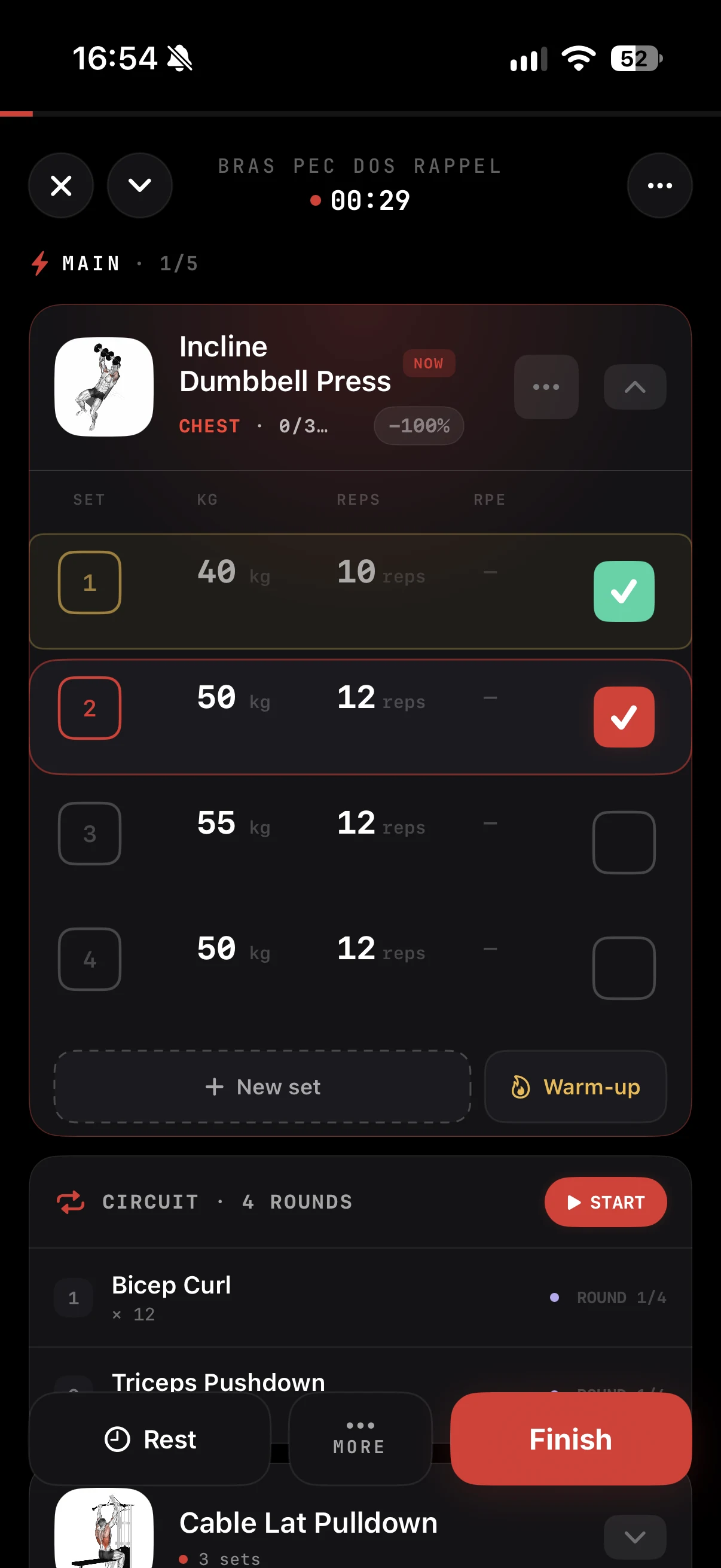
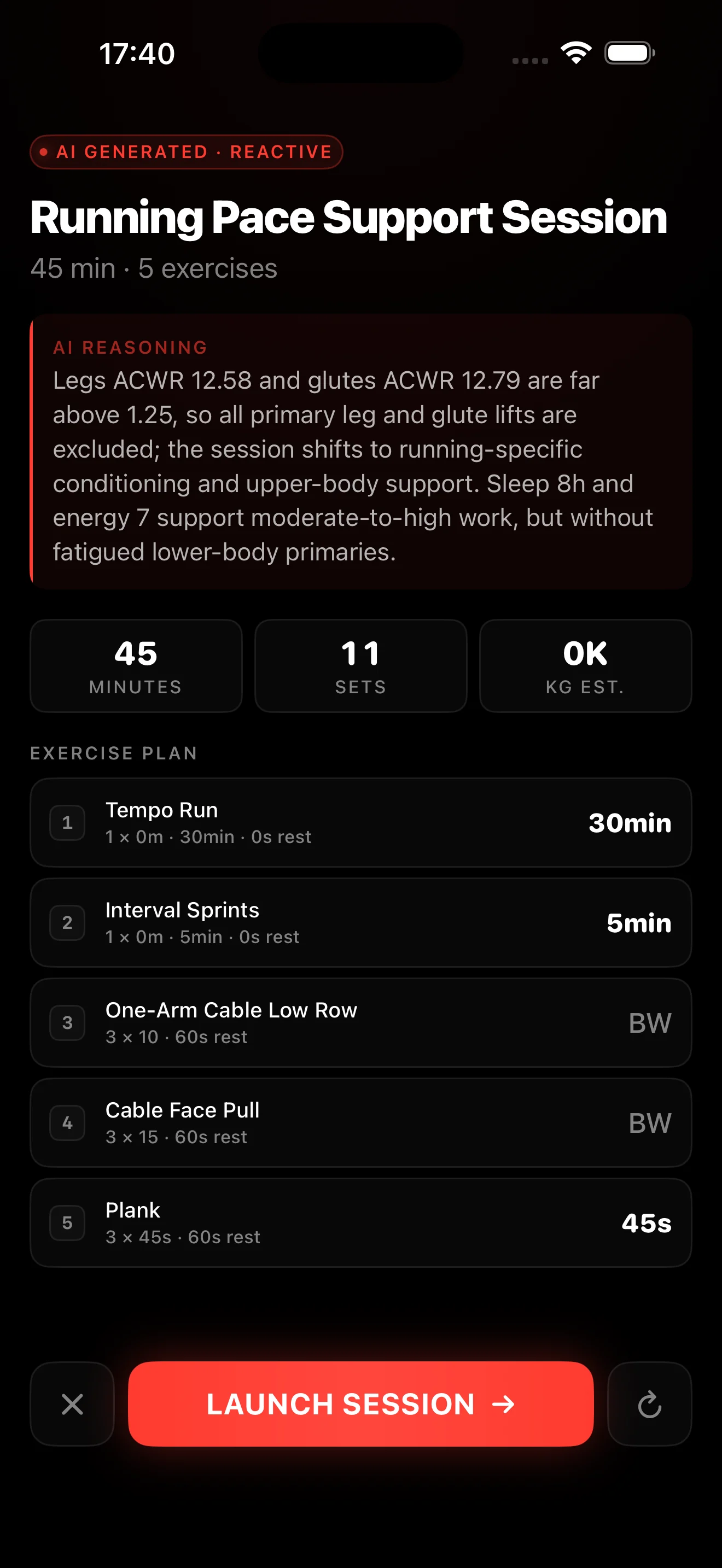
The reason we built ZON is that nobody on the working-athlete side keeps that spreadsheet for 12 weeks. The app logs your run from your watch, your lifts from your phone, and your station splits from your race-simulation timer in one timeline. By week 12, you have a race readiness picture that's data-driven, not vibes-driven. If you're comparing tools before starting your build, our best Hyrox workout app guide walks through the head-to-head.
Log every run, lift and station in ZON
One timeline across 12 weeks. Race simulations split automatically, run + lift + station data in one chart, no spreadsheet to maintain. Free to download.
The 5 mistakes that wreck a 12-week build
Starting with no aerobic base
Don't jump into a 12-week Hyrox plan from a 5km time over 30 minutes, because the base block won't close the gap. You'll arrive at the build phase under-prepared and the interval sessions will wreck your recovery instead of building your engine. Run 4 to 6 weeks of pure aerobic base first, then start the plan.
Running every session at moderate-hard intensity
Don't convert easy Z2 runs into moderate-pace tempo runs because Z2 "feels too easy," because the polarized 80/20 split is what builds the aerobic engine. Running everything at moderate intensity accumulates fatigue without delivering the adaptation. Wear a HR monitor and respect the ceiling.
Skipping sled work because your gym has no sled
Don't skip the sled because you don't have one at home, because the sled push and pull together cost 4-8 minutes of race time if you show up untrained. Drive 20 minutes to a CrossFit affiliate 3 times during the block. Reading about the sled doesn't teach your hamstrings what 102 kg feels like at minute 23.
Doing full race simulations every week
Don't simulate the full race weekly in the Specific block, because full simulations cost 5-7 days of recovery and you can't build through them. Half-race simulations every other week, with one full simulation at week 10 or 11, is the dose. More than that and you arrive at race day cooked.
Tapering by stopping completely
Don't go from 5 sessions/week to zero for the taper, because 7 days of zero kills your sharpness. Drop volume by 40%, keep intensity through short race-pace efforts, and rest hard the last 48 hours. The taper is a fine-tune, not a shutdown.
Race week and race day
Carb-load light: 6-8 g/kg of carbs in the 48 hours pre-race, not the 10+ g/kg you'd use for a marathon. Hyrox is 90 minutes, not 3 hours. Hydrate consistently across the week, not by chugging the morning of. Pre-race meal: 2-3 hours out, ~80g of carbs, low fiber, low fat. A bagel with honey and a banana is overkill-proof. Coffee 45 minutes before the wave (200-300mg caffeine helps endurance performance per the Burke et al. 2013 IOC consensus). Warm-up: 10 minutes of easy jogging, 4 stride-outs at race pace, 2 dynamic-stretching circuits, 2 light sled pushes if a sled is available in the warm-up area. Step into the corral with elevated HR, not cold.
During the race: stick to your HR plan, not your friend's pace. The race is run alone, even in a heat of 100 athletes. Drink at every aid station (small sips, don't chug), pass slower athletes on the runs not in the station box, and remember the math: the wall balls are at minute 75-85 of your race. Save 5% effort for that station.
Closing
A Hyrox training plan that works isn't the one with the most sessions or the heaviest weights. It's the one that gets the order right: base before build, build before specific, specific before simulation, simulation before taper. Stay in your HR corridors. Log what you do. Drill the 8 stations until they're boring. Race the race you trained for, not the race your watch tells you to run.
The next step is to commit to a starting Monday and track week 1. The plan only works if it gets executed; we built ZON so you can run your Hyrox blocks with EMOM and interval timers and let the execution side get out of your way.
- Wilson J. M. et al. (2012). Concurrent training: a meta-analysis examining interference of aerobic and resistance exercises. Journal of Strength & Conditioning Research, 26(8), 2293-2307.
- Stöggl T., Sperlich B. (2014). Polarized training has greater impact on key endurance variables than threshold, high intensity or high volume training. Frontiers in Physiology, 5:33.
- Solli G. S., Tønnessen E., Sandbakk Ø. (2017). The training characteristics of the world's most successful female cross-country skier. Frontiers in Physiology, 8:1069.
- Zourdos M. C. et al. (2016). Novel resistance training-specific rating of perceived exertion scale measuring repetitions in reserve. Journal of Strength & Conditioning Research, 30(1), 267-275.
- Burke L. M. et al. (2013). International Olympic Committee consensus on nutrition for high-performance athletes. British Journal of Sports Medicine.
- Hyrox official race format and station specifications, hyrox.com.