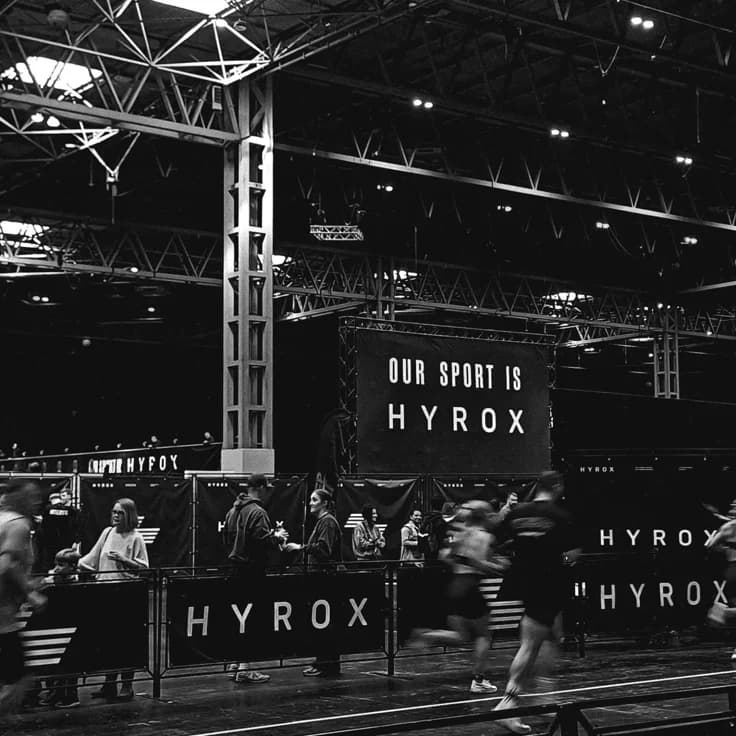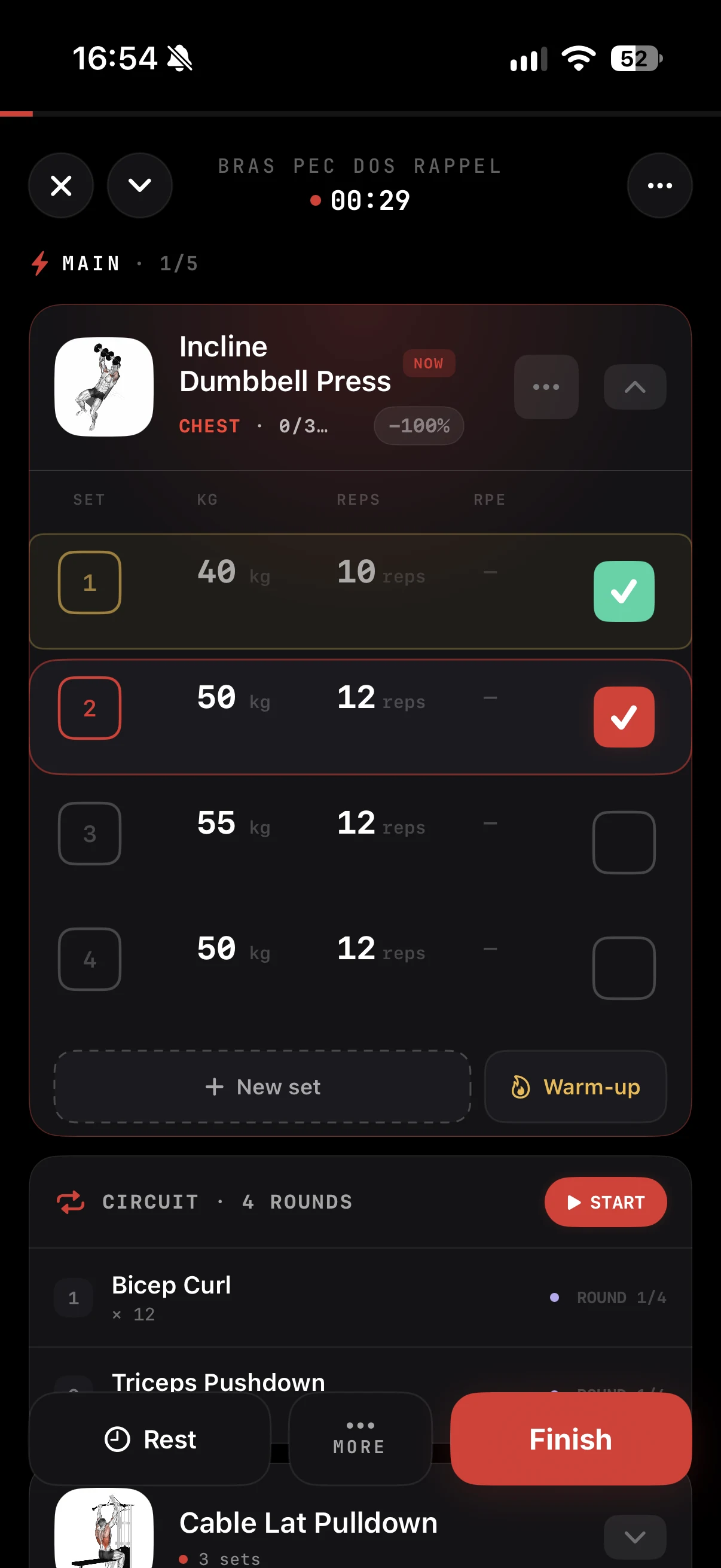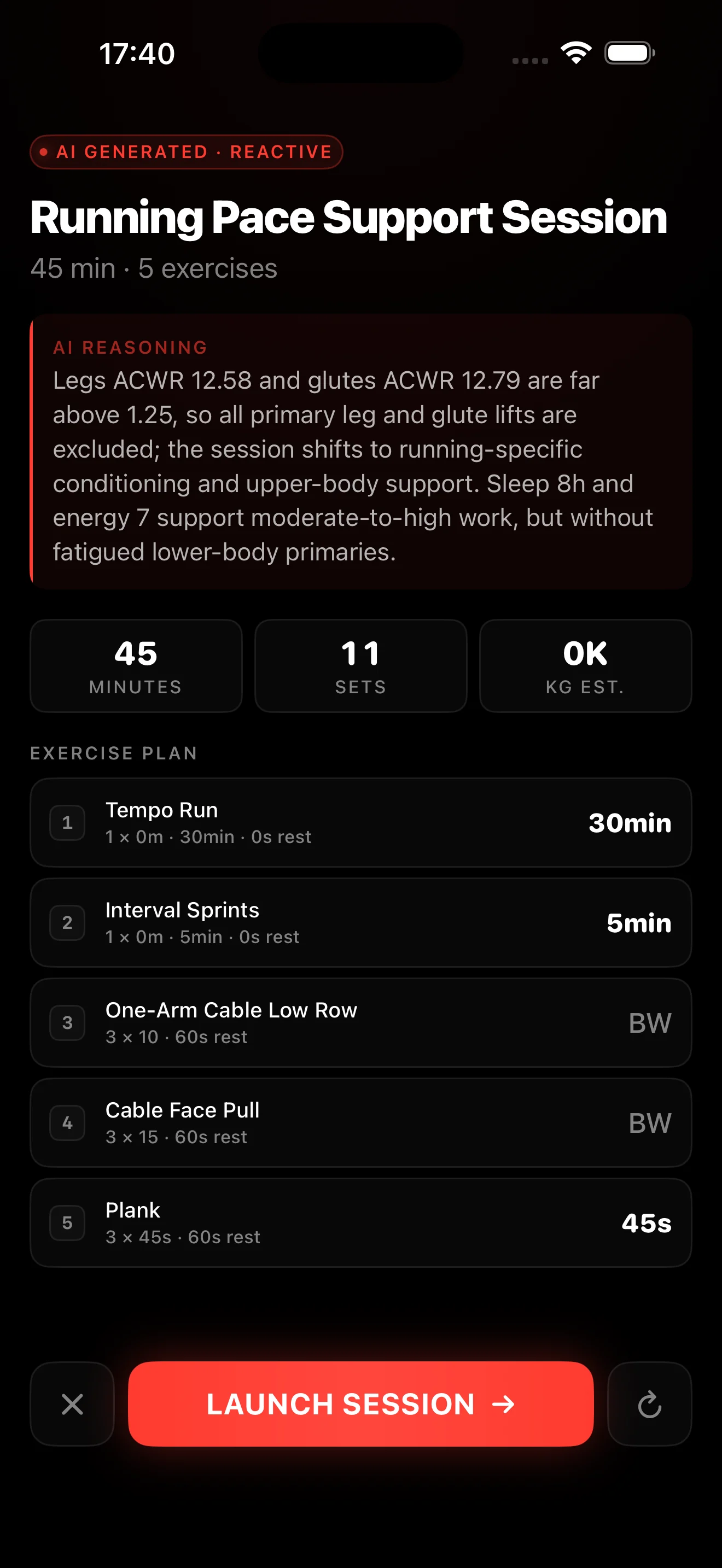
Your athlete wants to run a half-marathon AND gain 5kg of muscle. You know the two goals collide and most plans answer by stacking. We're not going to stack. We're going to program. Here's exactly the framework we use to move an athlete forward on both fronts at once, without breaking either one.
- The interference effect exists but it's programmable. Not a law of physics, but a question of proximity, ordering and polarization.
- You control 4 levers: modality, intensity, volume, time proximity. Proximity is the most underrated.
- Session order follows the primary goal. Strength before running for strength; the inverse for endurance.
- Easy running isn't a compromise, it's the lever that lets you lift heavy. 80% easy / 20% hard.
The real problem of the hybrid coach
We've coached hybrid athletes since 2019. Hyrox racers, triathletes, military operators, CrossFitters wanting a "real" squat. The pattern is always the same: the athlete shows up with two seemingly incompatible goals and a program that looks like a Frankenstein duct-taped together. 4 strength sessions on one side, 4 runs on the other, with no overarching logic.
The result is predictable: 6 weeks of mediocre progress on both fronts, then an injury, then the client concludes they "aren't cut out for hybrid." Wrong. They weren't programmed for hybrid. They were programmed twice in parallel, which is very different.
The interference effect in 200 words (honest)
When you run and lift in the same training block, two molecular signals fight over your body. Endurance activates the AMPK pathway (energy efficiency, mitochondria, oxidation). Strength activates the mTOR pathway (protein synthesis, hypertrophy). Poorly dosed, these signals partially inhibit each other.
In practical terms, the Wilson et al. (2012) meta-analysis shows poorly placed running can wipe out 10-30% of strength adaptation. More recent work by Schumann & Lundberg (2022) confirms the effect depends heavily on modality (concentric running ≈ cycling for interference), duration (>30 min of running starts to bite), intensity, and above all time proximity with the strength session.
Interference is massively programmable. Well ordered and well spaced, strength and running can coexist with near-zero adaptation loss. It's engineering, not magic.
The 4 levers you control
Every hybrid program comes down to four knobs you can turn. Master the four and you can build a week for any athlete.
Modality
Cycling, rower, ski-erg ≠ running. Running is concentric-dominant, creates leg DOMS, and is therefore more interfering with lower-body strength. Cycling less so. If your athlete can swap 20% of their running for recovery cycling, you gain recovery without losing cardio adaptation.
Intensity
A Z2 session at 65% max HR has nothing to do with the systemic impact of a 6×800m at 95%. High intensity hits the nervous system exactly like a heavy squat. That's why we never put them on the same day.
Volume
Under 30 km/week, the impact on strength is negligible for most athletes. Between 30 and 60 km, it gets noticeable and you have to polarize. Above 60 km, accept a strength plateau (you're now on a marathon goal).
Time proximity
The most underrated lever. Running and strength in the same hour: maximum interference. 6 hours apart: already much better. 24 hours: most of the effect is gone. The structure of your week is the #1 tool of the hybrid coach.
Rule #1: session ordering
When you do both in the same day, order decides who wins. The first quality you train is the one that adapts best; the second is degraded by residual fatigue. As simple as that, and as powerful as that.
| Main goal | Same day: order | Minimum gap | Ideal |
|---|---|---|---|
| Strength / hypertrophy | Strength → Running | 2 h | 6 h+ or separate days |
| Endurance / long-distance | Running → Strength | 3 h | 6 h+ or separate days |
| Hyrox / hybrid 50-50 | Whichever is the day's primary session | 3 h | Separate days on hard blocks |
| Weight loss / general | Strength → Running (easy) | 1 h | Strength + Z2 back-to-back OK |
The rule exists because the first quality gets fresh glycogen, a rested nervous system and your full attention. The second takes what's left. Put your priority second and you're programming against yourself.
Rule #2: separate qualities across the week
High intensity, whether strength or running, taxes the same central nervous system. Your heavy squat day isn't your 400m interval day. Your 40-min tempo day isn't your 5×3 deadlift day. The body has one neuromuscular recovery tank, and you're emptying the same bucket.
The model that works is polarization: 80% of weekly volume at easy intensity (Z1-Z2, submaximal accessory strength), 20% at hard intensity (max strength, short intervals). Hard days are spaced at least 48 hours apart. In between: easy running, mobility, accessory work.
3 ready-to-use weekly templates
These three templates come straight out of the framework. Use them as-is or adapt them; we've coached athletes on these structures for years. S = Strength · R = Running · Z2 = easy endurance · INT = intervals · Rec = active recovery.
Beginner: 3 days/week (weight loss, general fitness)
| Day | Session | Focus |
|---|---|---|
| Mon | S full-body | Squat + row + push-ups, 45 min |
| Tue | Rest | Optional 30-min walk |
| Wed | C Z2 | 30-40 min easy jog |
| Thu | Rest | Mobility |
| Fri | S full-body | Deadlift + press + core, 45 min |
| Sat | Rest | - |
| Sun | R Z2 long | 45-60 min very easy jog |
Intermediate: 4-5 days/week (half-marathon + general strength)
| Day | AM | PM | Focus |
|---|---|---|---|
| Mon | - | S lower | Squat 4×5, accessories, 60 min |
| Tue | R INT | - | 6×800m at 10k pace, 2' rest |
| Wed | - | S upper | Bench + pull-ups, 50 min |
| Thu | C Z2 | - | 40-50 min easy |
| Fri | - | S full-body | Deadlift + press, 50 min |
| Sat | R long Z2 | - | 75-90 min very easy |
| Sun | - | Rec / mobility | Walk, stretching |
Advanced / Hyrox: 6 days/week
| Day | AM | PM | Focus |
|---|---|---|---|
| Mon | S lower heavy | C Z2 40' | Back squat 5×3, accessories |
| Tue | R short INT | S upper | 10×400m, 1' rest / push-press 4×5 |
| Wed | Hyrox compromised running | - | 5 rounds: 1km + 50 wall-balls |
| Thu | C Z2 | Mobility | 60 min easy, conversational pace |
| Fri | S deadlift | C Z2 40' | Deadlift 5×3, posterior chain accessories |
| Sat | R long tempo | - | 75-90 min, 30 min tempo middle |
| Sun | Full rest | - | - |
What matters isn't the exact day of your interval session. It's: (1) you don't collide two hard sessions, (2) you respect the order dictated by your goal, (3) you protect at least one real recovery day.
Managing fatigue and readiness
A hybrid program built well on paper becomes a failed program if you don't read the athlete's actual state. Autoregulation is non-negotiable, and its foundation is simple: log your runs and lifts in one timeline, or readiness stays a hunch. Three tools are enough:
- RPE/RIR. Every strength set is rated. If planned RPE was 7 and the athlete hits 9, you back off the next session. Simple, robust cap.
- HR matinal. +5-10 bpm vs baseline for 3 days = accumulated fatigue. That's an early deload signal.
- Sleep < 6h. You convert the hard session into an easy one, full stop. No heroics.
Every 4-6 weeks, deload: -40% strength volume, -30% running volume, same intensity. One week is enough. For an advanced athlete in intensive phase (Hyrox prep), every 3 weeks.
Nutrition and recovery, in one page
The hybrid athlete burns more than they realize. Three levers to protect:
- Protein. 1.6-2.0 g/kg/day, spread over 4-5 meals. Without that base, strength adaptation drops first, endurance follows.
- Carbs around sessions. On double days or long sessions: 1 g/kg in the 2h before + 1 g/kg in the hour after. That's what lets you survive tomorrow's session.
- Sleep. 8h non-negotiable. If life doesn't allow 8h, we cut one run per week. Always.
The 5 mistakes that kill hybrid progress
Too much HIIT
Three interval sessions a week + two heavy-squat days = guaranteed burnout by week 8. One hard run per week is enough for 80% of athletes.
No periodization
The same weekly program repeated 12 weeks. No planned load progression, no deload. The body plateaus or breaks, never anything else.
Ignoring easy running
The athlete runs "a bit hard" on every easy run because it doesn't feel like "work" otherwise. Result: accumulated cardio fatigue without endurance gains, sabotaging the hard sessions.
Stacking without ordering
Running right after the squat because "I didn't have time to do them separately." You convert 80% of your strength adaptation into wasted endurance stimulus.
Ignoring readiness
You follow the plan because it's written, ignoring sleep, RPE, morning HR. Like driving with your eyes shut because you have a GPS.
Build an athlete's week in 5 steps
Actionable checklist. Walk through the 5 steps in order for any athlete walking in with a hybrid goal.
- Define the dominant goal. Which quality wins in case of conflict? Strength, endurance, or hybrid 50-50 (rare). Everything flows from this decision.
- Choose session count per quality. Strength: 2 (maintenance), 3 (progression), 4 (focus). Running: 2 (maintenance), 3 (half), 4-5 (marathon).
- Place the high-intensity days first. Heavy squat, deadlift, intervals, long tempo. Spaced at least 48h apart. That's the skeleton.
- Fill in the low-intensity work. Z2, accessories, mobility. Never adjacent to a hard day of the same quality.
- Audit the week and adjust. Count hard days (max 3), real recovery days (min 1), and double days (max 2). If a rule breaks, you rework it.
ZON builds your hybrid week and adjusts it daily
The framework inside the app: ZON Pro generates your program from your profile, the daily readiness score reads your sleep, HRV and load, and the AI copilot adapts the session when fatigue climbs, and explains why.
"The hybrid athlete isn't asking for more sessions. They're asking for order, separation, and logic."
- Hybrid training app buyer's guide, best hybrid training app 2026.
- Schumann M., Lundberg T. R. (2022). Concurrent Aerobic and Strength Training: Scientific Basics and Practical Applications. Springer.
- Wilson J. M. et al. (2012). Concurrent training: a meta-analysis examining interference of aerobic and resistance exercises. J Strength Cond Res.
- Coffey V. G., Hawley J. A. (2017). Concurrent exercise training: do opposites distract? J Physiol.
- Methenitis S. (2018). A Brief Review on Concurrent Training. Sports.
- Internal ZON coach interviews (2024-2026, n=31).