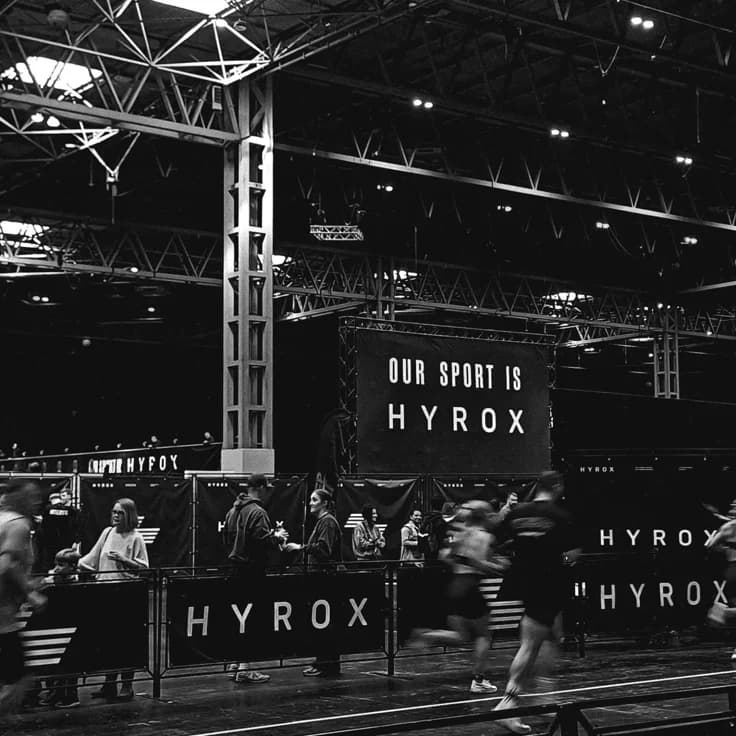
You've trained for sixteen weeks. The sled is now real, not a YouTube clip. The wall-balls are seven minutes from chewing your shoulders off. And the difference between a finish you're proud of and a finish you're rationalizing isn't fitness - it's the forty-eight hours surrounding the race. A hyrox race day checklist matters more than people admit, because the race format is logistically dense: you'll arrive into a noisy expo, queue for a warm-up zone, navigate a bag drop, fuel a sixty-to-ninety-minute effort, and execute a warm-up sequence that primes both your aerobic system and the eight specific stations you're about to hit. Most first-timers underperform on race day not because their engine was too small, but because they ran out of carbs at station 5, didn't pack a backup pair of shoes, or showed up to the start corral cold because the warm-up area was packed.
This is the checklist we wish someone had handed us before our first race, built from the data of fifty thousand finishers and a year of coaching hybrid athletes through their first season. Read it the week before, print it the night before, and pack the bag tonight. If you don't have the engine yet, this isn't the right document: start with our 12-week Hyrox training plan, then come back here on race week.
- The race starts 48 hours before the gun: light carb-load, hydration spread across the week, kit laid out and photographed the night before. Race day isn't improvised.
- Arrive two hours before your wave. Logistics (bag drop, toilets, corral, warm-up zone) eat more time than you think, and a rushed warm-up costs you the first 2 km.
- The single biggest race-day mistake is going out too hot on run 1. A 9-second-per-km positive split wrecks total time more surely than any station weakness.
- Fuel the effort. A 15-30 g carb top-up every 30-40 minutes protects station 5 (rowing) and the wall balls, where most first-timers run dry.
The 48 hours before: carb-load, sleep, kit
Hyrox lasts between sixty and ninety minutes for a first-timer, not three hours. That changes the nutrition prep entirely: you don't need the marathon carb-load of 10+ g/kg. Aim for 6-8 g of carbs per kg of bodyweight across the 48 hours pre-race, spread over your normal meals, tapering fat and fiber as you get closer. This isn't a pasta binge the night before: it's a moderate, consistent bump that tops off glycogen stores without leaving you bloated at the gun.
Hydration works the same way: across the week, not the morning of. Drink consistently the two days before and salt your meals a little more (sodium) rather than chugging liters of water on waking, which just fills your bladder and dilutes your electrolytes. The evening before, add a pinch of electrolytes to your last bottle. The goal is to arrive at the gun with pale urine, not clear.
Sleep: the night that matters is two nights before, not the night before. Almost everyone sleeps poorly the night before a race, adrenaline being what it is. The workaround is to stack sleep: go to bed early two nights out, so the bad pre-race night lands on an already-full tank. A single mediocre night doesn't degrade strength or endurance performance if the preceding nights were good. Don't panic if you're staring at the ceiling at 3 a.m.: your prep already banked the sleep.
The night before, lay out your full kit on the floor, in the order you'll put it on, and take a photo of it. The photo isn't a gimmick: it's your backup checklist when you're repacking half-asleep the next morning. Put each item back in its place immediately after the photo. And the small thing everyone forgets: a second, dry pair of socks in the bag. Damp feet over 8 km blister, and a blister at run 4 changes your stride for the next four.
Should you do a shake-out the day before? Yes, short. 15 minutes of very easy zone-2 jogging the evening before wakes the legs up without costing recovery, especially if you've traveled and spent hours sitting. It's not a session, it's a rinse. Add 4 short stride-outs at race pace at the end to remind the nervous system what speed feels like, then go home. Nothing hard, nothing long.
The kit list (printable)
Here's the list you print and tick off. It splits into four blocks: on-body, in-bag, fuel, and documents. The fifth block is the five small things almost everyone forgets, the ones that turn a minor annoyance into a race-day problem.
| Block | What to pack |
|---|---|
| On-body | Race kit (the one tested in training), race belt with bib, light runners (no lifting shoes unless pre-tested), technical socks, HR monitor/watch. Compression: optional, only if you already train in it. |
| In-bag | Spare shirt, towel, light jacket for after, liquid chalk, tape (for grip), mini foam roller, second dry pair of socks. |
| Fuel | Race-morning breakfast (for T-3 h), in-race carbs (gels or chews, 1 every 30-40 min), electrolyte drink, post-race protein (shake or bar). |
| Documents | ID, race confirmation email (printed or offline on phone), medical certificate/mask if the event requires it. |
| The 5 things people forget | Hair ties, vaseline (anti-chafe), blister plasters, a plastic bag for dirty kit, a little cash (cloakroom, parking, coffee). |
The shoe debate deserves one more sentence, because it comes up on every forum. Hyrox is 8 km of running to a few hundred meters of loaded work: the time budget leans massively toward running. Light, responsive runners beat lifting shoes for everyone except the heavy Pro athlete on the sled. To know what time you're racing to - and therefore how many gels to plan - our average Hyrox finish times 2026 study places you by division across ~50,000 results.
Race morning timeline, hour by hour
Here's the sequence from T-3 h to the gun. It's anchored to your wave, not the doors-open time: back-time each step from your official start, printed on your bib or in your confirmation email.
| Timing | Action |
|---|---|
| T-3 h | Breakfast: ~1 to 1.5 g carbs/kg, low fiber and fat. Bagel with honey + banana, or oats-honey-applesauce. |
| T-2 h | Arrive at venue, bag drop, bib pinned, body marking. Two hours absorbs the queues. |
| T-90 min | Explore the floor: find your corral, the toilets, the warm-up zone. Last fast-carb top-up (~15-30 g). |
| T-60 min | Caffeine: 200-300 mg if you tolerate it, timed to peak at the gun. |
| T-45 min | Dynamic warm-up: 8 full-body movements, ~1 min each (jog, leg swings, hip openers, world's greatest stretch, air squats, lunges, arm circles, air burpees). |
| T-25 min | Race-specific primer: 1000 m easy row/ski, 10 empty wall balls, 10 burpees, 2-3 accelerations. |
| T-10 min | Into the corral, warm. Rehearse your HR corridors and pacing plan. Final mental cue: 'let run 1 go.' |
Two things people miss in this timeline. First, caffeine at T-60 min only helps if you tested it in training: race day is not when you find out that 300 mg gives you palpitations or glues you to the toilet. Second, the primer at T-25 min has to actually raise your heart rate, not just move your joints. You want to step into the corral already warm, 8-10 bpm above rest, not cold. An athlete who starts cold spends the first 2 km warming up on the course, and pays for that lag on the first sled.
Log every station in ZON and compare to the 50k benchmark
An automatic split-by-split breakdown, compared to the 50,000-finisher benchmark, so you know exactly where you gained or lost time. Free to download.
On the floor: the 4 mistakes that wreck race times
Once the gun goes, the race turns on execution, not the fitness you brought. Here are the four costliest mistakes, in the order they hit. None is a fitness question: they're decisions, and you can make them right starting today.
Going out too hot on the first 1km
The corral adrenaline makes you start 15-20 seconds/km too fast. The data is clear: a positive split of ~9 seconds/km over the first half wrecks total time more surely than any station weakness, because a too-fast run base burns glycogen and spikes HR before the first sled. The fix is mental: run run 1 at 10 seconds/km under your target, let the wave go, and reel people back in on runs 5-8 when everyone else fades.
Skipping the rest before the sled push
Arriving at the sled with your HR at the ceiling and attacking immediately guarantees slipping feet and a mid-station panic. Most athletes save ~12 seconds on the station by taking 15 extra seconds of recovery before gripping the handles: by the time your HR drops under 90% max, you're driving with legs that respond instead of grinding against a maxed-out heart. The rest isn't lost time; it's invested time.
Mispacing the wall balls
Chaining 100 wall balls unbroken is only the right call for the seasoned athlete who drilled it all block. For everyone else, a set plan (25/25/25/25 or 30-20-15-10) with 5 deep breaths between blocks beats a failed unbroken attempt, because breaking the set by surprise at rep 40 and never recovering rhythm costs far more than planned pauses. Decide your break plan before you pick up the ball, not when your legs give out.
Neglecting chalk/tape between carry and lunges
The farmer's carry drains your grip, and the sandbag lunges land right after with a bag to hold in place. Dropping the bag means a penalty and a reset that cost 15-30 seconds. Take the 5 seconds of liquid chalk (or check your grip tape) in the transition between station 6 and 7. Those 5 seconds save you a drop, and a drop costs ten times that.
Beyond those four, the meta-lever is transition pacing: between each station and the next run, walk 5 meters out of the zone, raise your arms for three belly breaths, then restart the run 15 seconds/km slower for the first 200 meters. We break the full segment-by-segment HR-corridor strategy down in the pillar, and a Hyrox pace calculator gives you your numbered targets per station.
After the line: recovery and what counts
Across the line, the instinct is to collapse. Don't sit down immediately: walk for 10 minutes. Blood pools in your legs after a maximal effort, and sitting abruptly can leave you dizzy or trigger a vasovagal drop. Easy walking clears lactate, brings HR back toward rest, and prevents the light-headedness. Grab your light jacket from the bag: you'll cool down fast, and shivering piles on needless fatigue.
Recovery nutrition within 30 minutes: carbs plus protein, around a 3:1 to 4:1 ratio (for example ~60 g carbs and ~20 g protein). A shake with a banana does the job if your stomach won't take solids. Rehydrate with electrolytes, not just water: you sweated out sodium over 90 minutes. Cold exposure after the race (ice bath, cold shower) is more theater than a real lever for a single race: pleasant, but nothing that measurably changes your recovery. Keep it for comfort, not performance.
The last thing that counts, and almost nobody does it: log the race while it's fresh. Note your station splits, your RPE per segment, and where exactly it hurt (grip on the carry? legs on the lunges? lungs on the wall balls?). Those three data points drive your entire season-2 prep: they tell you which station to drill and which HR corridor to adjust. If you want that to happen automatically rather than with a pen in the post-race cold, our best Hyrox workout app comparison shows which tools split a race automatically and which leave you re-entering everything by hand.
Closing
The fitness, you built over sixteen weeks. Race day doesn't add to it; it makes you spend it well or badly. Pack the kit tonight, arrive two hours early, step into the corral warm, let run 1 go, fuel the effort, and log everything at the finish. The checklist isn't superstition: it's the logistical layer that lets your fitness show up instead of getting sabotaged by a wet sock or a bag-drop queue. Print it, tick it off, and go race the race you trained for.
- Official Hyrox athlete handbook (link in your race confirmation email).
- Burke L. M. et al. (2013). International Olympic Committee consensus on nutrition for high-performance athletes. British Journal of Sports Medicine.
- Jeukendrup A. (2014). A step towards personalized sports nutrition: carbohydrate intake during exercise. Sports Medicine, 44(S1), 25-33.
- RAMP warm-up protocol (Raise, Activate, Mobilise, Potentiate), Jeffreys I. (2007).
- ZON internal data: average split times by station, see average Hyrox finish times 2026.
- Hyrox official race format and station specifications, hyrox.com.