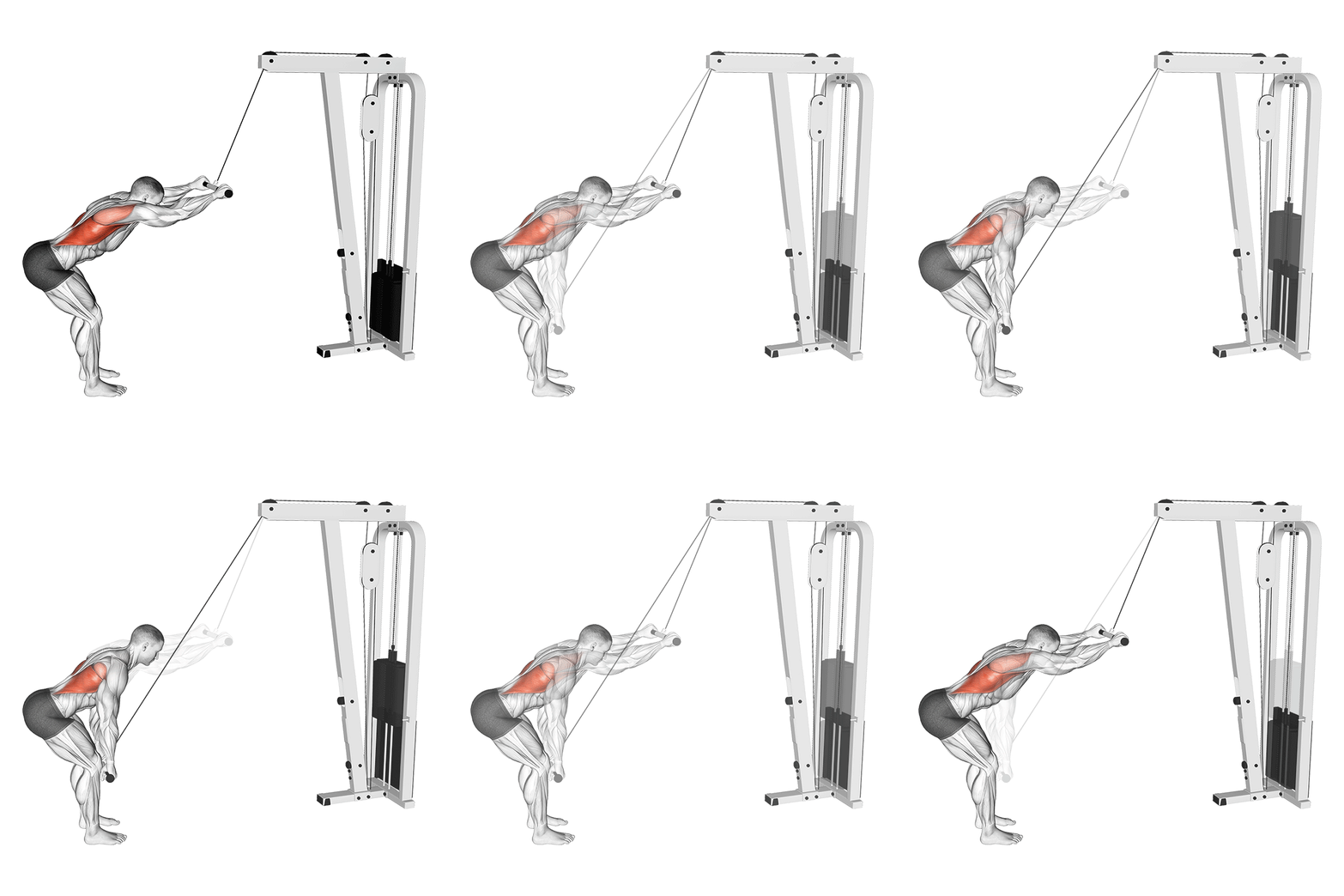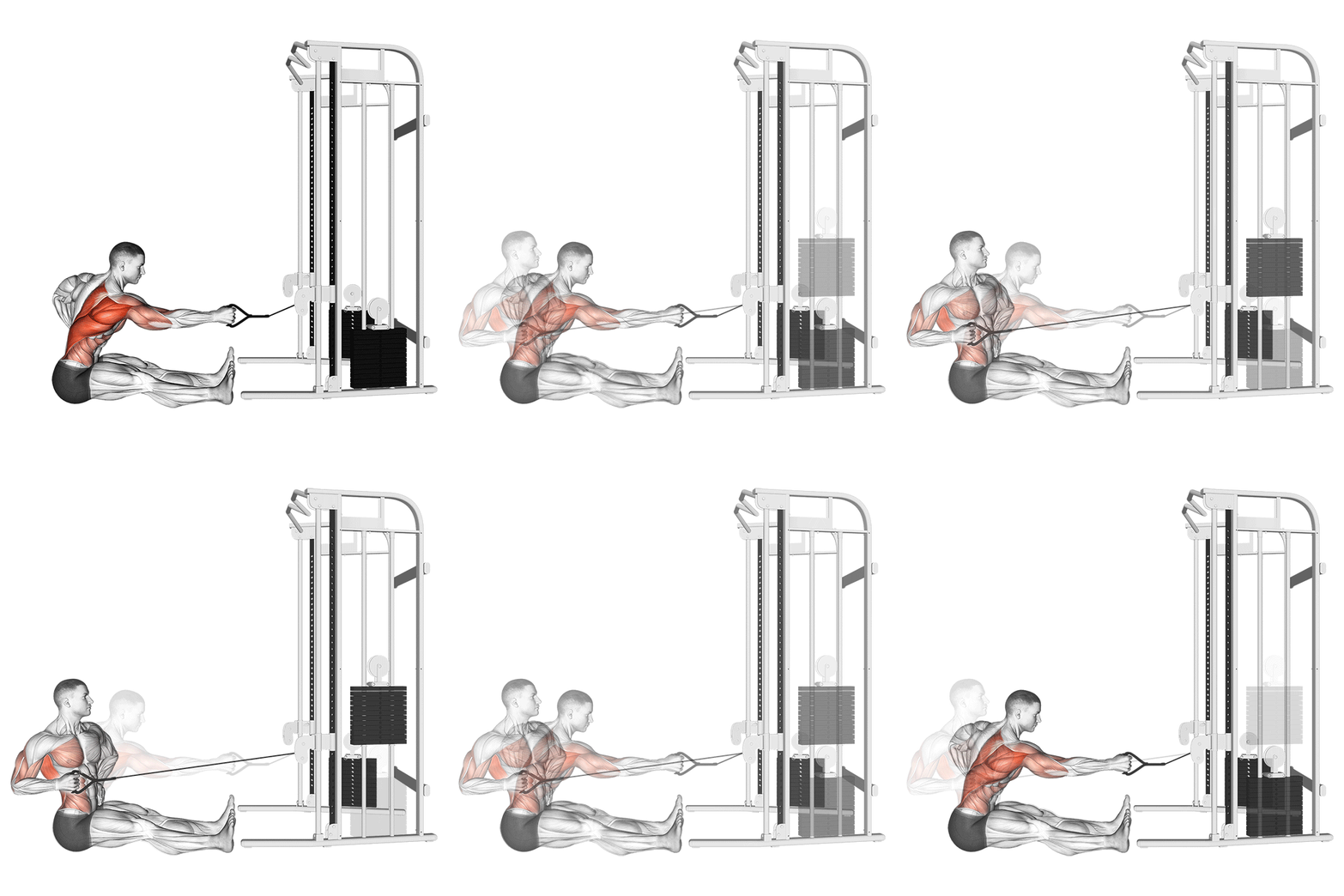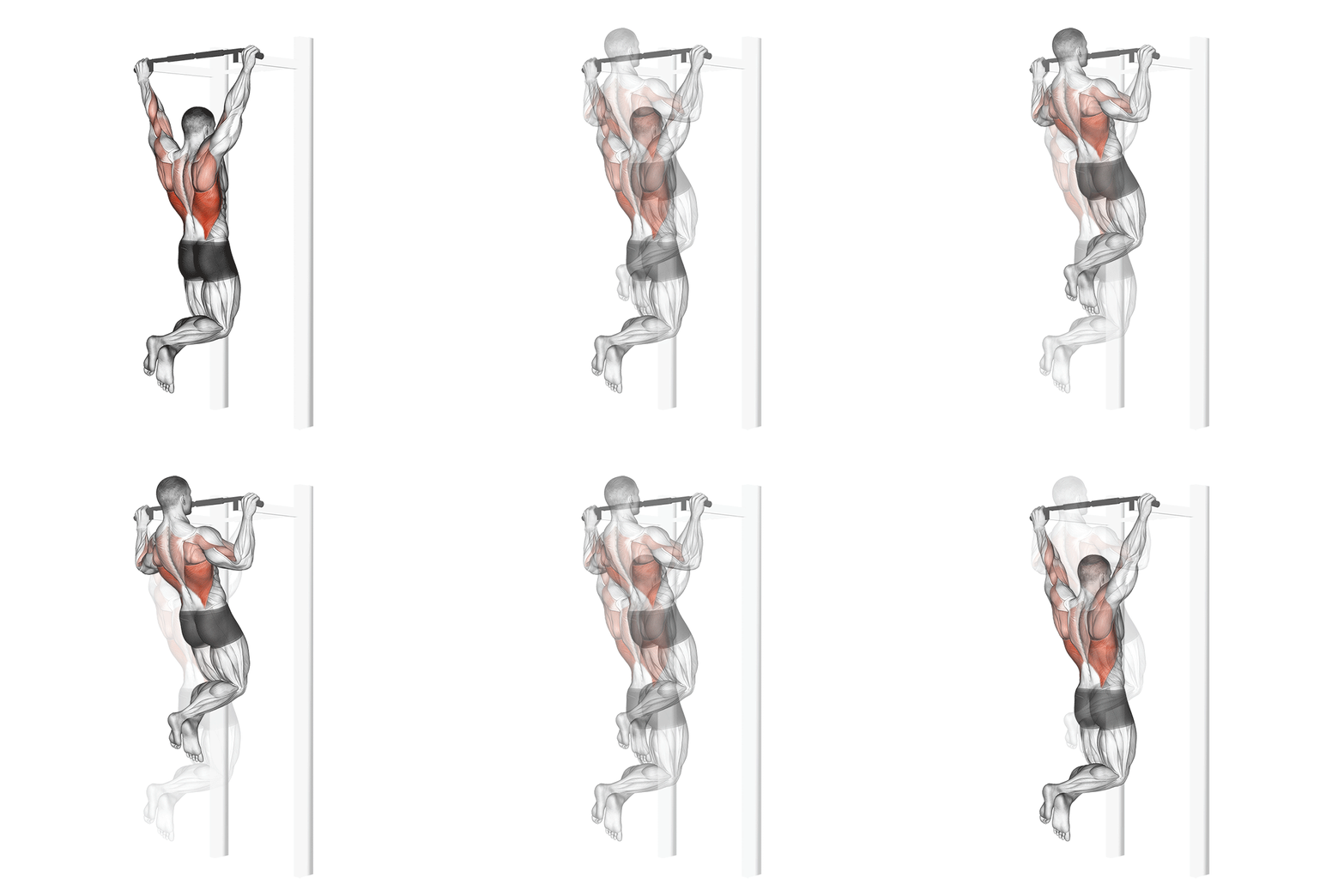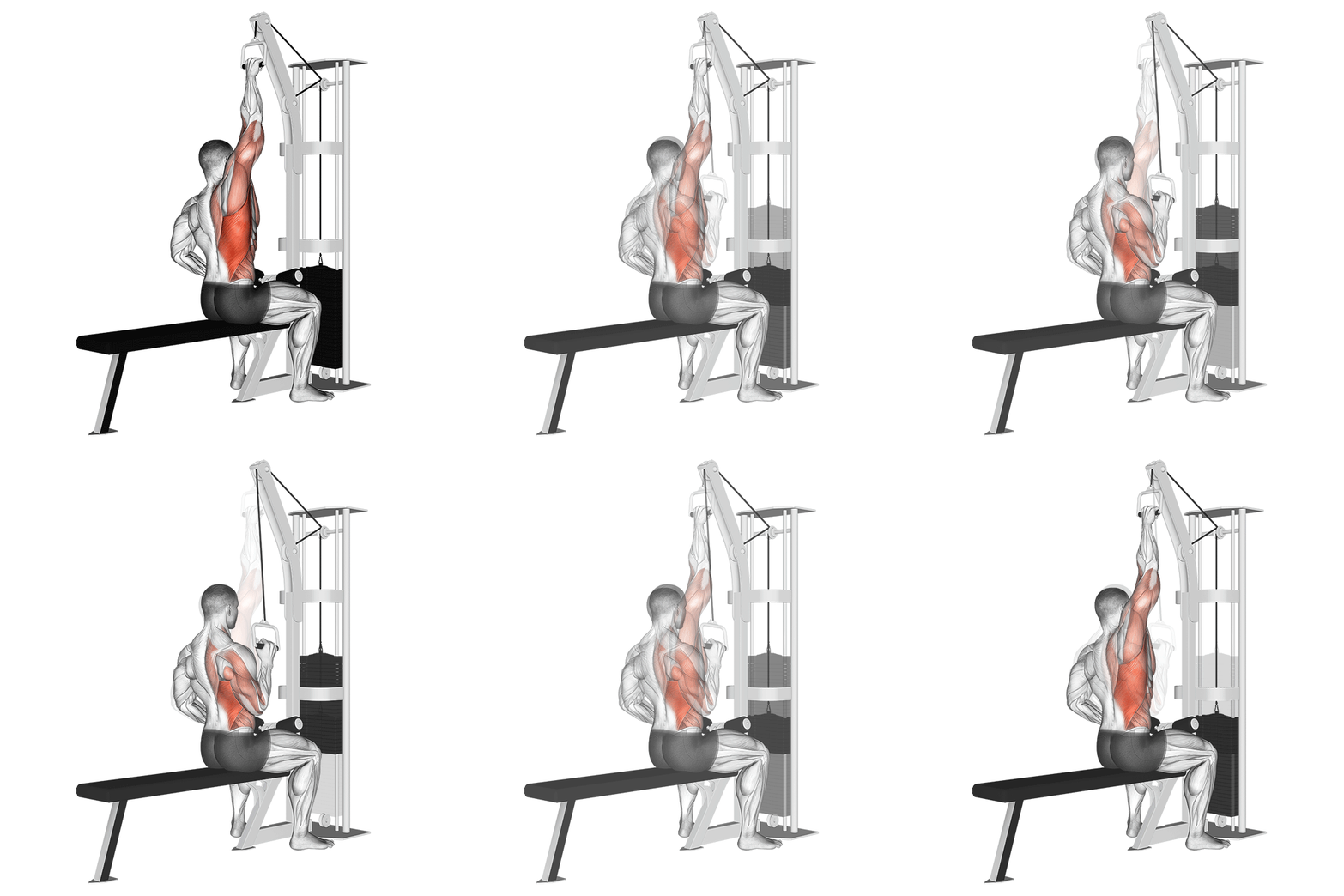
What is the single-arm lat pulldown?
The single-arm lat pulldown is a vertical pull done with a D-handle on a high pulley, seated at the pulldown station or half-kneeling in front of a cable column. Mechanically it does everything the bar version does, shoulder adduction and extension driven by the lat, with two upgrades: the hand is free to choose its path, so you pull through a longer arc and finish at the hip instead of being stopped at the chest by a bar, and each side works alone, so a stronger arm can no longer carry its partner. It is the standard prescription when one lat visibly lags, or when you never quite feel pulldowns in your back.
How to do the single-arm lat pulldown
- 1
Pick your station
Clip a D-handle to a high pulley. At the pulldown station, wedge your thighs under the pad and grip overhead. At a free cable column, take a half-kneeling stance, the knee on your working side down, the opposite foot planted, hips square to the stack.
- 2
Start from a true stretch
Let the working arm go long and allow the shoulder blade to rotate up toward your ear, so the lat reaches its full length. Keep the trunk tall and braced; the stack should feel like it is trying to lift you off the seat.
- 3
Drive the elbow to your hip
Set the shoulder blade down first, then pull the elbow down and into your side until your hand arrives next to your hip pocket. The hand is a hook; the elbow does the travelling, and the chest keeps facing forward.
- 4
Give the eccentric back slowly
Take 2-3 seconds to return to the full stretch, letting the shoulder blade ride up only in the last portion. If the stack snatches your arm up and clanks, you have found your cheat: slow it down or lighten it.
Pro tip
Grip the handle mostly with your pinky and ring finger and let the index finger stay almost relaxed. A hard thumb-side grip wakes up the biceps and turns the pulldown into a curl; shifting the pressure to the pinky side lines the pull up with the lat, and you will feel the difference on the very first rep.
Common mistakes
The hand winning the race.
If the hand reaches your chest while the elbow still points sideways, the biceps just did the set. Lighten the stack and rebuild the order: shoulder blade down, elbow to hip, hand merely along for the ride.
Twisting to shorten the path.
When the set bites, the torso starts rotating toward the stack to make the cable’s job shorter. Those reps belong to your obliques, not your lat; keep the chest square for every rep and call the set when you no longer can.
Cutting the top of the range.
Reversing with the elbow still half-bent keeps constant tension comfortable and quietly deletes the lat’s stretched range, which is where a large share of the growth stimulus lives. Full arm, rising shoulder blade, then pull.
Hanging passively on a heavy stack.
Letting the weight slam your shoulder up into your ear between reps shifts the load onto the joint and the neck. Controlled elevation at the top is the goal; a yanked, shrugged dead hang under a heavy stack is not.
Variations and progressions
Easier
Lat pulldown (bar)
Two arms share the load and the bar fixes the path, so there is less to coordinate and more total weight to pull. Build general vertical-pulling strength here first if the single-arm version feels like a juggling act.
Harder
Archer pull-up
A bodyweight pull-up where one arm does most of the work while the other assists out wide. Brutally harder, but it is the same idea pushed to its end point: one lat responsible for the rep.
Alternative
Dumbbell pullover
No cable available: the pullover loads the lats in the same overhead, stretched position through shoulder extension. It is bilateral, so if you came to the single-arm pulldown for an imbalance, keep a one-arm row in the plan too.
How to program it
Three protocols by goal. Pick one per cycle and aim for progression on load or distance.
| Goal | Sets × distance | Load | Rest |
|---|---|---|---|
| Hypertrophy | 3 × 10-12 per arm | RPE 8 | 90 s |
| Fixing an imbalance | 4 × 8, weaker side first | Set by the weaker arm; the strong arm only matches | 90 s |
| Technique and feel | 2 × 12-15, 3 s eccentric | Light, RPE 7 | 60 s |
Single-Arm Lat Pulldown FAQ
What does the single-arm version add over the bar pulldown?
Two things the bar cannot offer. The hand is free, so you can pull through a longer arc and finish by the hip instead of stopping where the bar meets your chest, which gives the lat extra shortened range. And each side works alone, so the stronger arm can no longer quietly top up the weaker one. The price is time, since every set is done twice, which is why it usually slots in as the second back exercise rather than the first.
Seated or half-kneeling?
Seated under the thigh pad lets you anchor against heavier weights, so it wins for loading and straightforward progression. Half-kneeling frees the torso angle, brings the trunk and glutes into the job of staying square, and tends to make the lat easier to feel. Neither is wrong: load on the seat, feel on the floor, and many lifters rotate between the two across a training block.
Why do I only feel it in my biceps?
Three usual suspects, in order: the stack is too heavy, the hand is squeezing instead of hooking, and the elbow is not leading. Drop the weight by a quarter, grip pinky-first with a relaxed index finger, and pull the elbow toward your hip with a one-second hold there. If the lat still will not speak up, slow the eccentric to 3 seconds; few muscles stay silent through that.
Should both arms use the same weight and reps?
Yes, and let the weaker side be the boss. Start every set with it, note what it manages, and have the stronger side match those numbers exactly, even if it could do more. Giving the strong arm extra weight or reps feels productive but just maintains the gap; capping it is what lets the weak side close the distance over a few months.