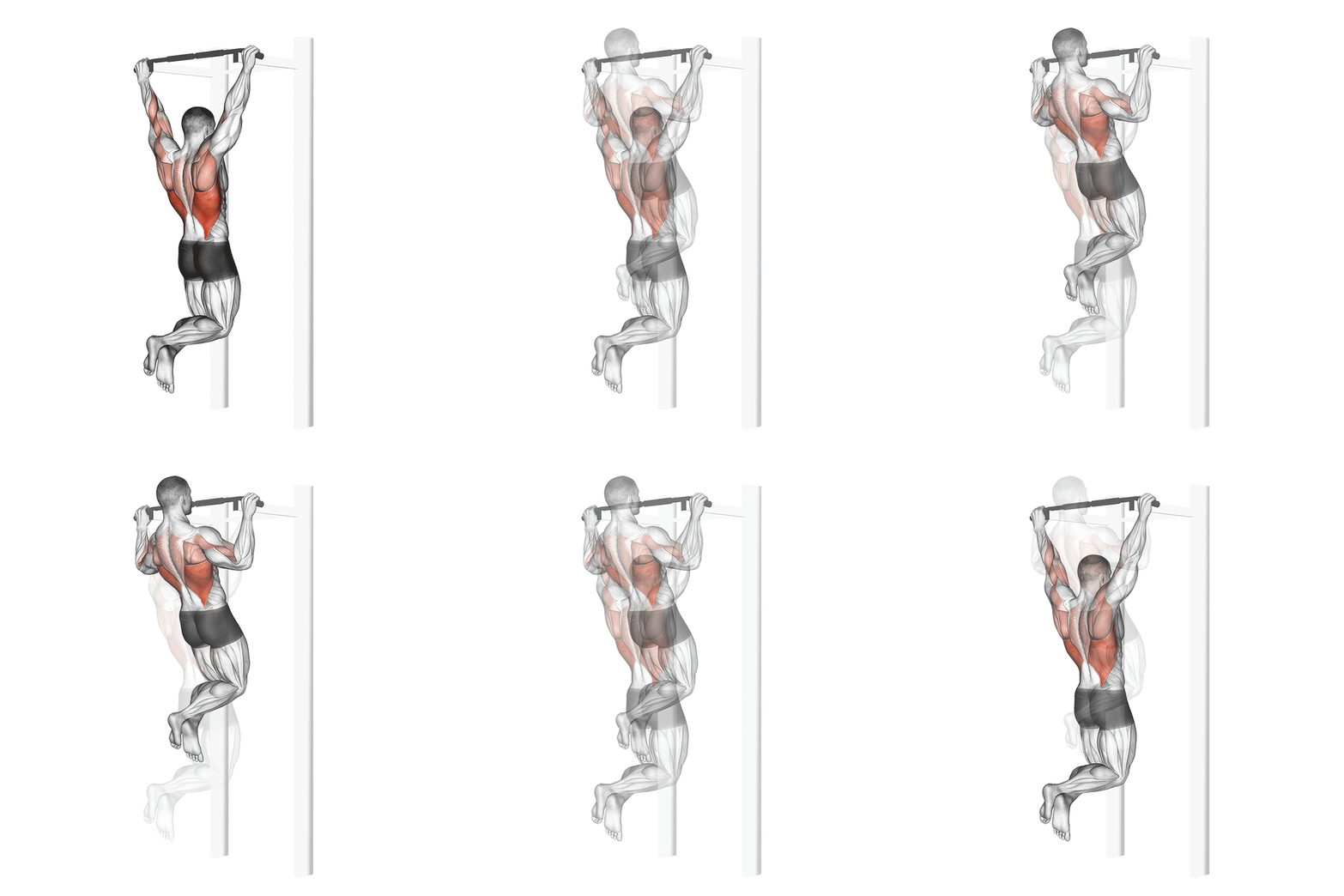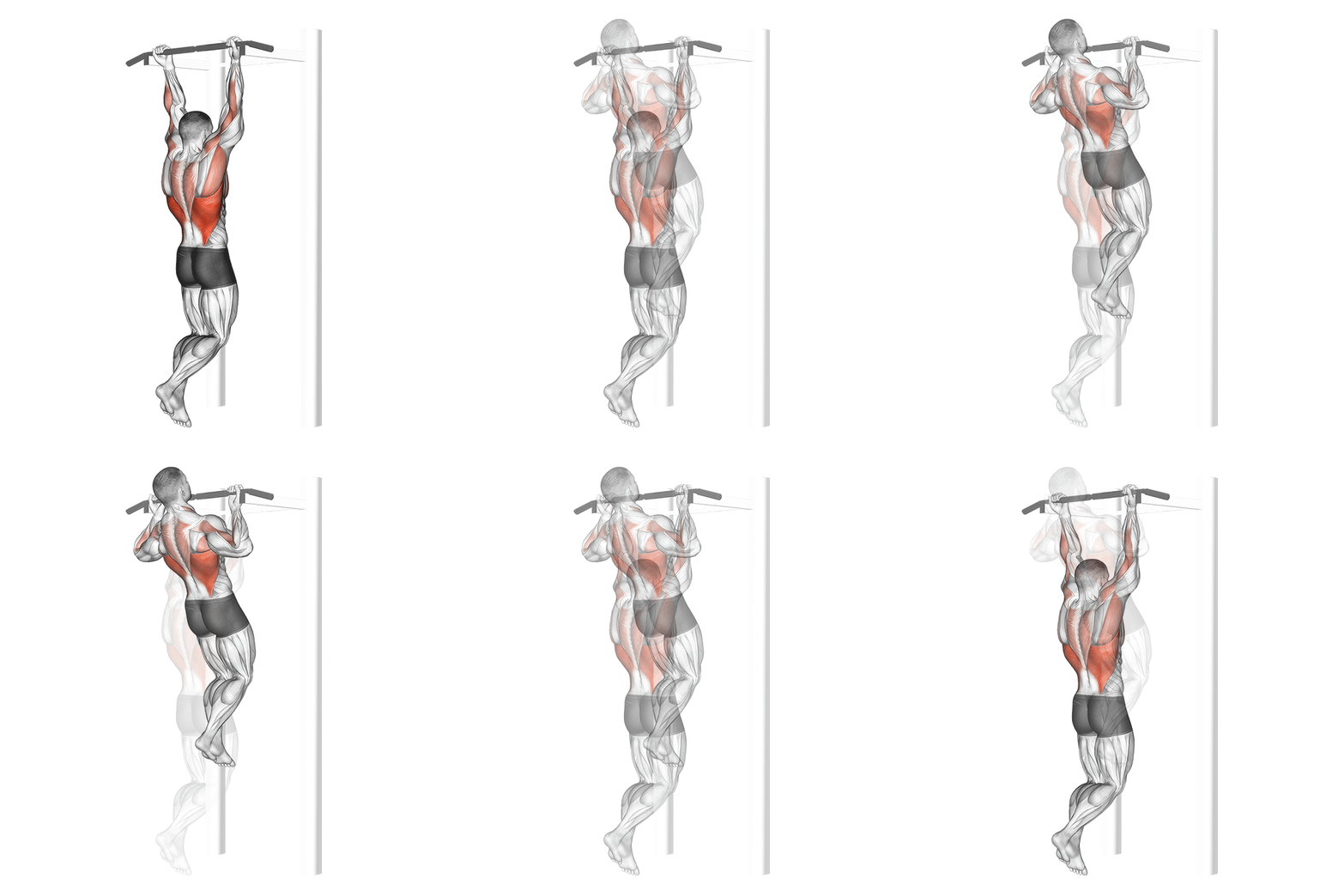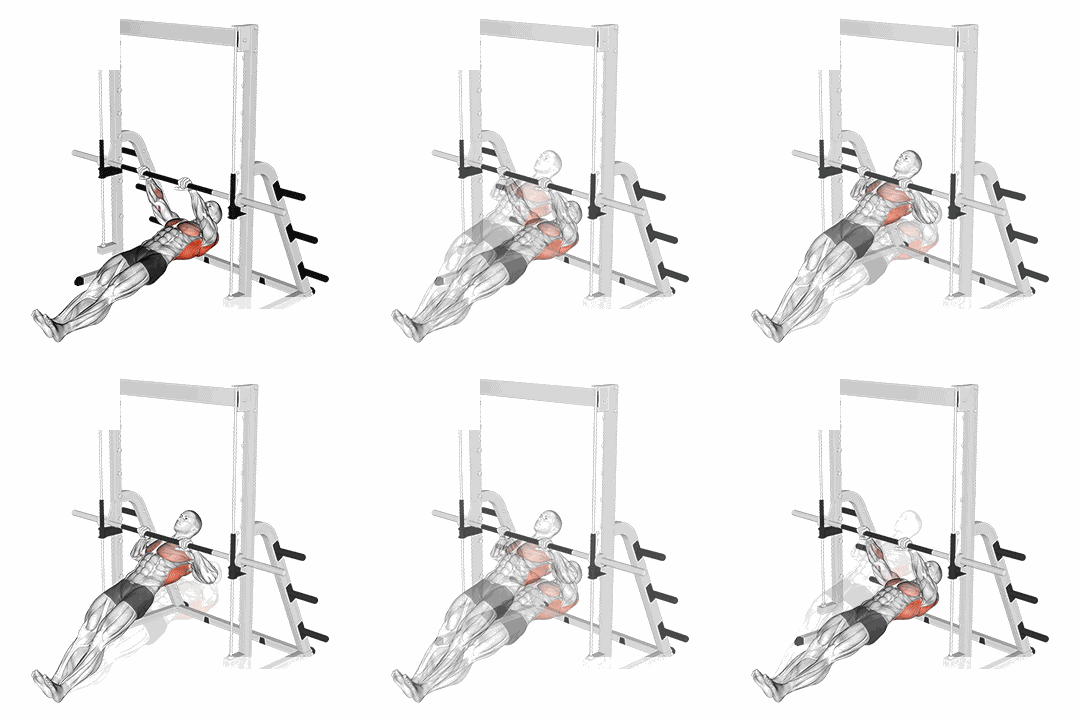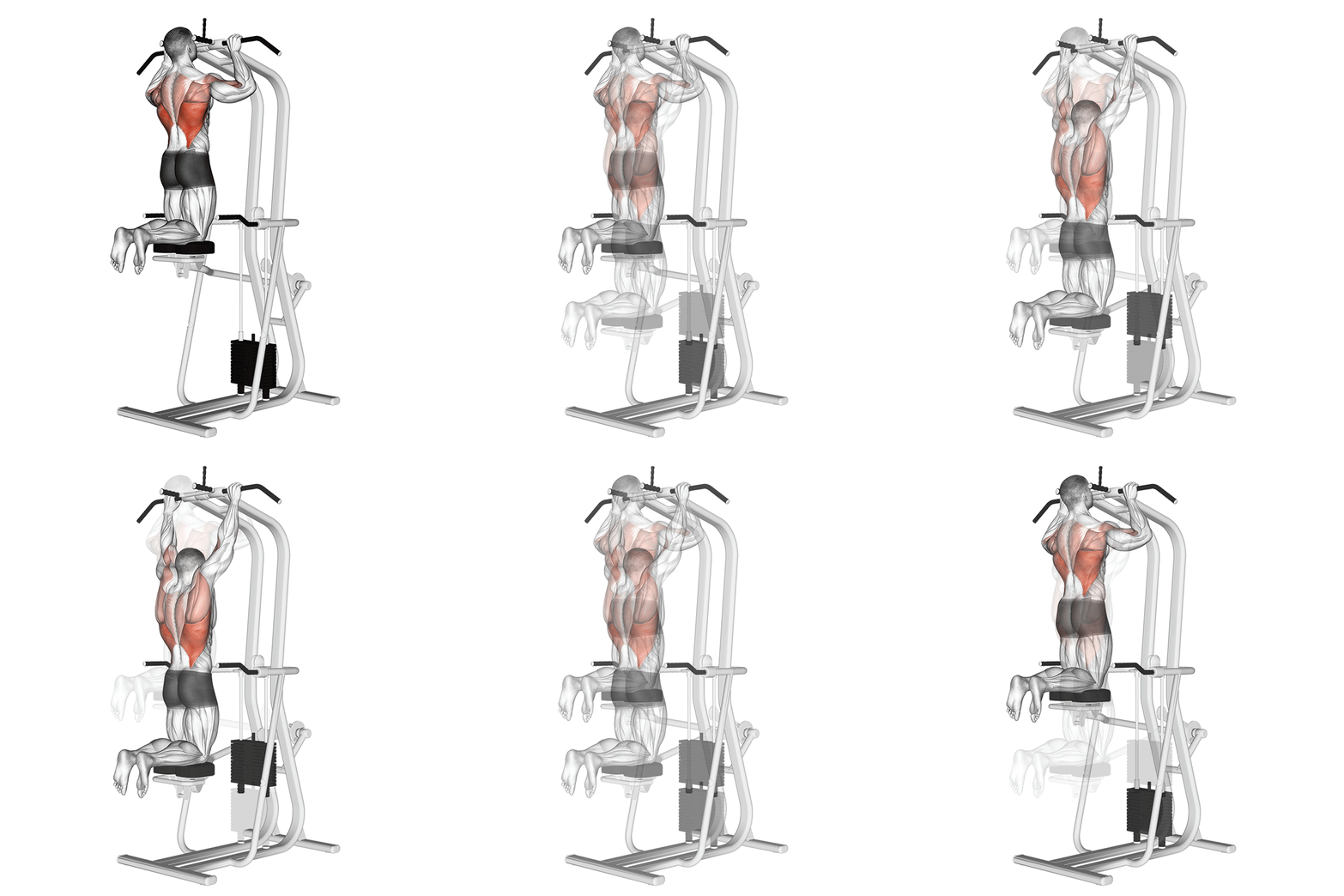
What is the assisted pull-up?
The assisted pull-up is a vertical pull in which a counterweighted knee pad, or a band looped over the bar, pushes you upward while you pull. On the machine, the weight you select is subtracted from your bodyweight, so a heavier pin means an easier rep. That lets you train the exact pull-up pattern, dead hang to chin over the bar, with clean strict reps instead of swinging half attempts. The lats, biceps and scapular muscles work just as they will on the real thing. Prefer it to the lat pulldown when the goal is the pull-up itself: it keeps the hang, the grip and the full-body tension a seated cable can't give you.
How to do the assisted pull-up
- 1
Dial in the assistance
Select a counterweight around a third of your bodyweight to start, then adjust so your target reps are strict but hard. Grip the bar just outside shoulder width and set both knees on the pad.
- 2
Start from a true dead hang
Arms fully extended, ribs down, glutes squeezed, shoulders pulled away from your ears. Every rep begins from this quiet, stretched position.
- 3
Pull the elbows to your ribs
Drive the elbows down and slightly back until your chin clears the bar, chest rising toward it. Exhale through the top half. No neck craning to steal the rep.
- 4
Lower in 2-3 s
Control the descent all the way back to straight elbows. The bottom is where pull-up strength is built; skipping it is why people stay stuck on the machine.
Pro tip
Track bodyweight minus assistance as your real pull-up number and log it like a lift. Nudge the pin down 2-5 kg whenever you finish all sets strict; when the help drops near 10 % of bodyweight, go test the real bar.
Common mistakes
Parking at the same pin for months.
If the assistance never shrinks, you're doing cardio for lats. Treat reducing the counterweight as the whole point of the exercise.
Half reps at the bottom.
Stopping at 90° elbows avoids the dead-hang start, which is precisely the part that fails when you attempt a strict pull-up. Full extension, every rep.
Kicking off the knee pad.
Driving the knees down or pumping the hips adds a kip the real bar won't give you. Stay rigid from knees to shoulders and let the arms and back do the pulling.
Craning the chin over the bar.
Reaching with the neck claims a rep your elbows never finished. Keep driving the elbows toward your ribs until the chin clears naturally.
Variations and progressions
Easier
Lat pulldown
Fully seated with thigh pads, no body tension to manage, and tiny load jumps. A good first stop if even maximum assistance feels rough.
Harder
Slow negatives
Jump or step to the top of the bar and lower yourself in 5 s with no assistance. Negatives bridge the last gap between the machine and your first strict rep.
No machine?
Band-assisted pull-up
Loop a band over the bar and put a knee in it. Know its flaw: the band helps most at the bottom and almost none at the top, the opposite of the machine's constant help.
How to program it
Three protocols by goal. Pick one per cycle and aim for progression on load or distance.
| Goal | Sets × distance | Load | Rest |
|---|---|---|---|
| First strict pull-up | 5 × 3-5 | Assistance for RPE 8 | 2-3 min |
| Hypertrophy | 4 × 8-10 | Moderate assistance, RPE 8 | 90 s |
| Volume | 3 × 12-15 | Generous assistance, RPE 7 | 60-75 s |
Assisted Pull-Up FAQ
How long until I can do a strict pull-up?
It depends on your starting point and bodyweight, but the path is fixed: reduce the assistance a little every week or two, keep reps strict and full range, and add slow negatives once the help gets small. When you can do 3 × 5 with about 10 % of bodyweight assisting, a single clean rep on the bar is usually there.
Assisted pull-up machine or lat pulldown?
Same prime movers, different transfer. The machine keeps you hanging from a fixed bar and managing your own trunk, which is most of what makes pull-ups hard. The pulldown wins for easy load jumps and pure lat hypertrophy. If you're chasing your first pull-up, make the machine the main course and the pulldown the side dish.
Why can I do 10 assisted reps but zero strict ones?
Do the math: at 70 kg bodyweight with 25 kg of help, you're pulling 45 kg. The pad also steadies you, while a free hang makes you stabilise every centimetre yourself. Close the gap by shrinking the pin, adding slow negatives and practising dead-hang starts; piles of high-assistance reps don't transfer on their own.