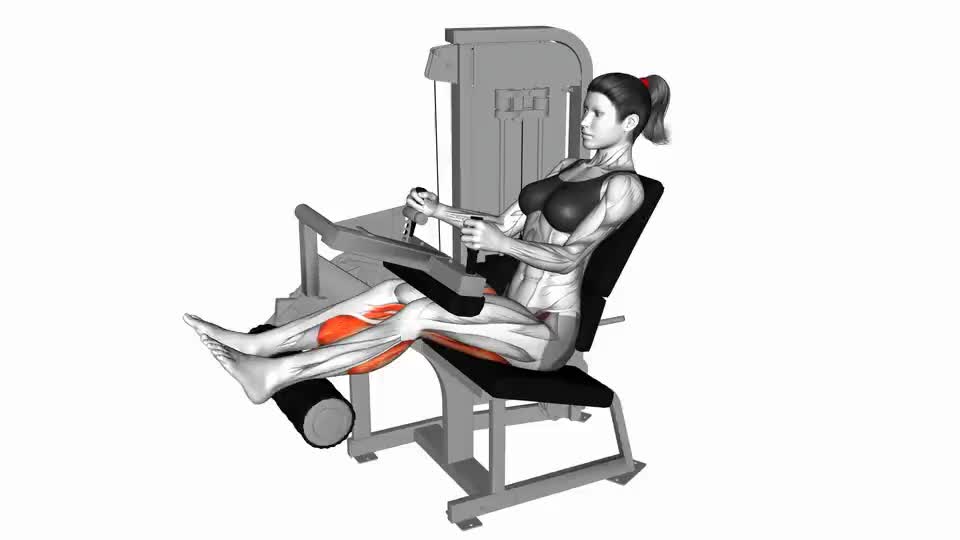
What is the leg curl?
The leg curl is a machine-based knee-flexion exercise where you lie prone, sit, or kneel and curl a padded lever toward your glutes against a stack. It isolates the hamstrings at the knee joint, the function that compound lifts like Romanian deadlifts only partially train. Because the spine is fully supported, you can push close to failure with zero lower-back cost, which makes it a key accessory for sprinters, hybrid athletes and anyone protecting a tweaky back.
How to do the leg curl
- 1
Set the pad position
Align the rotation axis with your knee joint. Place the ankle pad just above your heel, against the Achilles, not on the calf.
- 2
Lock the hips down
On a lying curl, press your hips hard into the bench. On a seated curl, clamp the thigh pad. Hips that lift steal work from the hamstrings.
- 3
Curl with intent
Drive the heels toward the glutes in 1-2 s. Squeeze hard at the top, point the toes if you want extra cramp on the hamstrings.
- 4
Lower under control
Take 2-3 s to lower back to a full stretch. The eccentric is where hamstrings grow and where they get bulletproof against sprint injuries.
Pro tip
Slow the eccentric to 3 s. Most lifters smash the curl up and crash it down, leaving 50% of the hamstring gains on the table.
Common mistakes
Hips lifting off the bench.
When the hips rise, the glutes take over and the hamstrings get easy work. Strap down or lighten the load.
Bouncing the bottom.
Letting the stack crash uses momentum, not muscle. Pause a half-second at full stretch every rep.
Pad placed on the calf.
Pad too high turns the move into a calf grind and shortens the lever. Place it just above the heel.
Loading until the form breaks.
If you can't get the heels close to the glutes, the weight is too heavy. Drop a plate and earn the full range.
Variations and progressions
Easier
Seated leg curl
The seated version is easier to set up and locks the hips, perfect for beginners.
Harder
Single-leg curl with 4 s eccentric
One leg at a time, 4 s on the way down. Exposes imbalances and torches each hamstring on its own.
No machine?
Nordic curls or slider curls
Nordic curls (kneel, fall forward slowly) are brutal and free. On a slick floor, slider hamstring curls hit the same pattern.
How to program it
Three protocols by goal. Pick one per cycle and aim for progression on load or distance.
| Goal | Sets × distance | Load | Rest |
|---|---|---|---|
| Hypertrophy | 4 × 10-12 | Moderate | 60-90 s |
| Strength accessory | 4 × 6-8 | Heavy | 90-120 s |
| Sprint injury proofing | 3 × 8, eccentric 4 s | Moderate | 60 s |
Leg Curl FAQ
Lying or seated leg curl?
Both train knee flexion, but the seated version puts the hamstrings in a stretched position at the hip, which research shows builds more muscle. If your gym has both, lead with seated curls for hypertrophy and use lying curls as a finisher or variation. The seated version also locks the hips harder.
Why do my calves cramp during leg curls?
Calf cramps mean your gastrocnemius is helping the hamstrings flex the knee, usually because your toes are pointed away. Try pointing your toes toward your shins (dorsiflexion). That puts the calf on slack and forces the hamstrings to do all the work. Cramps stop, hamstrings burn harder.
Do I need leg curls if I already do Romanian deadlifts?
Yes. RDLs train the hamstrings as hip extensors but barely train knee flexion, which is the other half of their job. Without direct knee flexion work, you're leaving half the hamstring undertrained, and the knee-flexion role is exactly what fails during sprints. Add 2-3 sets of curls after your RDLs once a week.