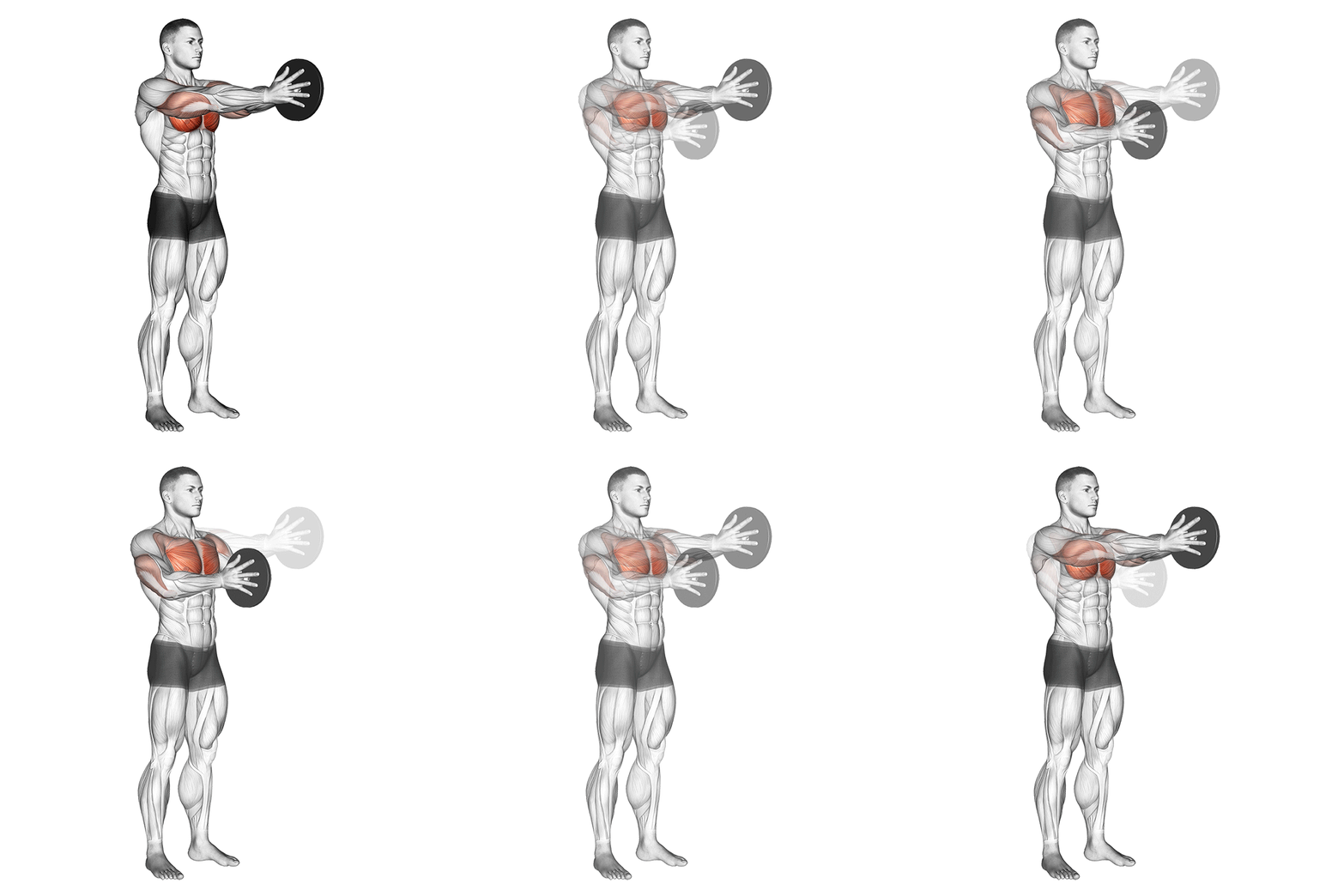
What is the svend press?
The Svend press, named after Norwegian strongman Svend Karlsen, is a standing press with a twist: you sandwich one or two small plates between your flat palms and crush them together while pressing straight out from your chest. That inward squeeze is the entire point. Pressing the hands together is pec adduction, so your chest stays under tension through the whole arm path, including lockout, where a bench press goes quiet. The load is deliberately tiny, a pair of 1.25 or 2.5 kg plates, which makes it useless for max strength but excellent as a warm-up activator, a finisher, or shoulder-friendly pressing on cranky days.
How to do the svend press
- 1
Sandwich the plates at mid-chest
Stand tall and press one or two small plates (1.25-2.5 kg) flat between your palms, fingers pointing forward, hands at sternum height with the elbows lifted out to the sides.
- 2
Squeeze before anything moves
Crush your palms together as if trying to make the plates disappear, until you feel both pecs switch on. That squeeze is the exercise; the press is just a way of making it harder to keep.
- 3
Press straight out, slow
Extend the arms at sternum height over 2-3 seconds, stopping just short of locked elbows, plates level with the floor the whole way. The squeeze gets harder to hold the further the plates travel: do not let it fade.
- 4
Pull back under the same tension
Bring the plates back to your sternum just as slowly, elbows tracing the same path out to the sides. One rep is one full round trip with zero seconds off for the pecs.
Pro tip
Progress by subtraction, not addition: keep the plates tiny and add a 2-3 second pause at full extension, where the lever is longest and the squeeze hardest to hold. Two 1.25 kg plates with a long pause beat two 5 kg plates that start to slip apart mid-set.
Common mistakes
Choosing the plates with your ego.
Past 2.5 kg per plate, the discs wobble, the shoulders take over and the squeeze turns into a desperate grip job. This is the one lift where the smallest plates in the gym are the right call.
Letting the squeeze die at lockout.
Most lifters squeeze hard at the chest and coast once the arms extend, exactly where the tension matters most. If at any point of the rep the plates could be held with one finger, the rep stopped counting at that point.
Leaning back to push.
Tipping the torso backwards sneaks the lower back into the lift and tilts the press upward. Ribs down, glutes on; if you still drift, do it seated with your back against a bench.
Shrugging the plates up.
As fatigue builds, the traps creep toward the ears and the delts steal the show. Keep the shoulders low and wide: the plates stay at sternum height, not chin height.
Variations and progressions
Easier
Palms-only squeeze press
The same movement with empty hands, pressing palm into palm as hard as you can. Zero equipment, and surprisingly brutal when the squeeze is sincere.
Harder
Paused Svend press
A 3-second hold at full extension on every rep, or a slow 5-count out and back. The lever does the loading, so the plates never need to get bigger.
Alternative
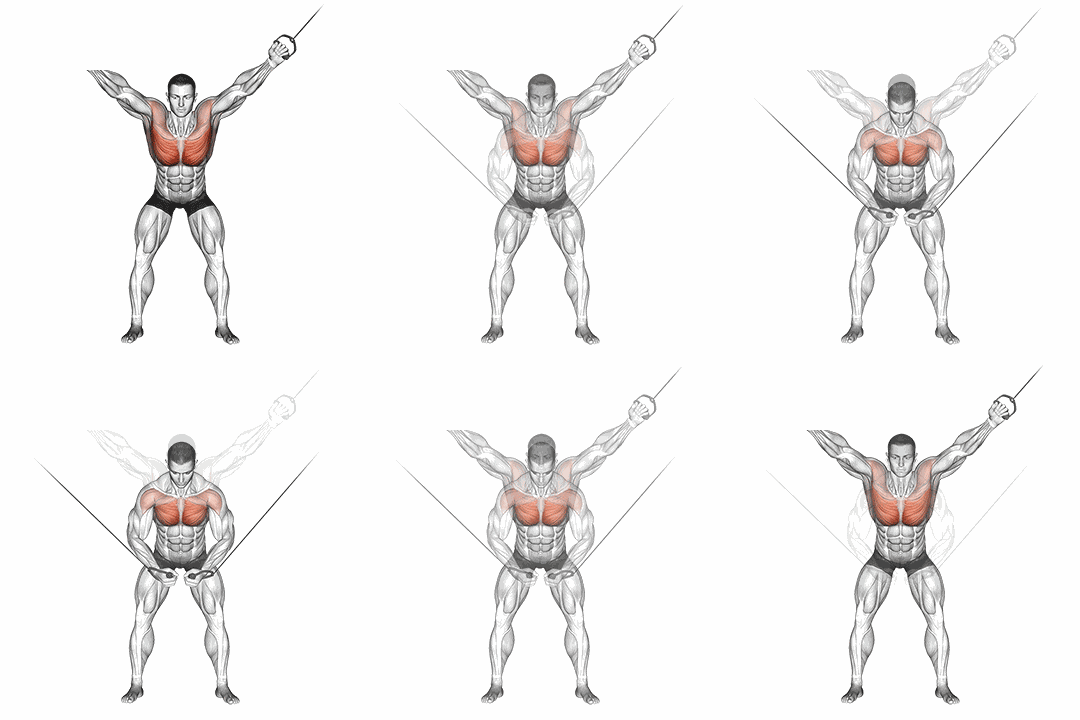
Cable crossover
The machine version of constant adduction tension, with real progressive overload behind it. Pick it to build the chest; keep the Svend press to wake it up.
How to program it
Three protocols by goal. Pick one per cycle and aim for progression on load or distance.
| Goal | Sets × distance | Load | Rest |
|---|---|---|---|
| Pre-bench activation | 2 × 12-15 | Two 1.25 kg plates | 45 s |
| Chest finisher | 3 × 15-20 | Two 2.5 kg plates | 60 s |
| Tempo and pauses | 3 × 8-10 | Light, 3 s out, 2 s pause | 90 s |
Svend Press FAQ
What is the Svend press actually good for?
Three jobs: waking the pecs up before bench or push-up work, finishing a chest session with a burn once the joints have had their dose of heavy, and teaching lifters who cannot feel their chest what real pec tension is. It is a precision tool, not a mass builder: the load is too small to drive growth on its own.
How heavy should the Svend press be?
Lighter than pride would like: one or two plates of 1.25-2.5 kg each. The exercise lives in the squeeze between the palms, and heavier plates break it: they slip, the forearms cramp, the shoulders take over. If reps get easy, add a pause at extension or slow the tempo instead of grabbing bigger discs.
Does the Svend press build the inner chest?
You cannot isolate the inner fibres of a muscle that contracts as a unit, so no exercise owns that spot. What the Svend press does do is maximise adduction tension at full reach, a position where most pressing goes slack. A visible inner chest comes mainly from overall pec size and low body fat: use the Svend press for feel and activation, and let presses and flyes do the building.
Where does the Svend press get its name?
From Svend Karlsen, the Norwegian strongman who won World's Strongest Man in 2001 and made the plate-squeeze press famous. The movement needs nothing but a couple of change plates, which is probably why it survived: it fits any gym, any garage and any hotel fitness room.