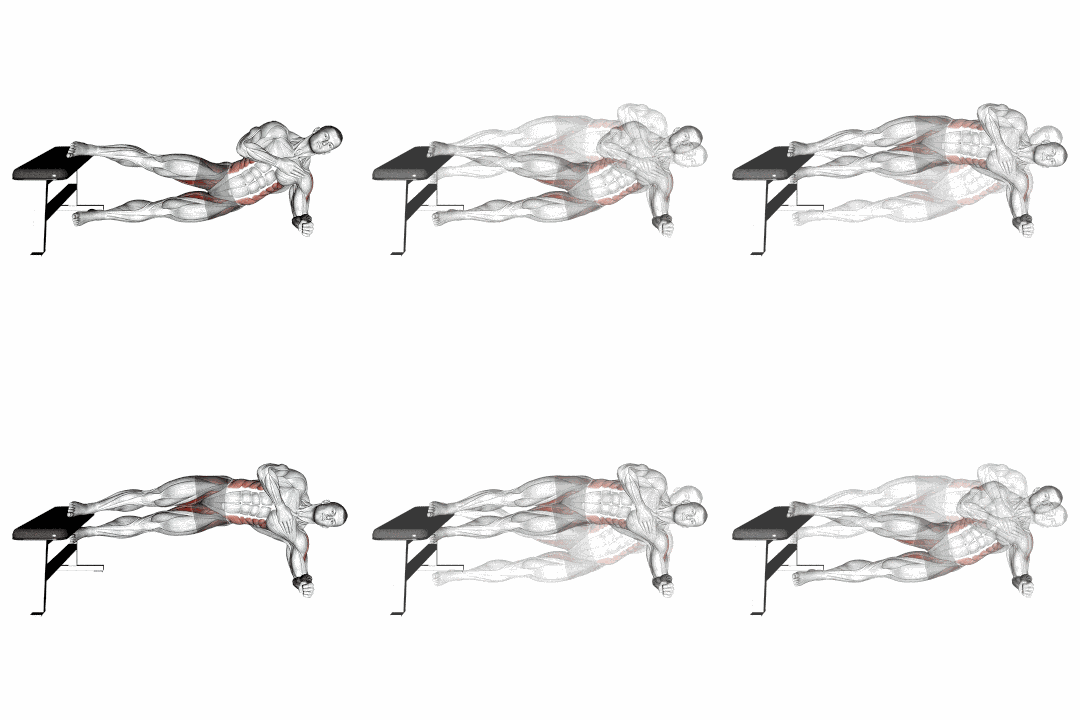
What is the copenhagen plank?
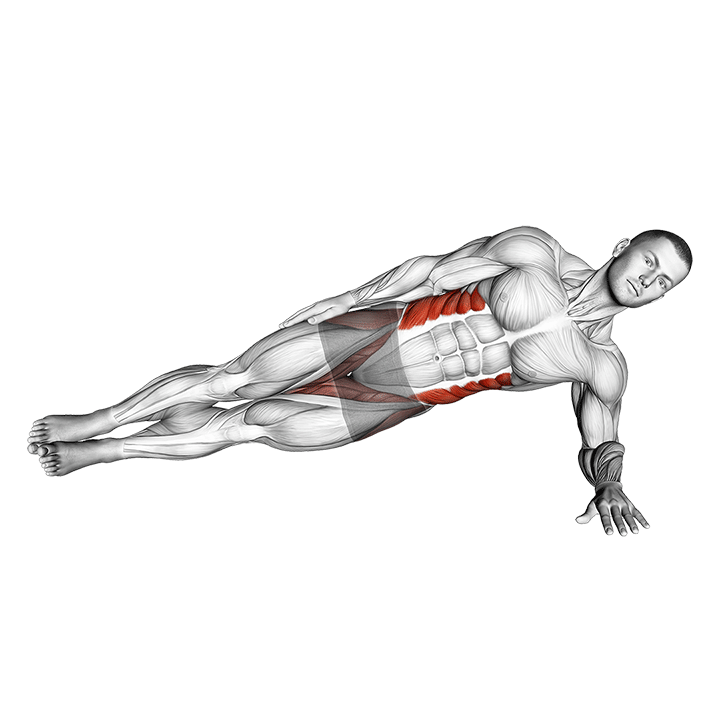
The Copenhagen plank is a side plank where your top leg rests on a bench and your bottom leg hovers beneath it, so the inner-thigh muscles of the top leg carry your entire bodyweight. Developed by Danish sports-medicine researchers, it loads the adductors isometrically and eccentrically while the obliques keep the trunk rigid. Nothing else strengthens the groin this efficiently with zero equipment beyond a bench. It belongs in the weekly routine of anyone who sprints, lunges, skates or changes direction: footballers, Hyrox racers and runners logging heavy lunge and running volume.
How to do the copenhagen plank
- 1
Set up beside a bench
Lie on your side, forearm on the floor with the elbow under your shoulder. Place the inside of your top ankle on the bench pad; your bottom leg slides underneath it.
- 2
Lift into one straight line
Press the inside of your top foot down into the bench and raise your hips until ankle, hip and shoulder line up. The bottom leg hovers, carrying nothing.
- 3
Hold, stacked and breathing
Keep shoulders and hips stacked vertically, squeeze the inner thigh hard, and breathe normally through the hold. No sagging, no rotation.
- 4
Lower with control, switch sides
Bring your hips down slowly rather than collapsing, rest briefly, then repeat on the other side. Always train both sides evenly.
Pro tip
Squeeze the bench between both legs: top leg presses down, bottom leg lifts up toward the pad. That double squeeze doubles the adductor work and instantly stops your hips from wobbling.
Common mistakes
Going long-lever on day one.
Full Copenhagen with the ankle on the bench hammers unprepared adductors and the DOMS is legendary. Earn it: start with the knee on the pad for 2-3 weeks.
Hips sagging toward the floor.
A broken line means the adductors have stopped working and the hold is junk volume. Shorten the set before you shorten the body line.
Rolling the chest to the ceiling.
Rotating turns it into a vague oblique exercise. Keep shoulders and pelvis stacked; a wall behind you is a great honesty check.
No padding under the leg.
A bare bench edge digging into your ankle or knee will end the set before your adductors do. Fold a mat or towel over the pad.
Variations and progressions
Easier
Short-lever Copenhagen (knee on bench)
Rest the knee on the pad instead of the ankle. The shorter lever cuts the adductor load roughly in half, the standard starting point for everyone.
Harder
Dynamic Copenhagen adductions
From the top position, lower your hips toward the floor and lift back up for slow reps. The eccentric phase is where the groin gets truly bulletproof.
No bench?
Partner hold or ball squeeze
A partner holding your top leg replicates the original Danish protocol. Alone, a hard ball squeezed between the knees in a side plank is the budget version.
How to program it
Three protocols by goal. Pick one per cycle and aim for progression on load or distance.
| Goal | Sets × distance | Load | Rest |
|---|---|---|---|
| Injury prevention | 3 × 15-30 s per side | Bodyweight, short lever first | 60 s |
| Adductor strength | 3 × 6-10 slow reps per side | Bodyweight, long lever | 90 s |
| In-season maintenance | 2 × 20 s per side, 2x/week | Bodyweight | 45-60 s |
Copenhagen Plank FAQ
Does the Copenhagen plank really prevent groin injuries?
It has the best evidence of any groin exercise. A large Danish trial across dozens of semi-pro football clubs found about 41% fewer groin problems in teams that ran a simple progressive Copenhagen program. No exercise makes you injury-proof, but if you sprint or change direction for sport, skipping this one is leaving cheap insurance on the table.
Why are my adductors so sore afterwards?
Because you just loaded a muscle group that almost nobody trains with your entire bodyweight. Copenhagen DOMS can make walking funny for two days. Start short-lever, two or three sub-maximal holds per side, and keep that dose for two weeks. The soreness drops off fast with consistency, and that adaptation is exactly the protective effect you came for.
Knee or ankle on the bench?
Knee on the bench is the short-lever regression; ankle on the bench is the full long-lever version, roughly twice as hard. Progress when you can hold 30 clean seconds per side: short lever, then long lever, then dynamic reps. Most people need 4-6 weeks to graduate honestly, and rushing the jump is the number-one cause of Copenhagen-induced groin tweaks.