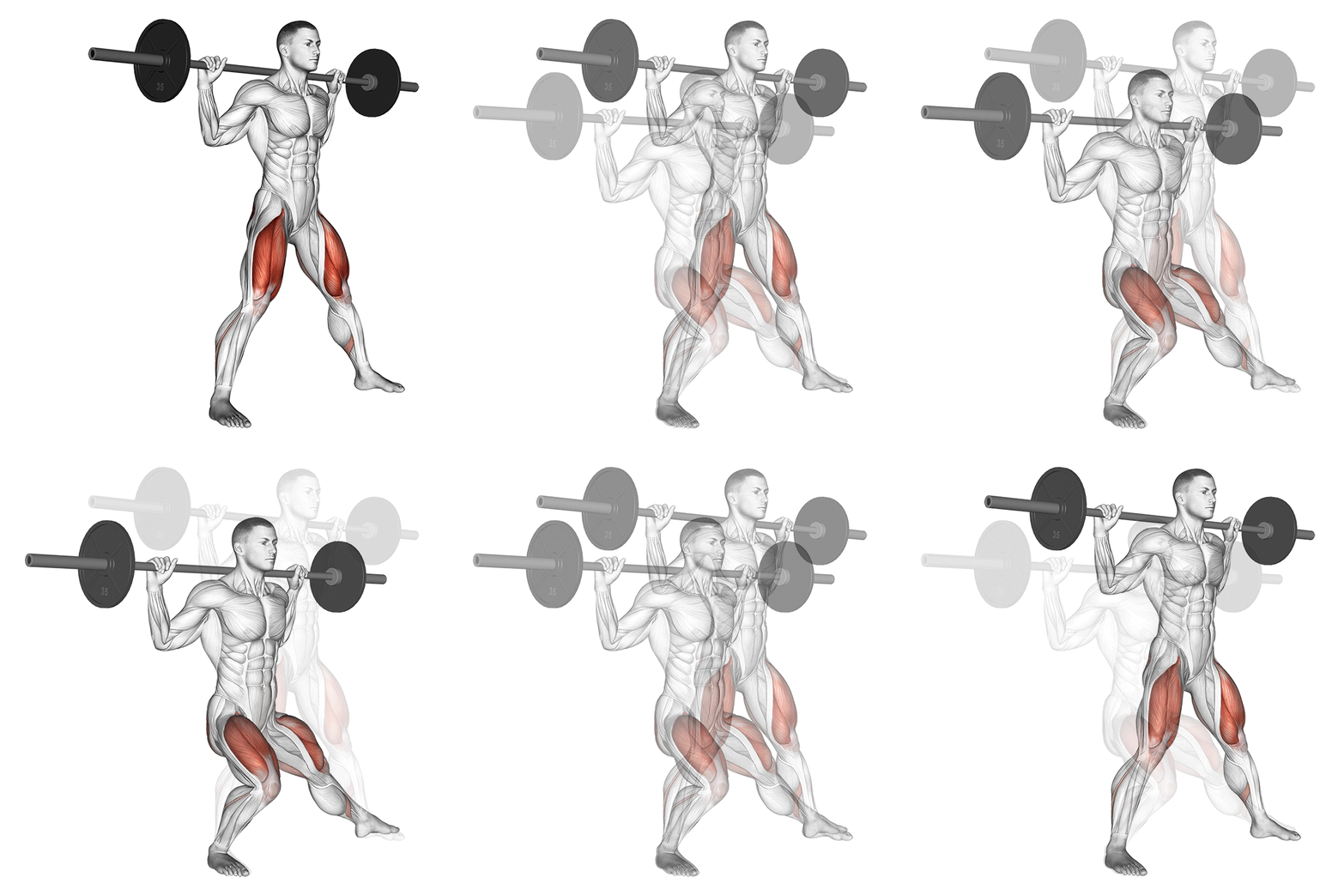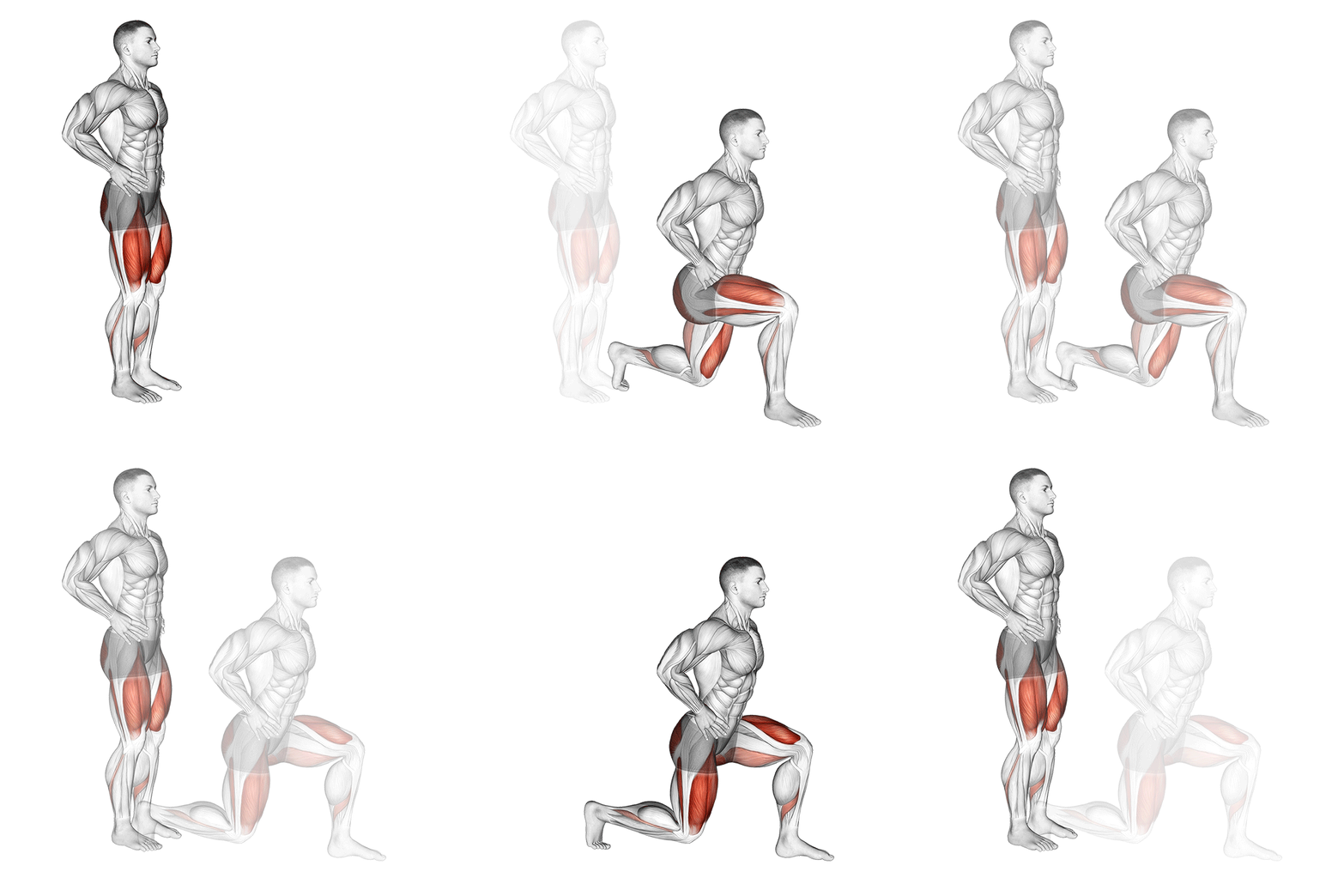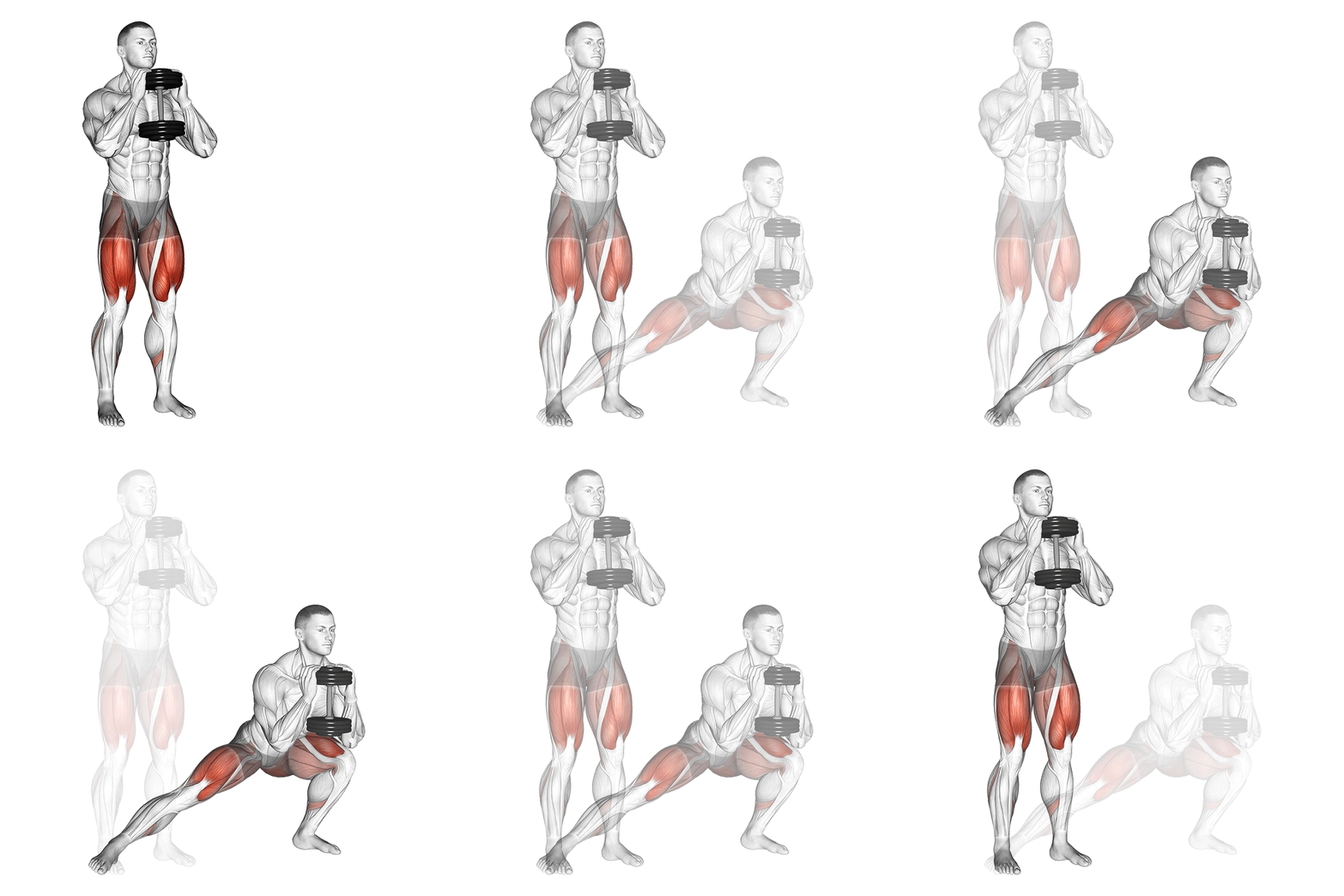
What is the dumbbell side lunges?
The dumbbell side lunge is a frontal-plane lunge: from a standing position you step wide to one side, sit your hips back onto the stepping leg while the other leg stays straight, then push back to the start. Hold one dumbbell at the chest or one in each hand. The bent leg squats; the straight leg gets its adductors stretched under load, a stimulus almost nothing else in the gym provides. Pick it over forward lunges when you need side-to-side strength for sport, injury-proof groins, or hips that move in more than one direction. It asks for more mobility than a split squat, less than a cossack squat.
How to do the dumbbell side lunges
- 1
Set up tall, load secure
Feet hip width, toes forward. Hold one dumbbell at the chest goblet-style for balance, or one in each hand once the pattern is clean.
- 2
Step wide, land flat
Step sideways roughly one leg-length, landing on a flat foot with the toes forward or slightly out. Both feet stay pointing ahead, not splayed like a sumo squat.
- 3
Sit onto the stepping leg
Push the hips back and down over 2 s until the thigh nears parallel. The knee tracks over the mid-foot, the other leg stays locked straight with its foot flat, chest up.
- 4
Punch the floor, come home
Drive hard through the bent leg's whole foot and push yourself back to standing in one piece. Exhale on the push. Alternate sides or finish one side first.
Pro tip
Nail the straight leg's foot flat to the floor. The moment its inside edge peels up, the adductor stretch is gone and the stress dumps into the knee. If you can't keep it flat, shorten the step, not the depth.
Common mistakes
The knee diving inward.
Under load the stepping knee collapses toward the big toe and the groin takes the strain. Think about spreading the floor and keep the knee over the mid-foot.
A timid step.
Step too short and it becomes a crooked squat: no straight leg, no adductor stretch. Step wide enough that the trailing leg is fully straight at the bottom.
Rounding down to chase depth.
Letting the spine round so the dumbbells can reach the floor trains nothing but bad habits. Depth comes from the hips sitting back; the chest stays proud.
Bending the trailing leg.
Two bent knees means zero stretch and an awkward half squat. Lock the trailing knee before you descend and keep it locked until you stand back up.
Variations and progressions
Easier
Bodyweight side lunge
Same pattern, hands free for balance, shallower depth. Build the groin tolerance for a few weeks before adding load.
Harder
Cossack squat
Stay in the wide stance and shift side to side through full depth, trailing toes pointing up. Maximum range, maximum mobility demand.
No dumbbells?
Any single front load
A kettlebell, a plate or a loaded backpack hugged at the chest works identically: the front load even helps you counterbalance the hips sitting back.
How to program it
Three protocols by goal. Pick one per cycle and aim for progression on load or distance.
| Goal | Sets × distance | Load | Rest |
|---|---|---|---|
| Strength base | 4 × 6-8 per side | RPE 7-8 | 2 min |
| Hypertrophy | 3 × 10-12 per side | RPE 8 | 90 s |
| Mobility under load | 2 × 8 per side, 2 s pause at depth | Light | 60-90 s |
Dumbbell Side Lunges FAQ
What do side lunges work that regular lunges don't?
Two things. The straight leg's adductors get lengthened under load, which forward and reverse lunges barely touch, and the hips learn to produce and absorb force sideways, the motion behind cutting, skating and change of direction. If your training lives entirely in the sagittal plane, this is the cheapest insurance you can buy for your groin.
Side lunge or cossack squat?
The side lunge is the on-ramp. You step in and out of each rep, depth stops around parallel and the trailing foot stays flat, so ankle and hip demands stay reasonable. The cossack squat keeps you in the wide stance, goes to full depth with the trailing toes up, and punishes any missing ankle or adductor mobility. Progress to it when paused side lunges at depth feel comfortable.
Should I alternate sides or do all reps on one side?
Going heavy or chasing muscle: finish one side first, the constant tension and focus are worth more than variety. Training for sport or conditioning: alternate, because re-stepping every rep mimics the stop-start reality of play. Whichever you pick, always start the set on your weaker side while you are fresh.