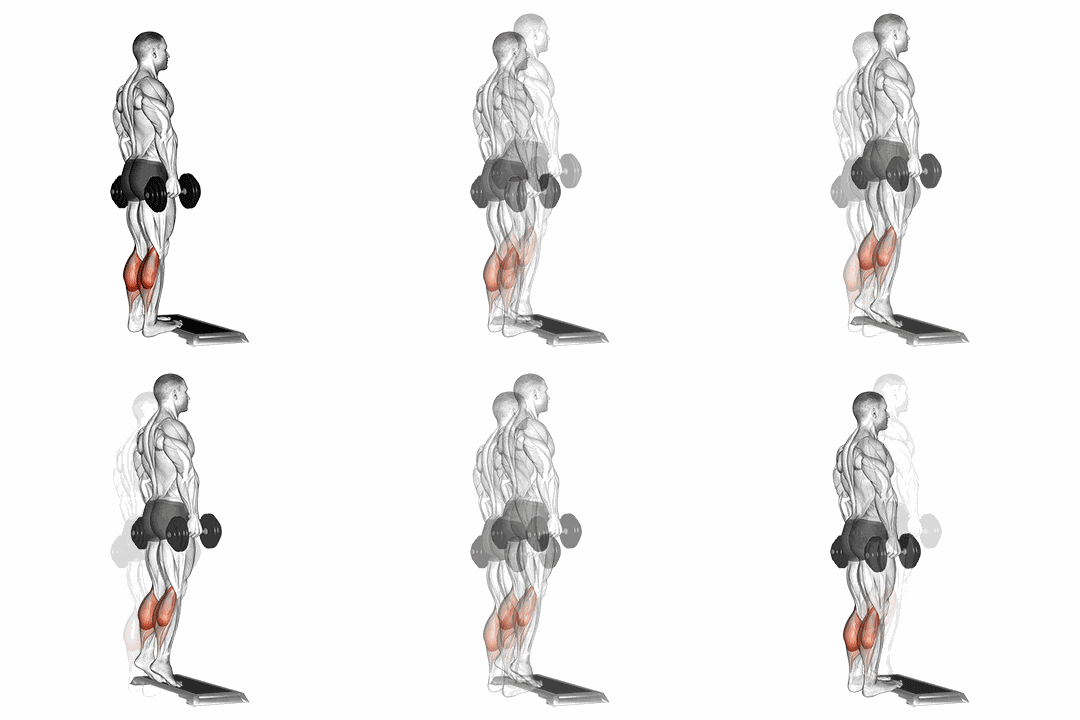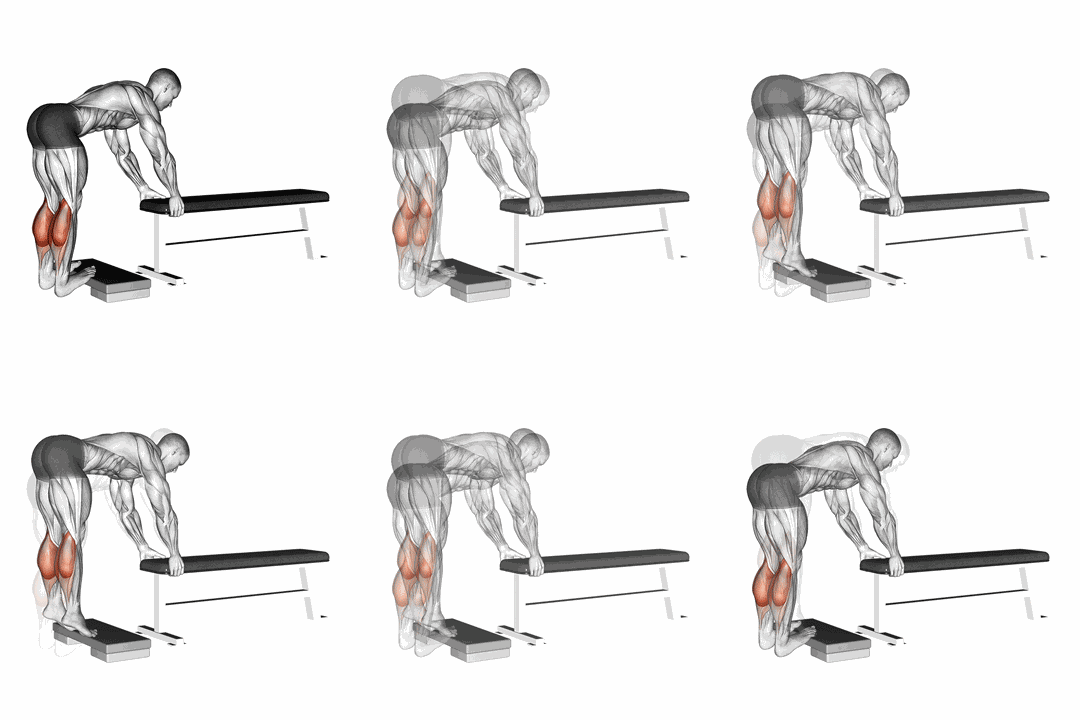
What is the donkey calf raise?
The donkey calf raise is a straight-knee calf raise done with your torso hinged to roughly ninety degrees and the weight resting over your hips: a dedicated machine, a dip belt, or, in the old-school version, a training partner sitting across your lower back. Because the knees stay locked, the gastrocnemius does almost all of the work, and the hinged position lets you go heavy without a bar compressing your spine. The balls of your feet sit on a block, so every rep travels from a deep stretch to full tiptoe. It suits lifters whose standing raises have stalled, and anyone whose back complains under heavy top-loaded calf work.
How to do the donkey calf raise
- 1
Build your platform and support
Place a sturdy block or step next to a bench or inside a rack. Hinge at the hips to about ninety degrees, forearms or hands braced on the support, balls of both feet on the edge of the block, heels hanging free.
- 2
Load the hips, not the spine
Set the machine pad, dip belt or partner squarely over your hip bones, never up on the lumbar spine. Knees straight but not jammed into hyperextension, back flat from head to tailbone.
- 3
Sink into the deepest stretch you own
Lower your heels under control for 2-3 s until they drop well below the block and you feel a deep pull through the calves and Achilles. Hold the bottom for a full second without relaxing.
- 4
Drive tall through the big toe
Press through the base of the big toe until you are as high on your toes as you can get, squeeze for a second at the top, then start the next slow descent. Knees stay locked for the entire set.
Pro tip
Kill the bounce with a dead stop: count one full second in the stretched bottom before every rep. The Achilles tendon is a powerful spring, and without the pause it does half the lifting; with it, every centimetre belongs to the muscle.
Common mistakes
Bouncing out of the stretch.
The Achilles tendon is elastic, and a quick reversal lets it catapult the weight up while the muscle barely works. Dead-stop for a full second at the bottom; if the weight will not come up without a bounce, it is too heavy.
Knees unlocking as the set grinds.
A little knee bend sneaks in leg drive and slackens the gastrocnemius, the muscle you came for. Keep the knees straight but soft from first rep to last; if they insist on bending, drop the load.
Load creeping onto the lumbar spine.
A pad, belt or partner sitting too far up your back turns a hip load into a lower-back bend. Re-set the weight squarely over the hip bones and keep the back flat; your spine should feel pinned, not folded.
Shrinking range as the plates grow.
Calves grow from the stretched half of the rep, exactly the part heavy partials delete. Pick the load by the depth of your heels, not the number on the stack: full stretch below the block on every rep or the set does not count.
Variations and progressions
Easier
Bodyweight calf raise on a step
Same full range from deep stretch to tiptoe, loaded only with bodyweight. Master a 3 s descent and a dead-stop pause here before adding external load.
Harder
Single-leg donkey calf raise
All the load on one calf doubles the stimulus without touching the plates, and exposes the size and strength gap most people hide between their two legs.
Alternative
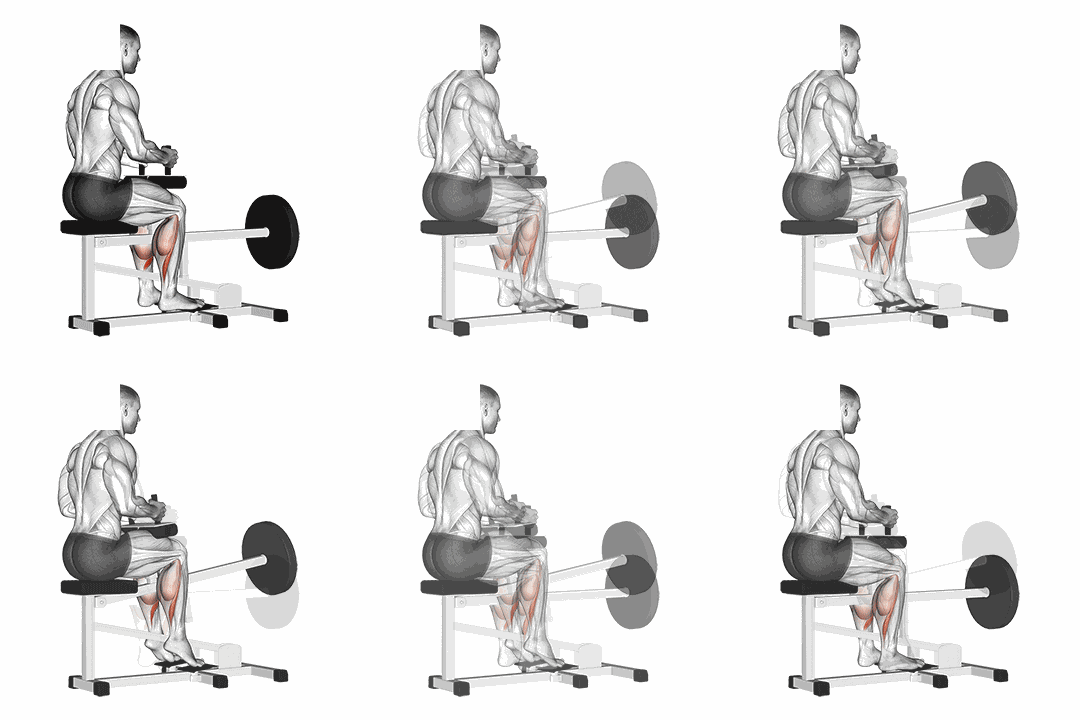
Seated calf raise machine
Bent knees slacken the gastrocnemius and hand the work to the soleus underneath. Not a replacement but the perfect partner: the donkey covers the stretch-loving gastroc, the seated raise covers the endurance-built soleus.
How to program it
Three protocols by goal. Pick one per cycle and aim for progression on load or distance.
| Goal | Sets × distance | Load | Rest |
|---|---|---|---|
| Strength | 4 × 6-8 | Heavy, 1 s pause top and bottom | 2 min |
| Hypertrophy | 3-4 × 10-15 | RPE 8, 2 s in the stretch | 90 s |
| High-rep finisher | 2-3 × 15-20 | Light, 3 s descents | 60 s |
Donkey Calf Raise FAQ
Donkey calf raise vs standing calf raise: what's the difference?
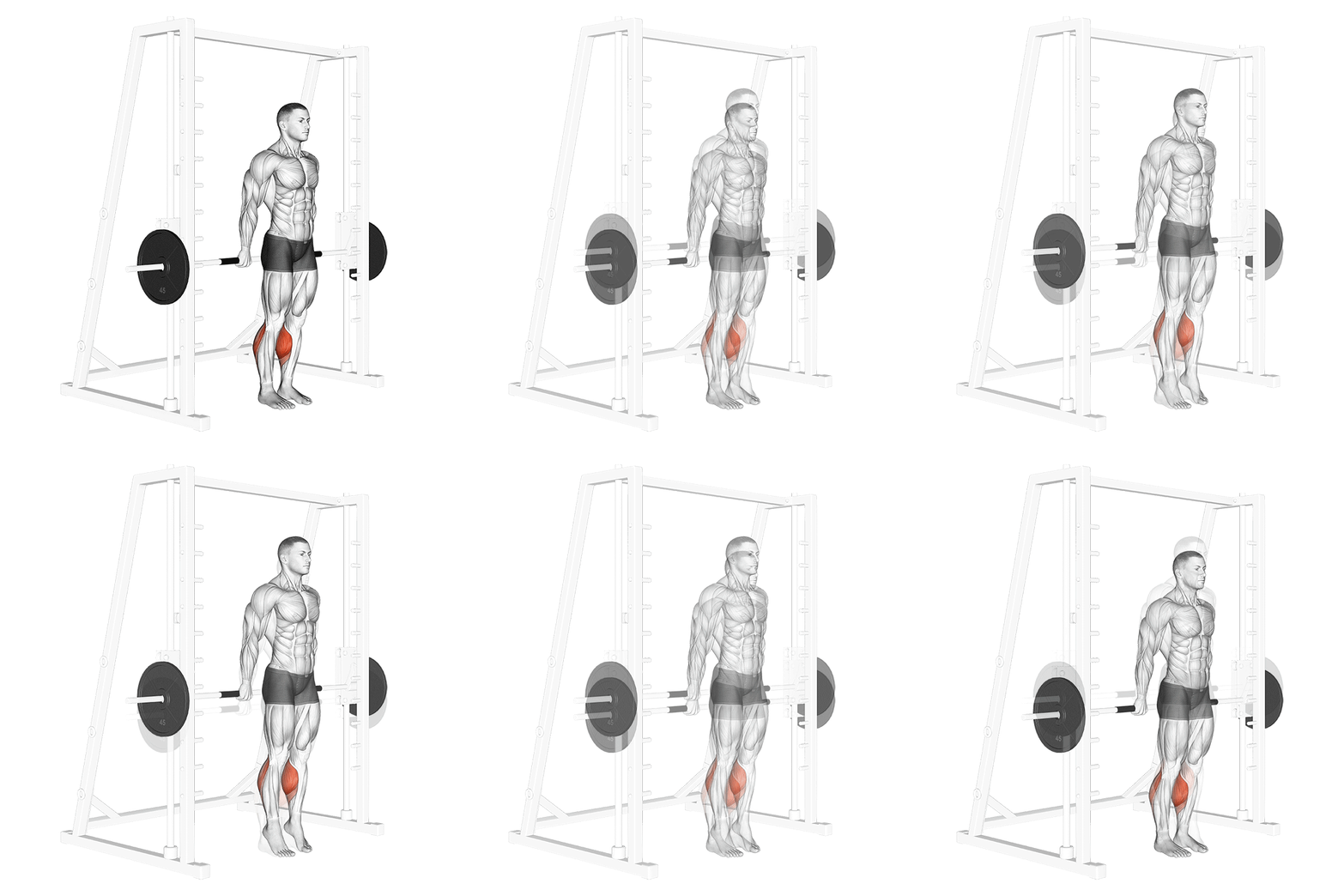
The hinge. In a standing raise the load stacks from your shoulders down through the whole spine; in the donkey version it rests over your hips, so the calves get the same straight-knee stimulus with far less to hold up top. Most lifters also find the bottom stretch deeper and easier to control, because the braced torso takes balance out of the picture. If both are available, the donkey raise is usually the better pick for heavy full-range work.
Do donkey calf raises work the soleus?
Only as a helper. With the knees locked, the gastrocnemius is at full length and takes the lead; the soleus still contributes to every plantar flexion but is not the limiter. To target it directly, add bent-knee work like the seated calf raise machine: between them, the two exercises cover the whole calf.
How do I do donkey calf raises without the machine?
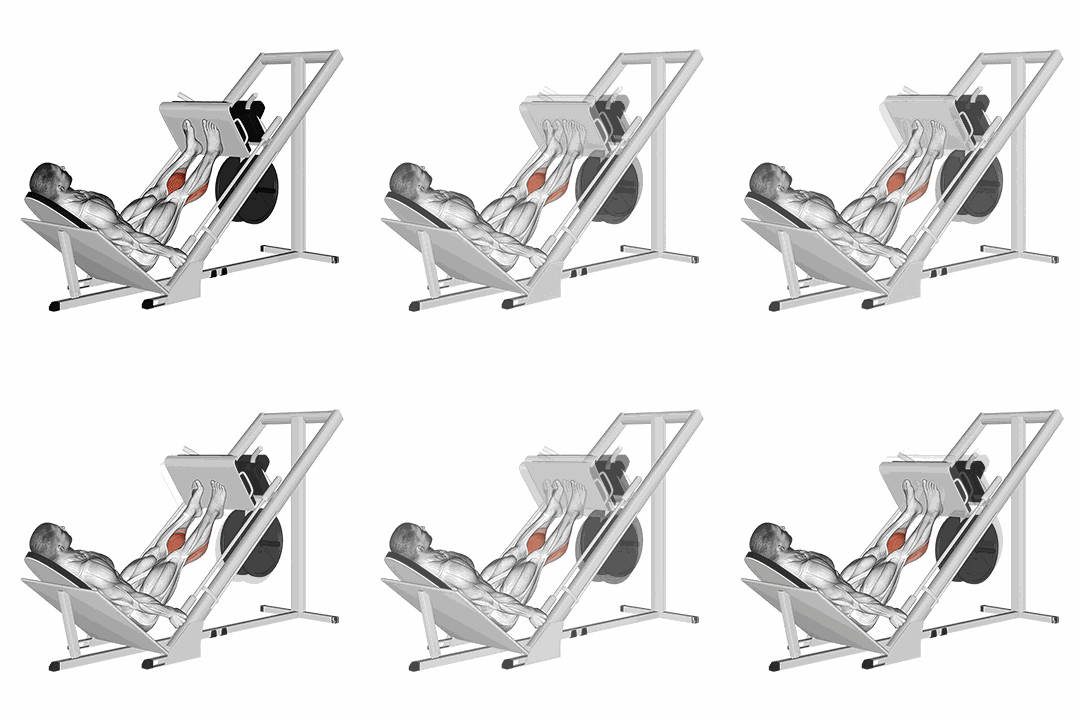
Three honest options. Hinge over a bench or rack with a dip belt and plates hanging from your hips; load a sturdy backpack or have a partner add weight across your hips, old school; or, if none of that flies in your gym, the leg press calf raise reproduces the same locked-knee, supported-torso loading with zero setup.
How heavy should donkey calf raises be?
Heavier than you expect, but only through a full range. Calves spend all day carrying your bodyweight, so they shrug off light sets; work up until 8-12 reps with a paused stretch are genuinely hard. The moment your heels stop dropping below the block, the extra plates are costing you growth, not buying it.