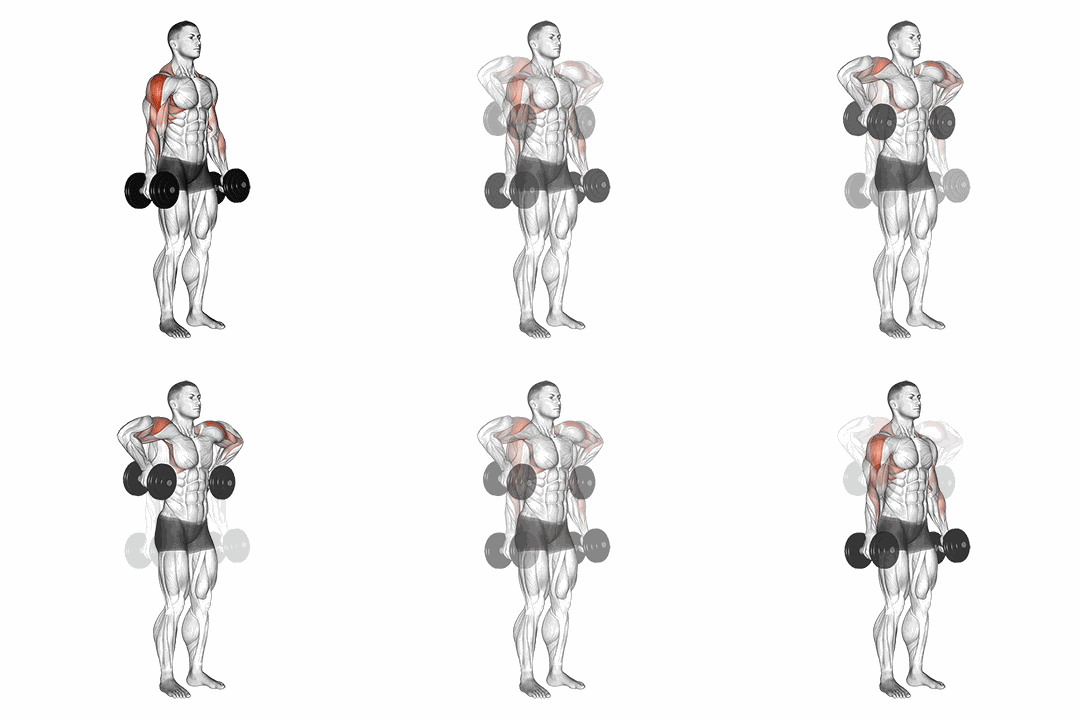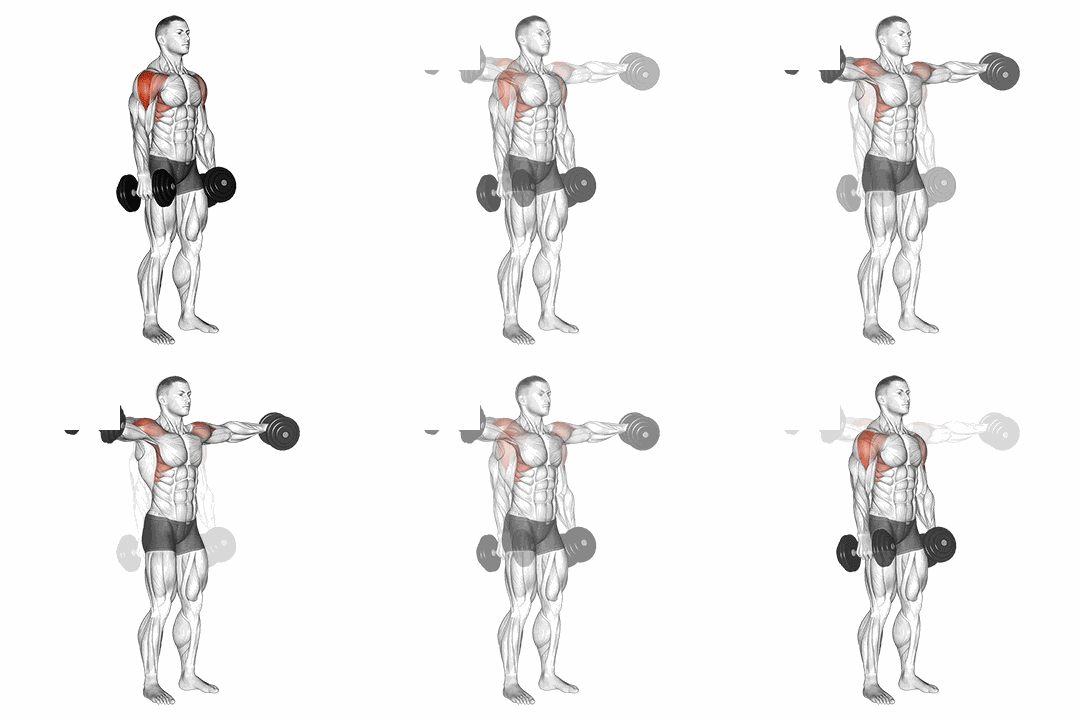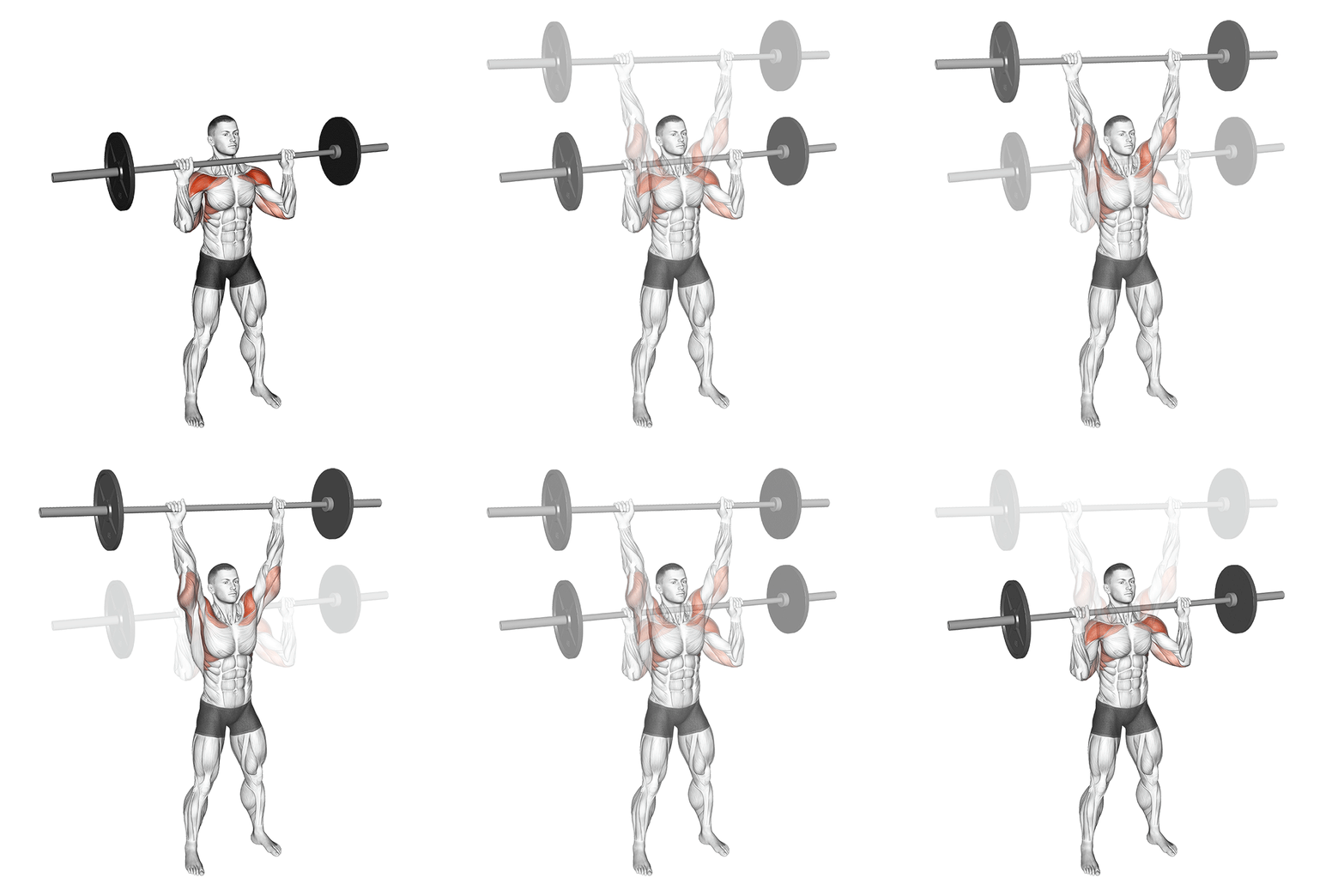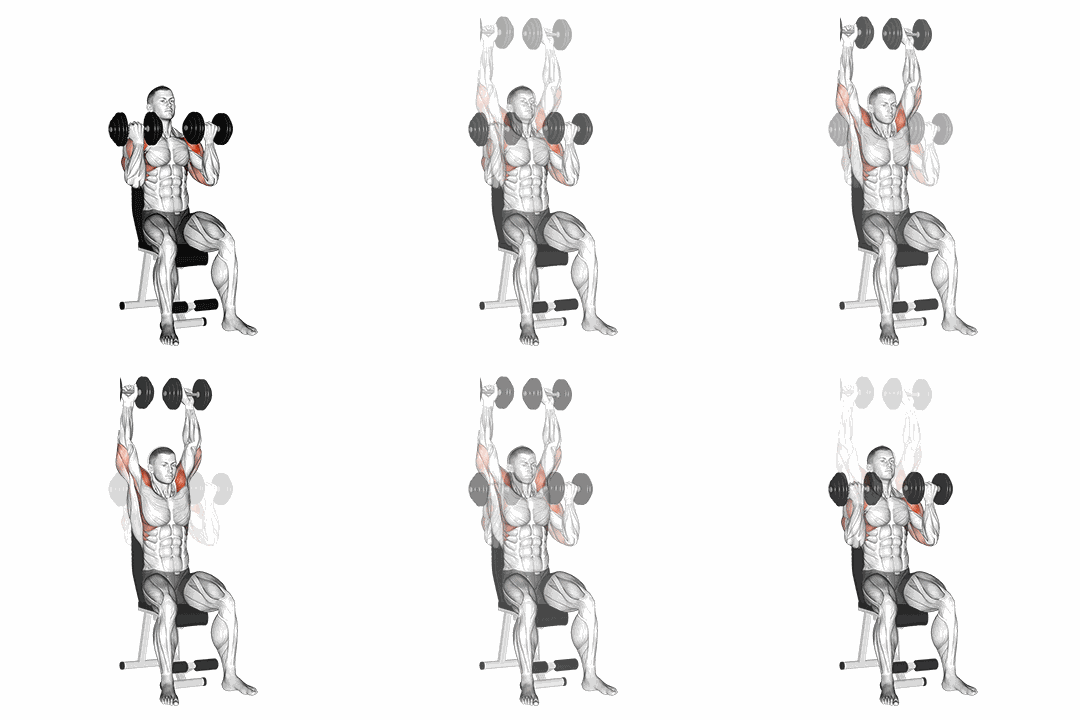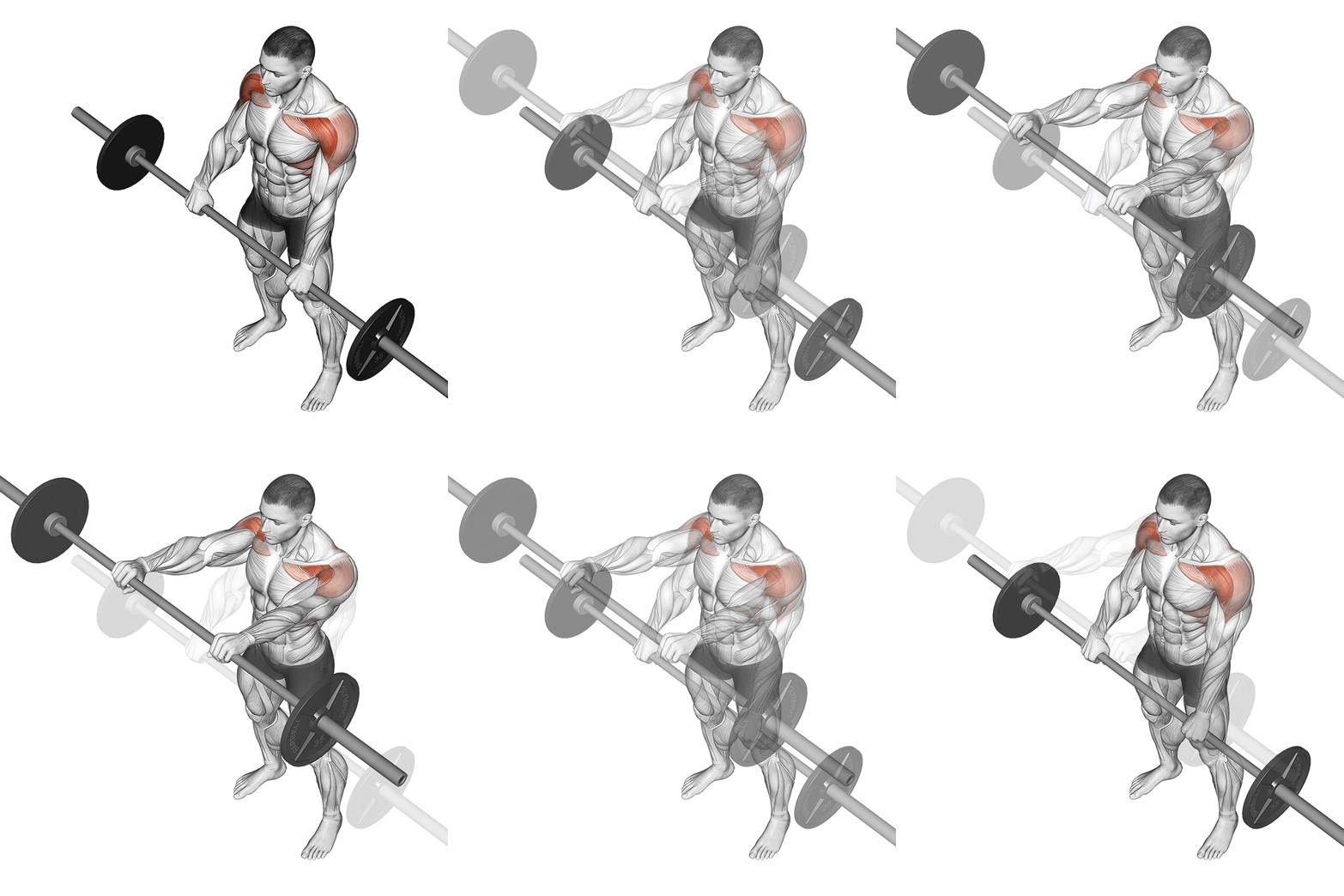
What is the barbell front raise?
The barbell front raise locks both hands to one bar, overhand and shoulder width, and lifts it from your thighs to shoulder height with nearly straight arms. It is pure anterior delt work: no leg drive, no press, just a long lever swinging a light bar through a strict arc. The bar brings two things dumbbells don't: both arms are forced to move together at the same speed, and the load sits in one piece, so it is simple to add in small jumps. The trade-off is that a bar hides left-right differences and punishes cheating with your hips, which makes strictness non-negotiable here.
How to do the barbell front raise
- 1
Grip the bar at shoulder width
Overhand grip, hands directly under your shoulders, standing with the bar resting against your thighs. An EZ-bar or a light fixed barbell works as well as an Olympic bar here.
- 2
Lock your trunk before the bar moves
Squeeze your glutes, tuck the ribs and soften the knees. Every hip swing you allow now becomes a cheat rep later, so kill the momentum at the source.
- 3
Raise the bar to shoulder height
With elbows almost straight, sweep the bar up and slightly away from you until your arms are parallel to the floor. Exhale on the way up and keep the wrists flat.
- 4
Lower slower than you lifted
Control the bar back down for 2-3 s and stop a fist's width above your thighs. Touching down lets the delts rest; hovering keeps them honest for the next rep.
Pro tip
Think long arms: reach the bar toward the wall in front of you as it rises. Lengthening the arc is how you make a light bar brutally heavy; adding plates is how you make your hips do front raises.
Common mistakes
Kicking the bar up with your hips.
A small bump at the bottom launches the bar through the half of the range where the delts should work hardest. If rep one needs a bump, the bar is too heavy for a raise.
Raising above horizontal.
Past shoulder height the traps take over and the lower back arches to keep you balanced. Stop the bar at shoulder level; the extra 20 degrees build nothing you want.
Ribs flaring as the bar climbs.
When the trunk leans back and the ribcage lifts, your lumbar spine is paying for weight your delts cannot handle. Re-brace, or trade plates for a stricter arc.
Bending the elbows to shorten the lever.
Each degree of elbow bend makes the bar easier and the stimulus smaller. Fix the slight bend you chose at the setup and keep it identical from the first rep to the last.
Variations and progressions
Easier
Alternating dumbbell front raise
One arm works while the other rests, and each hand can turn to the grip your shoulder likes. The standard entry before locking both arms to a bar.
Harder
Seated barbell front raise
Sit on the end of a bench and run the same arc. With the hips out of the equation there is no cheating left; expect to drop the load by a third.
No barbell?
Plate front raise
Hold a plate at 3 and 9 o'clock and raise it through the same arc. The neutral grip sits easier on some shoulders and the single object keeps both arms synced.
How to program it
Three protocols by goal. Pick one per cycle and aim for progression on load or distance.
| Goal | Sets × distance | Load | Rest |
|---|---|---|---|
| Hypertrophy | 3 × 10-12 | Light bar, RPE 8 | 60-90 s |
| Strict control | 3 × 8, 2 s pause at the top | Very light, RPE 7-8 | 90 s |
| Finisher | 2 × 15-20 | Empty bar or EZ-bar, RPE 9 | 45-60 s |
Barbell Front Raise FAQ
Barbell or dumbbell front raise?
The bar is the strict option: both arms move at one speed, the path never wanders, and loading in 1.25 kg jumps is easy. The cost is that a stronger side can quietly carry a weaker one, and your wrists are stuck in full pronation. Dumbbells reveal asymmetries and let the grip rotate, but invite sloppier arcs. Build the habit with dumbbells, then use the bar when you want controlled, measurable progression.
Do I need front raises if I already press?
Usually not much. Every press, bench or overhead, already trains the anterior delts hard, and for most lifters they are the least neglected muscle in the shoulder. Front raises earn their slot in two cases: a program light on pressing, or a front delt visibly lagging behind your side and rear delts. Keep the dose small, one or two sessions a week of a few light sets, and spend the saved time on lateral raises and rear delt work.
How heavy should a barbell front raise be?
Embarrassingly light is correct. The bar sits at the end of two straight levers, the full length of your arms, the worst possible mechanical position, so a 10-15 kg bar challenges most intermediate lifters for strict sets of 10-12. A simple ceiling: you should be able to stop and hold the bar at shoulder height for 2 s on any rep. The day you cannot, the weight is programming your hips, not your delts.