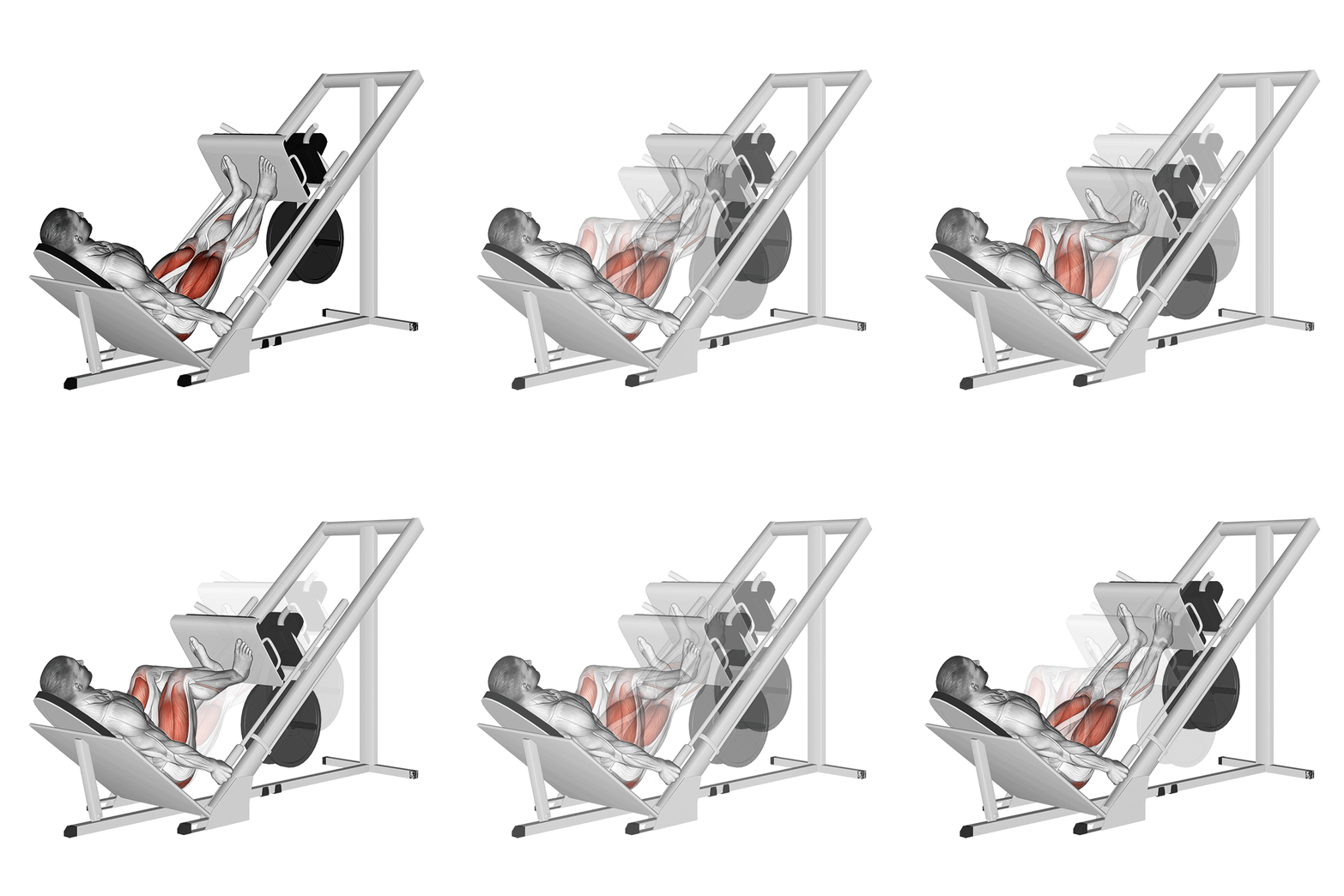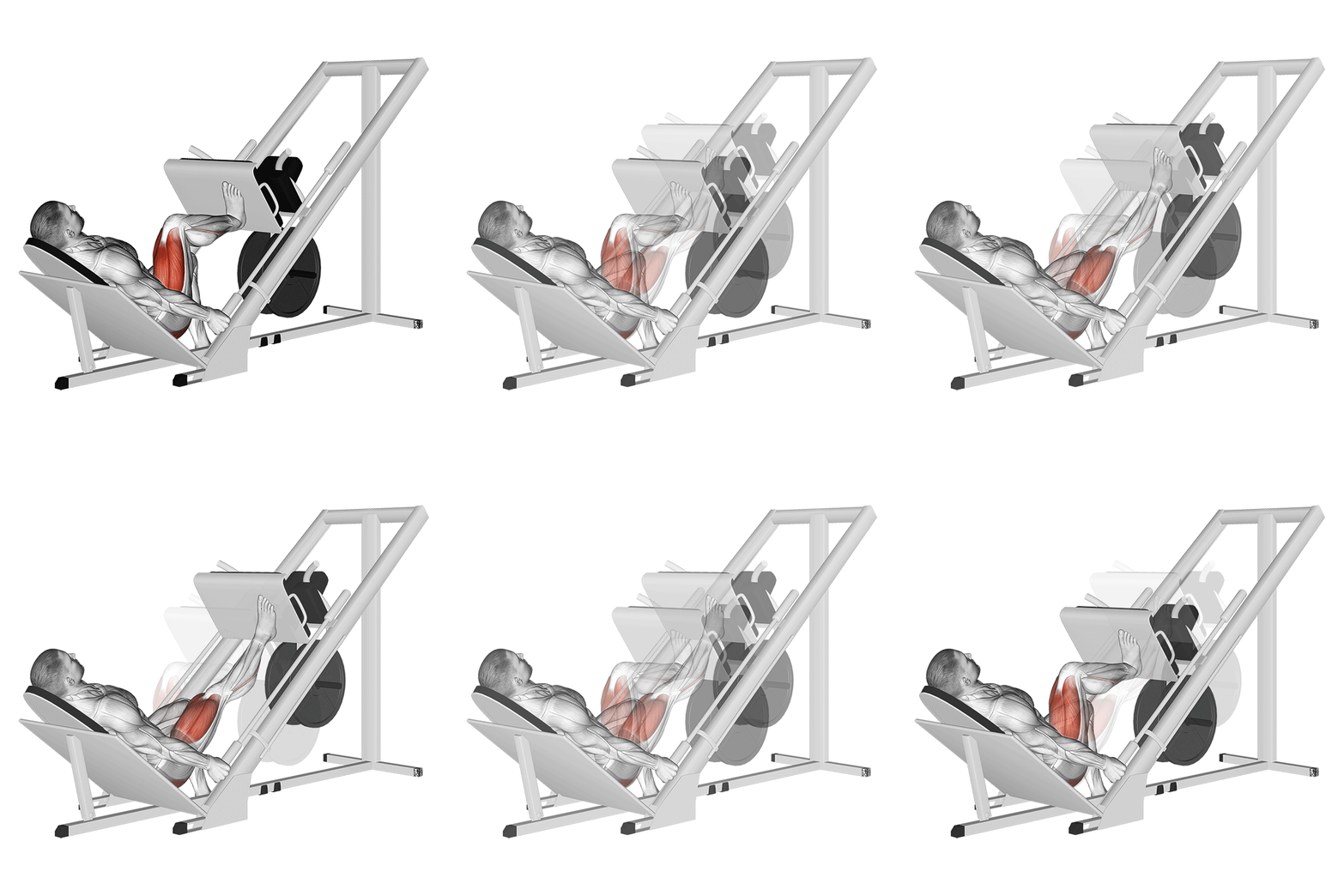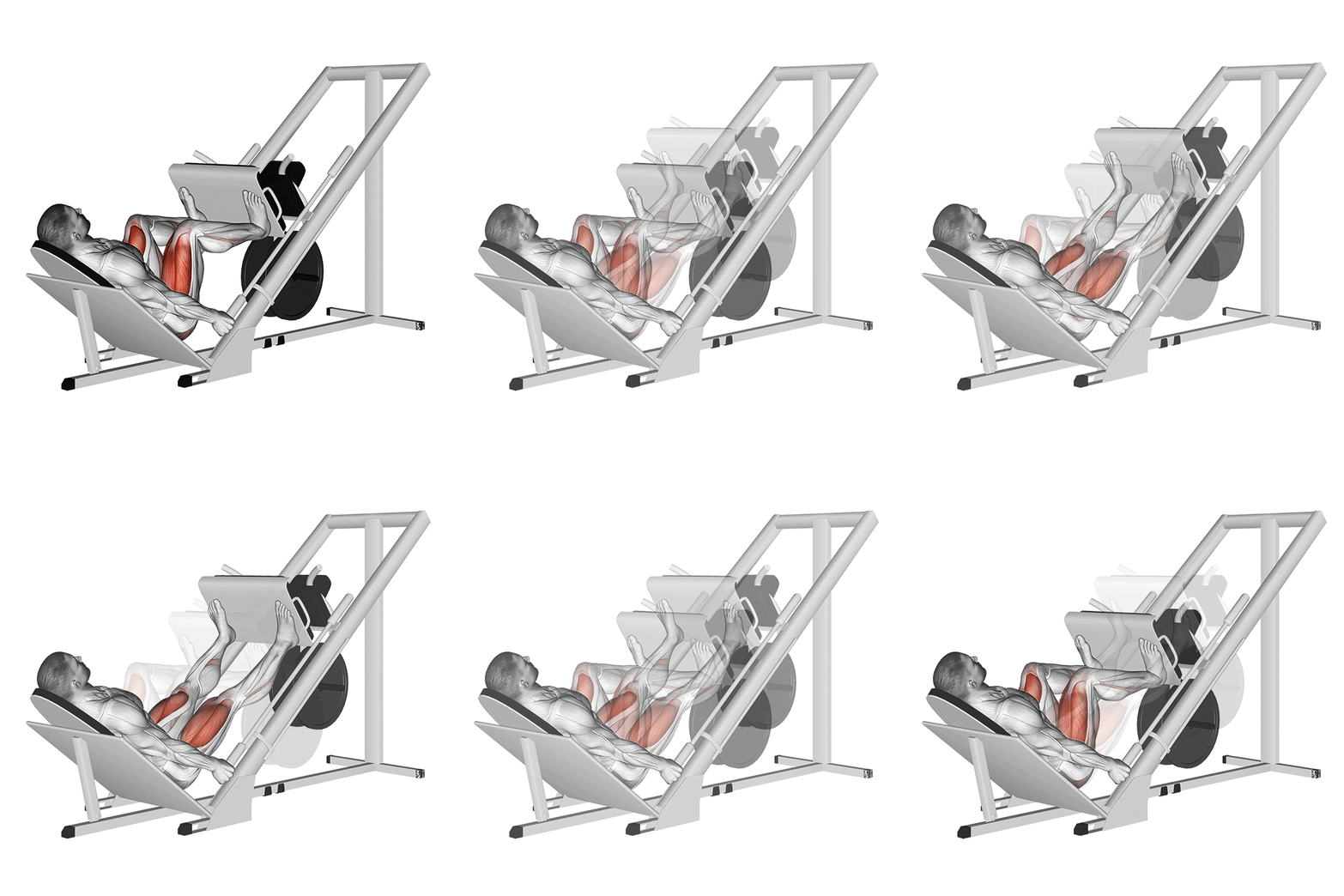
What is the wide stance leg press?
The wide stance leg press is a 45-degree leg press performed with the feet set wider than the shoulders, placed on the upper half of the platform, toes turned out around 20-30 degrees. Compared with a standard stance, this setup reduces how far the knees drift forward, deepens the hip flexion you reach at the bottom, and shifts the work toward the glutes, the adductors and the inner thigh. It is the stance of choice for lifters with sensitive knees, for long-femured athletes who struggle to find depth in the squat, and for anyone chasing heavy hip-dominant pressing without putting a bar on their spine.
How to do the wide stance leg press
- 1
Set the seat and the feet
Sit with the lower back and pelvis pressed flat into the pad. Place the feet a few centimetres wider than your shoulders, on the top half of the platform, toes out 20-30 degrees.
- 2
Unrack with intent
Press the platform up, flip the safety handles open and keep your hands on them. Take a breath and brace before the first rep, not during it.
- 3
Lower deep, knees over toes
Bend the knees and let them travel out over the toes, not toward each other. Lower until the thighs come toward your ribcage, stopping just before the pelvis starts to tuck off the pad.
- 4
Press through the heels
Drive through the heels and mid-foot, squeezing the glutes as the legs extend. Stop just short of locking the knees so the tension never leaves the muscles.
Pro tip
Your usable depth ends the instant your tailbone peels off the pad. On a warm-up set, slide a hand under your lower back and find that exact point, then stop every working rep a couple of centimetres above it.
Common mistakes
Letting the pelvis tuck at the bottom.
When the hips run out of room, the pelvis rolls off the pad and the lumbar spine flexes under heavy load. Cut the range just above that point; depth you can't own is depth you don't need.
Knees caving on the press.
A wide stance punishes valgus: the knees dive toward each other as fatigue sets in. Actively push them out toward your little toes on every rep, and drop a plate if you can't.
Slamming into lockout.
Snapping the knees straight transfers the load from muscle to joint and invites hyperextension against a moving sled. Finish each rep with a soft knee and constant tension.
Stacking plates, cutting range.
Quarter reps with the whole gym's plates defeat the point of this stance, which is deep hip flexion. Load what you can move through the full range you mapped out.
Variations and progressions
Easier
Standard stance leg press
Feet shoulder-width in the middle of the platform. Less hip mobility required and a more familiar pattern: build your base here before widening out.
Harder
Paused wide stance press
Hold 2-3 seconds at your depth limit before pressing. The pause removes the stretch rebound and forces the glutes and adductors to produce every newton from a dead stop.
Alternative
Dumbbell sumo squat
The same wide, hip-dominant pattern as a free weight. You lose total load but gain trunk work and a setup you can do in any gym, or at home.
How to program it
Three protocols by goal. Pick one per cycle and aim for progression on load or distance.
| Goal | Sets × distance | Load | Rest |
|---|---|---|---|
| Hypertrophy | 4 × 10-12 | RPE 8, 2 reps in reserve | 2 min |
| Strength | 4 × 6-8 | Heavy, full range | 2-3 min |
| Volume finisher | 2-3 × 15-20 | Moderate | 90 s |
Wide Stance Leg Press FAQ
Does the wide stance really hit the inner thighs?
Yes, meaningfully. The adductor magnus is a powerful hip extensor, and a wide stance taken deep puts it under load through a long range. You will feel it, often as next-day soreness high on the inner thigh. It still won't isolate the adductors the way an adduction machine does; it trains them as part of a heavy compound.
Wide or narrow stance: what actually changes?
Foot placement decides which joint does the work. Low and narrow sends the knees far forward: maximum knee flexion, maximum quads. High and wide limits knee travel and deepens hip flexion: more glutes and adductors, less stress through the knee. Neither is superior; they are two different exercises on the same machine.
Is it better for sore knees?
Often, yes. Less forward knee travel means less demand on the knee joint and the quad tendon, which is why many lifters with grumpy knees press wide and high while they rebuild tolerance. It is a way to keep training legs hard, not a treatment: if pain persists, get it assessed.
How wide and how high should the feet go?
Start a hand-width wider than your shoulders on each side, heels on the upper half of the platform, toes out 20-30 degrees. Wider than that, most people's hips run out of room and the ankles start twisting. Adjust a few centimetres at a time until the bottom position feels deep but stable.