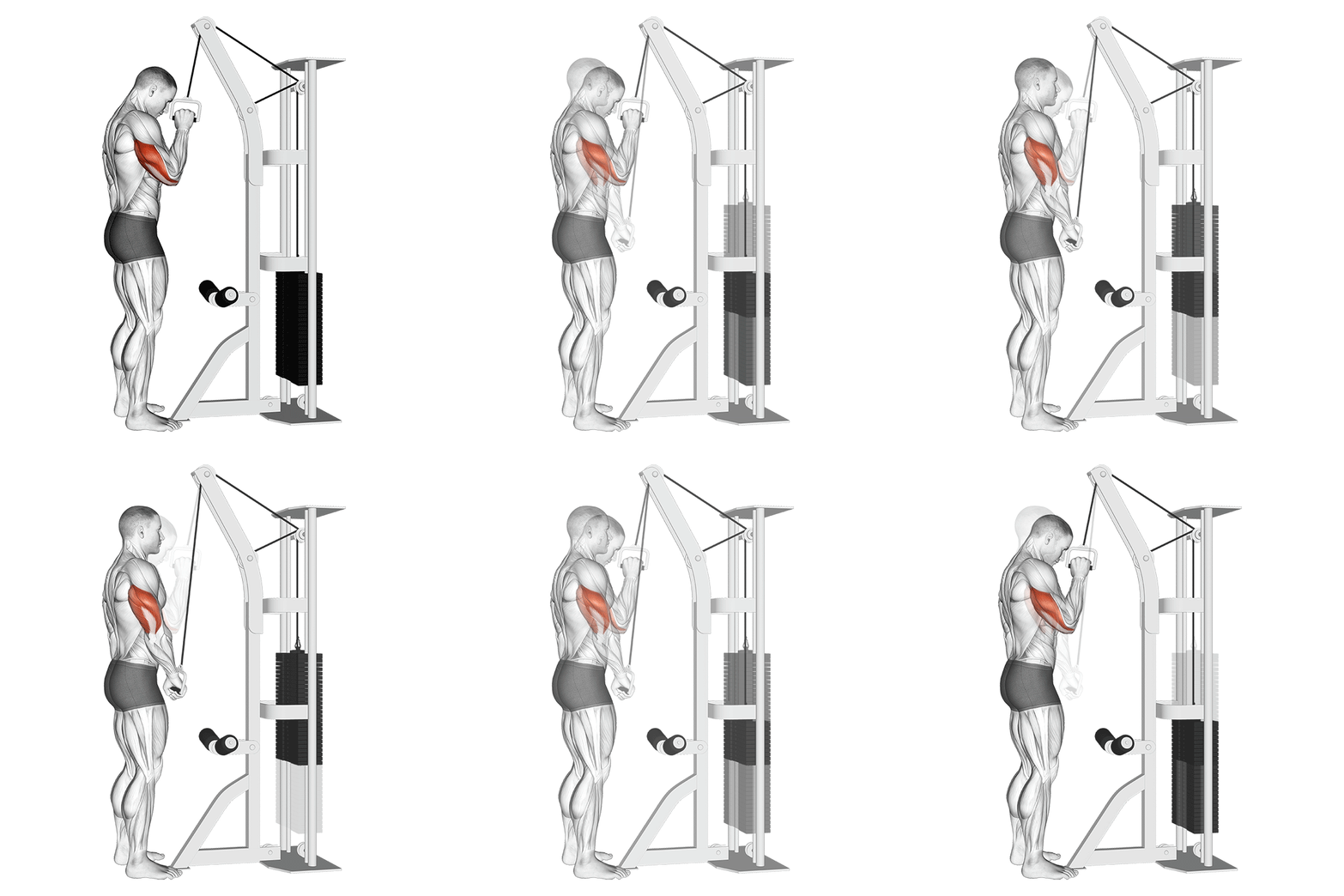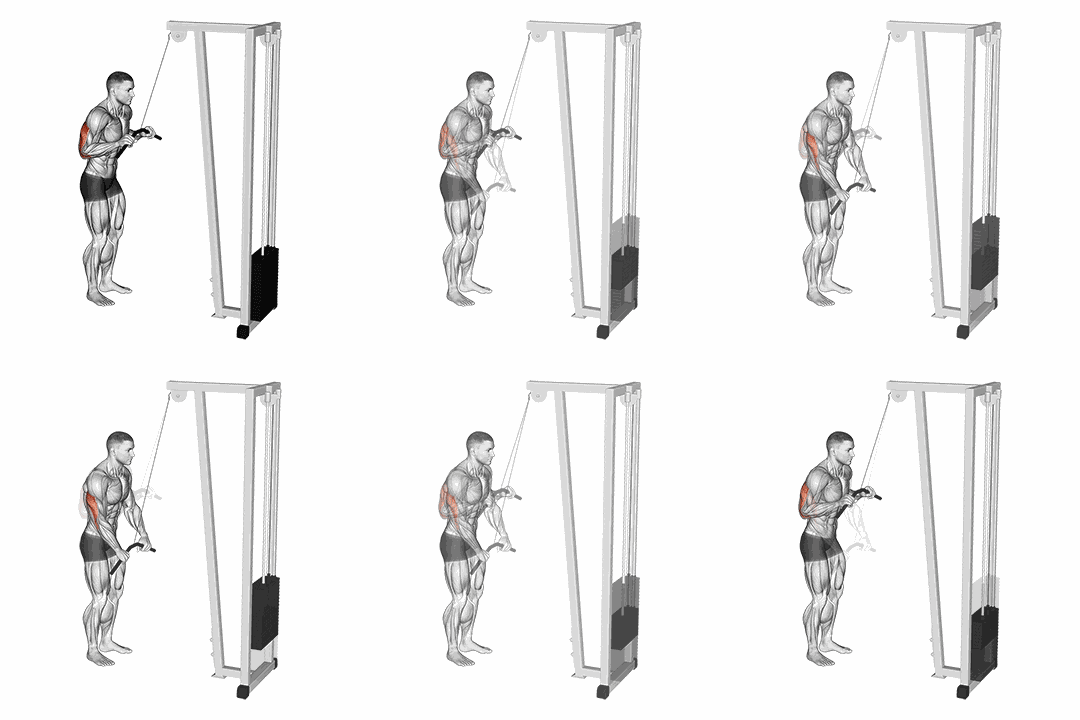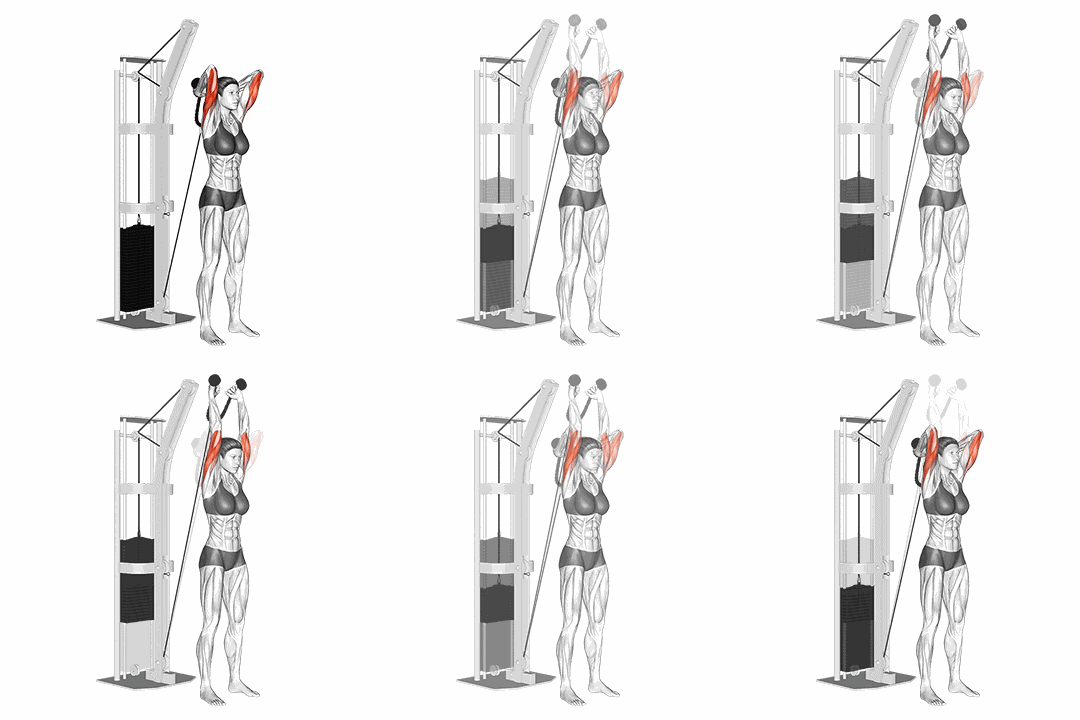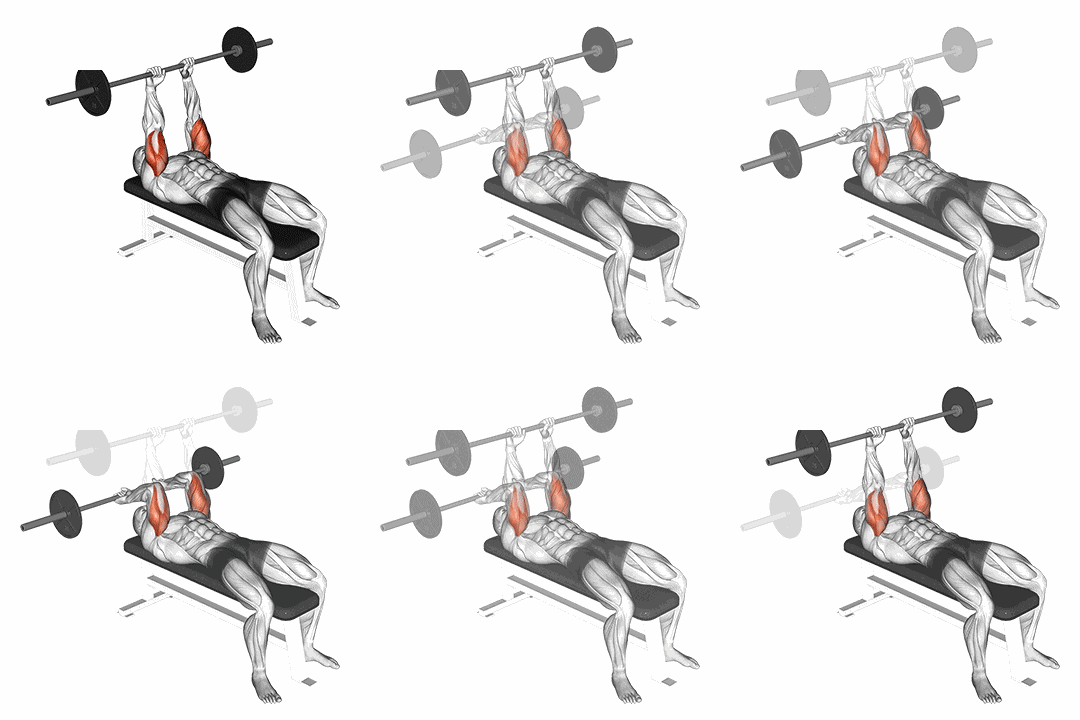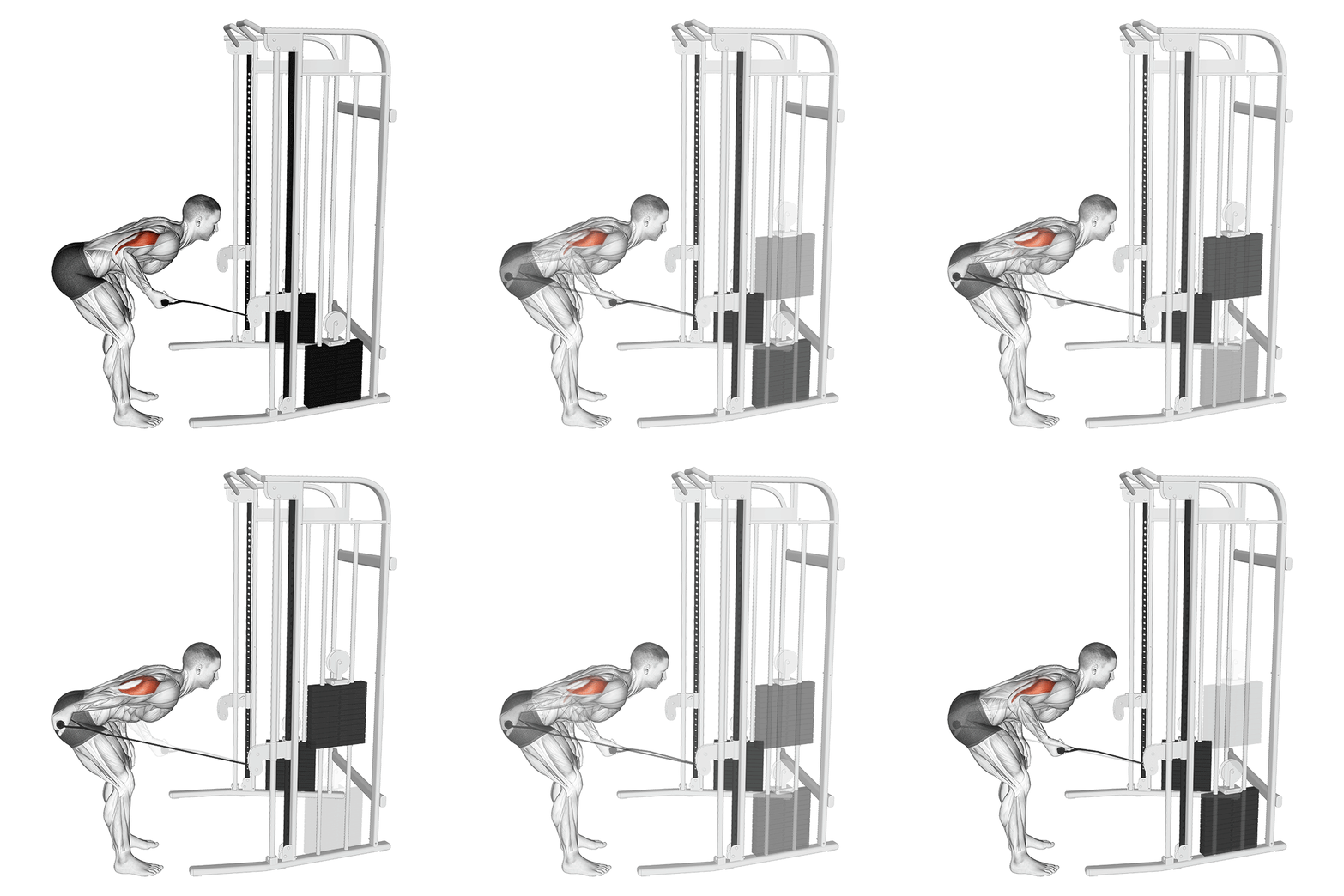
What is the cable triceps kickback?
The cable triceps kickback is a single-arm extension done bent over, with the cable set at the bottom of the column and your upper arm pinned parallel to the floor. You straighten the elbow against the cable until the arm points behind you, then resist the pull on the way back. The cable is what makes the exercise worth doing: with a dumbbell, gravity gives the triceps nothing until the forearm passes horizontal, while the pulley pulls against you from the very first degree. Done strictly and light, it delivers a peak contraction with the shoulder extended that almost no other triceps movement reaches.
How to do the cable triceps kickback
- 1
Set up without an attachment
Set the pulley to its lowest position and grab the cable's rubber ball directly, no handle needed. Face the machine, take a step back and hinge your torso to roughly 45 degrees with a flat back.
- 2
Pin the upper arm
Row your elbow up until your upper arm is parallel to the floor and glued to your ribs, elbow bent around 90 degrees. That position is non-negotiable: it is the whole exercise.
- 3
Kick back to a straight arm
Extend the elbow until your arm is completely straight behind you and hold the squeeze for one second. Nothing else moves: not the shoulder, not the torso, not the hips.
- 4
Resist the return
Let the cable bend your elbow back to 90 degrees over 2 s while your upper arm stays frozen in place. Finish the set on one arm before you swap sides.
Pro tip
Film yourself from the side once: if your elbow dips toward the floor at the start of each rep, you've turned the kickback into a mini row and the triceps are coasting. A lighter stack and a frozen upper arm beat any amount of weight swung backward.
Common mistakes
Elbow dropping each rep.
When the stack gets heavy the elbow drifts down and the lats start helping, turning extension into a pull. If you can't keep your upper arm parallel to the floor, move the pin up the stack, not down.
Standing too upright.
Without a real hinge, your locked-out arm ends up pointing at the floor and the cable barely loads the elbow where the squeeze should happen. Bend to 45 degrees or lower and the top of the rep becomes work again.
Loading it like a pushdown.
The kickback puts the triceps in their weakest leverage position, so the right weight looks embarrassingly small next to your pushdown stack. Chasing kilos here just buys you swinging, a dropped elbow and a sore lower back.
Rushing the lockout.
The only reason to pick this exercise is the squeeze at full extension; cut it short and a pushdown would have done more. Own a full one-second hold with a straight arm on every single rep.
Variations and progressions
Easier
One-arm cable pushdown
Same single-arm extension, but standing tall at the high pulley with no hinge to hold. Build the elbow-pinned habit upright before you add the bent-over position.
Harder
Paused cable kickback
Add a strict 2 s hold at full extension on every rep. The load barely changes but the set becomes brutal, and cheating becomes impossible to hide.
No cable?
Chest-supported dumbbell kickback
Lie chest-down on an incline bench with a dumbbell in each hand. You lose the bottom-range tension but gain a locked torso and two arms working at once.
How to program it
Three protocols by goal. Pick one per cycle and aim for progression on load or distance.
| Goal | Sets × distance | Load | Rest |
|---|---|---|---|
| Hypertrophy | 3 × 12-15 per arm | Light, RPE 8 | 60 s |
| Lockout finisher | 2 × 15-20 per arm | Very light, 1 s hold each rep | 45 s |
| Technique groove | 3 × 10 per arm | Minimal, 2 s hold at lockout | 60 s |
Cable Triceps Kickback FAQ
Cable kickback or dumbbell kickback?
The cable, every time you have one free. A dumbbell only resists gravity, so at the start of the rep, with your forearm hanging down, the triceps feel almost nothing; the work only begins near horizontal. The cable pulls along its own line from the first centimetre, so the muscle is loaded through the entire range. The dumbbell version earns its place when you travel or train at home, not when a pulley is three metres away.
Why do kickbacks burn so much with so little weight?
Because the exercise loads the triceps at the exact point where their leverage is worst: arm straight, shoulder extended behind the body. There is no stronger muscle to share the load and no stretch reflex to bounce out of, so a few kilos produce a contraction that heavier pushdowns never quite match. Judge the exercise by the quality of the squeeze, not the number on the stack; 5 to 10 kg is honest work here.
Which triceps head does the kickback target?
All three heads extend the elbow, so all three work. What is specific here is the long head, which also crosses the shoulder: with your arm held behind your body it contracts at its shortest length, the exact opposite of overhead extensions, which load it at full stretch. Pairing the two in one session covers the long head across its whole range, the kickback supplying the squeeze and the overhead work supplying the stretch.