What is the dumbbell preacher curl?
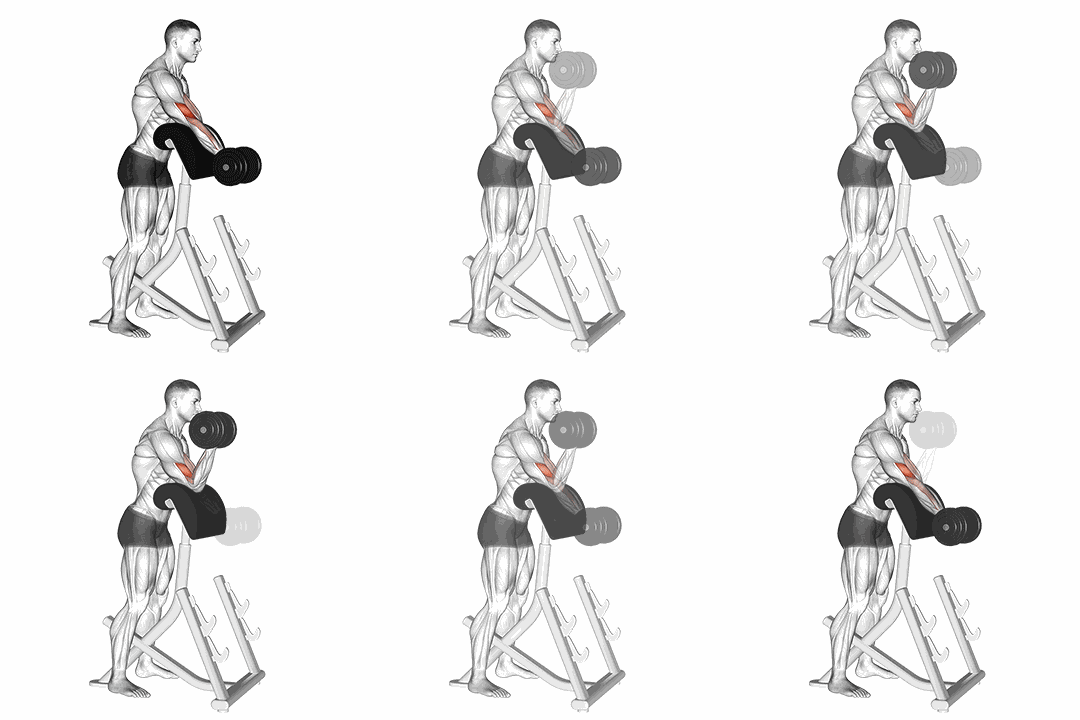
The dumbbell preacher curl is a single-arm biceps curl with the back of your upper arm braced on the angled pad of a preacher bench, also called a Scott bench. Because the pad fixes the shoulder in front of the body and blocks all torso swing, the biceps works alone, and the hardest part of the rep sits in the bottom half, where the muscle is close to full stretch. With the shoulder held in flexion, the long head is slightly slackened, so the short head and the brachialis underneath pick up more of the work than in a standing curl. Choose it for strict, cheat-proof arm volume, to fix a left-right gap, or to rebuild a standing curl that has turned into a swing.
How to do the dumbbell preacher curl
- 1
Set the seat height
Sit so the top of the pad wedges into your armpit and the back of your upper arm lies flat on it. If the elbow floats or the shoulder hunches, adjust before touching a dumbbell.
- 2
Start just short of straight
Grab the dumbbell palm up, arm extended down the pad with a soft 10° bend. Shoulders square to the bench, free hand gripping the pad edge.
- 3
Curl to the peak squeeze
Drive the dumbbell up until the forearm is just past vertical and squeeze. Going higher only stacks the weight over your elbow and gives the biceps a rest.
- 4
Lower slow into the stretch
Take 3 s down, keeping tension all the way to the long starting position. Never relax at the bottom with a loaded arm. Switch arms each set.
Pro tip
Keep a tiny bend at the very bottom and treat it like a wall. The preacher pad puts maximum load on a biceps at near-full stretch: controlled, that is exactly why it grows arms; relaxed and bounced, it is how preacher curls earned their bad elbow reputation.
Common mistakes
Elbow lifting off the pad.
The instant the elbow rises, your shoulder joins in and the strictness that justifies the exercise is gone. If you cannot keep it down, the dumbbell is too heavy.
Dropping and bouncing at the bottom.
A fast, slack bottom on a preacher pad throws heavy load on a maximally stretched biceps. Lower in 3 s and keep a soft 10° bend.
Curling with the wrist.
Flicking the wrist up fakes the top of the rep with the forearm flexors. Keep the wrist neutral so the biceps moves the weight, not the hand.
Variations and progressions
Easier
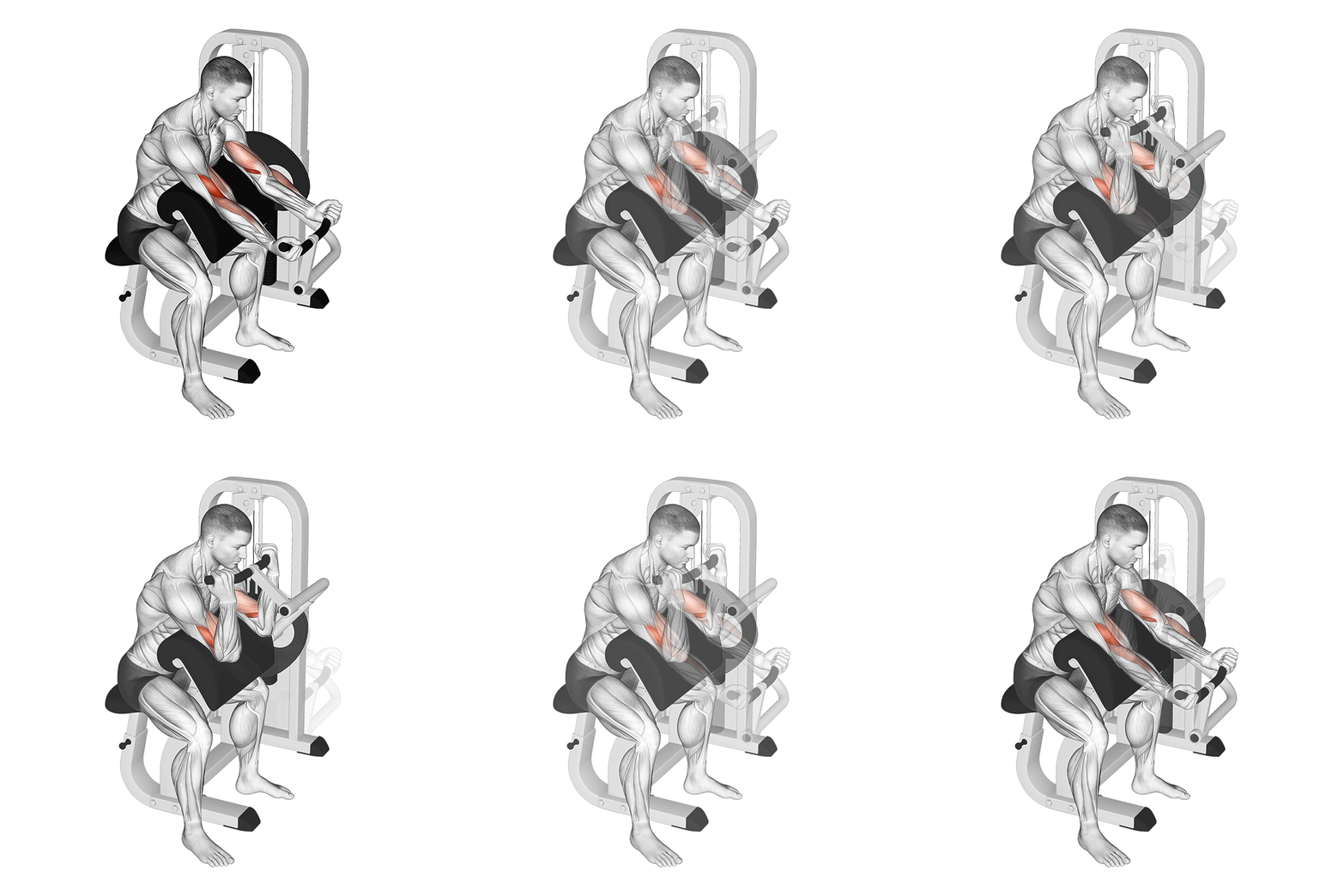
Machine preacher curl
The machine fixes the path and lets you reach failure safely with no dumbbell to dump. Ideal for learning the elbow-down discipline.
Harder
Paused preacher curl
Stop dead for 2 s in the bottom third of every rep. The stretched-position isometric is the hardest arm work a single dumbbell can buy.
No preacher bench?
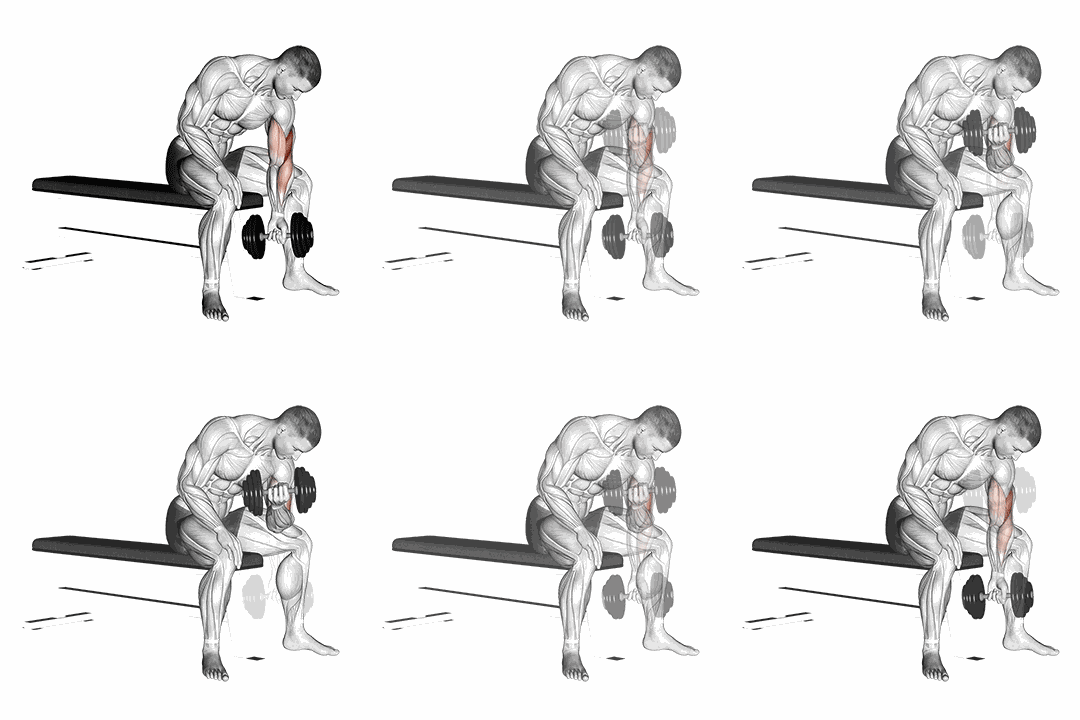
Concentration curl
Seated, elbow braced against your inner thigh: the same cheat-proof, one-arm strictness with nothing but a dumbbell and a bench.
How to program it
Three protocols by goal. Pick one per cycle and aim for progression on load or distance.
| Goal | Sets × distance | Load | Rest |
|---|---|---|---|
| Hypertrophy | 3 × 8-12 per arm | RPE 8 | 90 s |
| Stretch volume | 3 × 12-15 per arm | Moderate, 3 s eccentric | 60-75 s |
| Strict finisher | 2 × 15 per arm | Light, elbow glued down | 45-60 s |
Dumbbell Preacher Curl FAQ
Why am I so much weaker on the preacher curl?
Because everything that inflates a standing curl is gone: no hip drive, no lean-back, no shoulder lift, and the hardest zone sits near full stretch where the biceps is weakest. Lifting less here is not a problem, it is the measurement working. Pick the dumbbell that lets the elbow stay glued down for every rep and progress from there.
Should I fully straighten my arm at the bottom?
Go deep, but keep about 10° of bend and arrive there slowly. The near-full stretch under load is exactly what makes the preacher curl productive; the danger is not the depth, it is relaxing or bouncing there with a heavy dumbbell. Control the last few centimetres instead of avoiding them.
Dumbbell or EZ bar on the preacher bench?
The one-arm dumbbell version exposes and fixes left-right gaps, lets the wrist find its own angle, and forces each arm to earn its reps. The EZ bar loads both arms at once and takes more total weight. If one arm is visibly behind or your standing curl is crooked, start with the dumbbell and let the weaker side set the pace.