What is the dumbbell kickback?
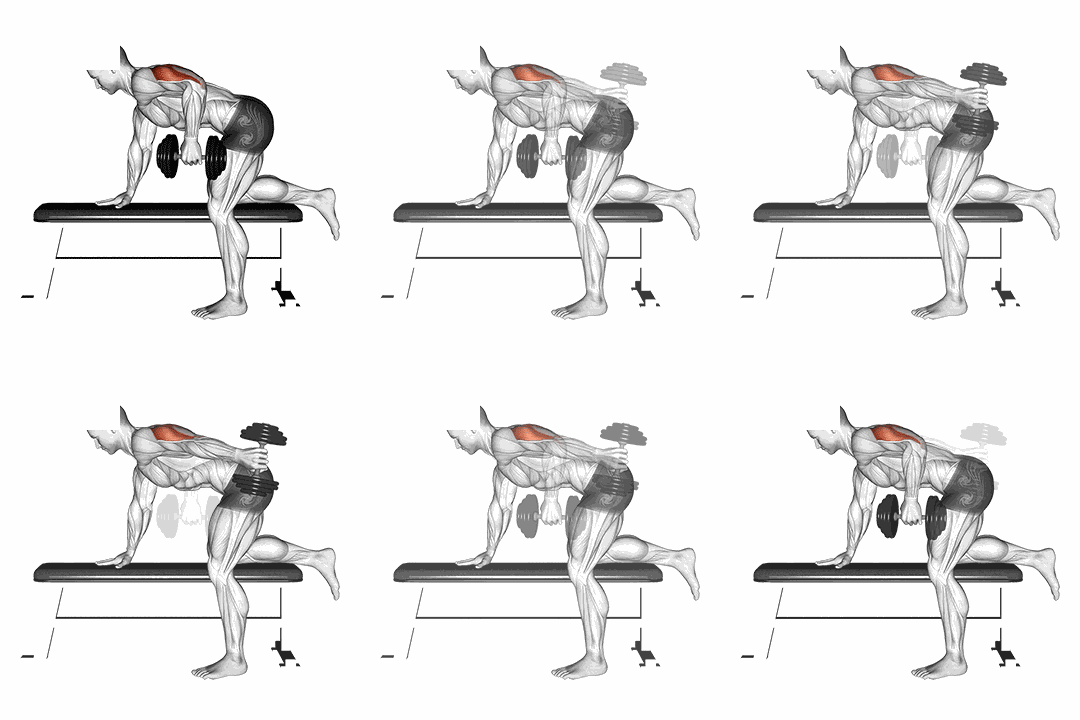
The dumbbell kickback is a single-joint triceps exercise performed bent over, torso near parallel to the floor, upper arm pinned against your side. From a 90° elbow bend you extend the forearm straight back until the arm is fully locked out. Because the forearm is horizontal at lockout, the dumbbell's torque peaks exactly at full extension, the opposite of pushdowns and skull crushers that go easy up top. With the shoulder extended behind the body, the long head is fully shortened, making the kickback the rare movement that trains the triceps hard in its peak-contraction position. Use it as a strict finisher, not a mass builder you load heavy.
How to do the dumbbell kickback
- 1
Hinge over and brace
Hold a light dumbbell, hinge at the hips until your torso is close to parallel with the floor, back flat. Support yourself with the free hand on a bench or on your thigh.
- 2
Pin the upper arm high
Raise your upper arm until it is parallel to the floor, tight against your ribs, elbow bent at 90°. This position must not change for the whole set.
- 3
Extend to a hard lockout
Straighten the forearm back in about 2 s until the arm is fully locked, exhale, and squeeze the triceps for a full second at the top.
- 4
Lower under control
Bend the elbow back to 90° in 2 s without letting it drift toward the floor. Finish all reps, then switch arms.
Pro tip
Test every weight with a 1 s hold at lockout on rep one. If you cannot freeze the arm fully straight and parallel to the floor, the dumbbell is too heavy for this exercise, no matter what you press or curl with it.
Common mistakes
Elbow drifting down.
As the set burns, the upper arm drops and the lockout stops fighting gravity, so the triceps gets a rest instead of a stimulus. Keep the elbow at rib height or end the set.
Swinging the dumbbell.
Momentum carries the weight through the exact part of the range the exercise exists for. Two seconds out, one second of squeeze, two seconds back.
Going too heavy.
The hardest point is full lockout, so an ego weight just means reps that never straighten. Drop the load until every rep finishes dead straight.
Rounding the lower back.
A slack hinge turns the position into a lumbar endurance test. Flat back, braced core, hand on a bench if you need it.
Variations and progressions
Easier
Chest-supported kickback
Lie chest-down on a 30-45° incline bench and kick back both arms at once. The bench holds your posture so you only think about the triceps.
Harder
Pause kickback
Hold every lockout for 2-3 s before lowering. The isometric at peak contraction is brutal with even a tiny dumbbell.
No dumbbell?
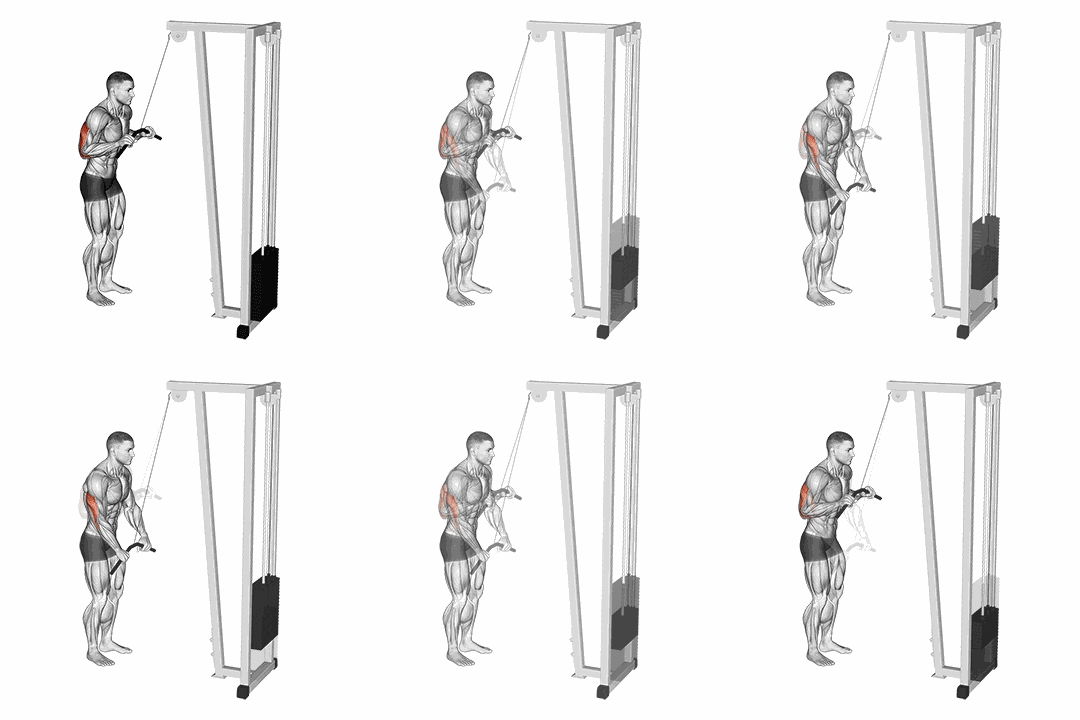
Cable kickback
A low cable keeps tension on the triceps through the whole arc, including the bent-elbow start the dumbbell leaves unloaded.
How to program it
Three protocols by goal. Pick one per cycle and aim for progression on load or distance.
| Goal | Sets × distance | Load | Rest |
|---|---|---|---|
| Hypertrophy | 3 × 12-15 per arm | Light, RPE 8 | 60 s |
| Peak-contraction finisher | 2 × 15-20 per arm | Very light, 1 s hold | 45 s |
| Tempo quality | 3 × 10 per arm | 2 s out, 2 s back | 60-90 s |
Dumbbell Kickback FAQ
Are dumbbell kickbacks actually effective?
Yes, for one specific job: loading the triceps at full lockout with the shoulder extended, where the long head is completely shortened. No pressing movement trains that position hard. They are a poor choice for heavy overload though, so treat them as a precision tool after your pushdowns and dips, not instead of them.
How heavy should I go on kickbacks?
Far lighter than your other triceps work. Torque peaks when the arm is fully straight and horizontal, so a dumbbell you can push down for 15 clean reps will never reach lockout here. Most lifters do their best work with a weight light enough to pause 1 s fully straight on every rep.
Kickback or triceps pushdown?
The pushdown is the heavier, more loadable base movement: the cable spreads tension across the range and the stack goes high. The kickback is the opposite: light, strict and hardest exactly at lockout. Build volume on pushdowns, then use kickbacks to finish or to re-teach the full elbow extension your pushdown reps keep skipping.