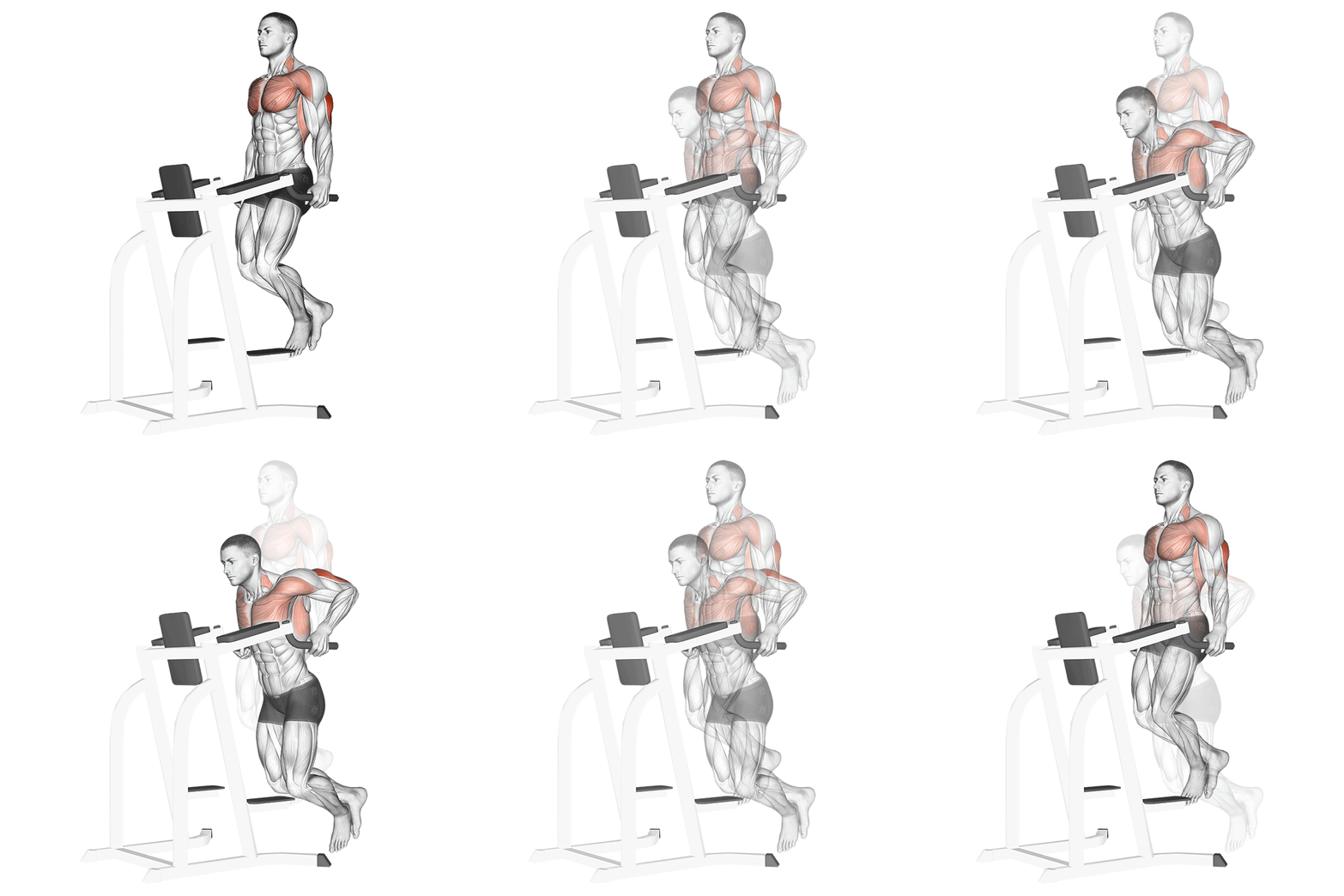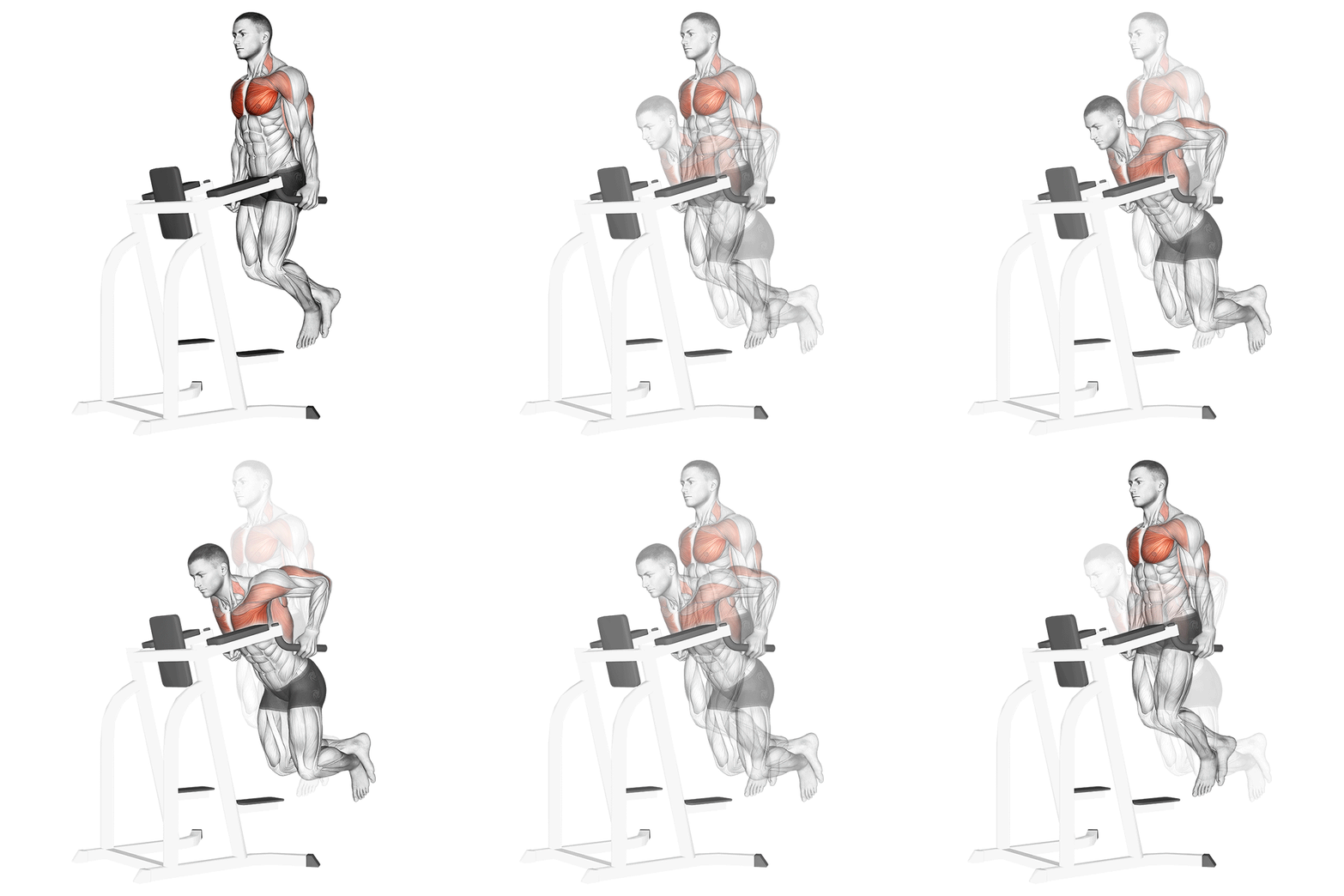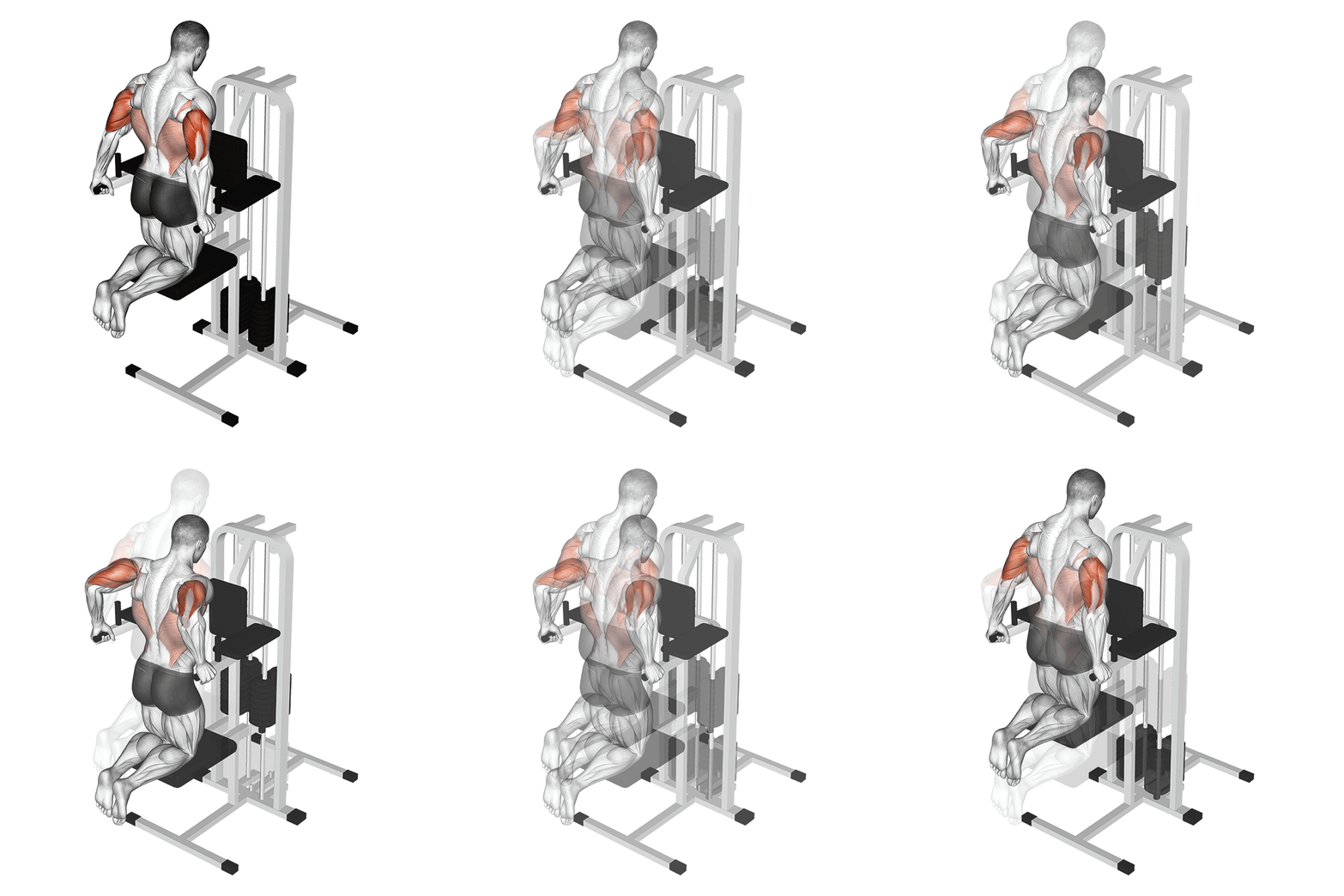
What is the assisted machine dips?
Assisted machine dips are parallel-bar dips done on a machine whose knee pad is connected to a weight stack: the stack pushes the pad upward and cancels part of your bodyweight. Unlike a resistance band, the help is constant and measurable, identical at the bottom and the top, and you can shave it down by exactly 2 or 5 kg at a time. That turns the dip from a pass-or-fail bodyweight test into a loadable lift with a clean progression line. It is the standard road to a first free dip, and it stays useful afterwards for high-rep chest and triceps volume.
How to do the assisted machine dips
- 1
Set the assistance, in reverse
Pin the stack knowing the rule flips here: more weight means more help, so an easier rep. Start with assistance around a third to half of your bodyweight and adjust until 8-10 full reps are hard but clean.
- 2
Mount tall
Grip the handles, place one knee then the other on the pad (or stand on the foot plates), and start at the top: elbows locked, chest up, shoulders pressed down away from your ears.
- 3
Lower to real depth
Bend the elbows and lean the torso slightly forward, lowering for 2-3 seconds until your upper arms are about parallel to the floor, shoulders just below the elbows. That bottom half is where the strength you are chasing gets built.
- 4
Press to a full lockout
Drive through your palms back to straight arms without the pad bouncing you out of the hole. Finish each rep with the elbows fully extended and the shoulders still down, then go again.
Pro tip
Log bodyweight minus assistance as your working load, not the number on the stack. 40 kg of help means nothing on its own: for a 90 kg lifter it is a 50 kg dip, for a 70 kg lifter a 30 kg dip. Tracking the difference keeps your progression honest even while your bodyweight moves.
Common mistakes
Reading the stack like a normal machine.
On every other machine a bigger number is a badge; here it is a bigger crutch. Progress on this exercise means the pin climbing the stack toward less weight, week after week, until the machine is barely helping.
Too little help, too little depth.
Choosing minimal assistance to look closer to a free dip usually buys quarter reps in the top range. The bottom half of the dip is precisely what transfers to the real thing; add assistance and buy back the full range.
Shoulders swallowing the ears at the bottom.
At depth, a passive shoulder shrugs up and the joint takes the load the triceps should. Keep the shoulder blades pulled down and stop at the depth where your chest can stay proud; deeper will come as you get stronger.
Letting the counterweight do the turnaround.
Diving fast into the bottom lets the machine’s assistance spring you back up, and the hardest centimetres never get trained. Control the descent, pause for a beat, and make the press start from muscle, not from bounce.
Variations and progressions
Easier
Bench dips
Hands on a bench behind you, feet on the floor, hips sliding up and down in front of the pad. The load is a fraction of bodyweight and the equipment is everywhere; keep the hips close to the bench to spare the shoulders.
Harder
Bodyweight dips
The graduation exam. When your assistance is down to roughly 10% of bodyweight for 3 × 6, move to the parallel bars: the load barely changes, but your body suddenly has to provide all the balance the machine was donating.
Alternative
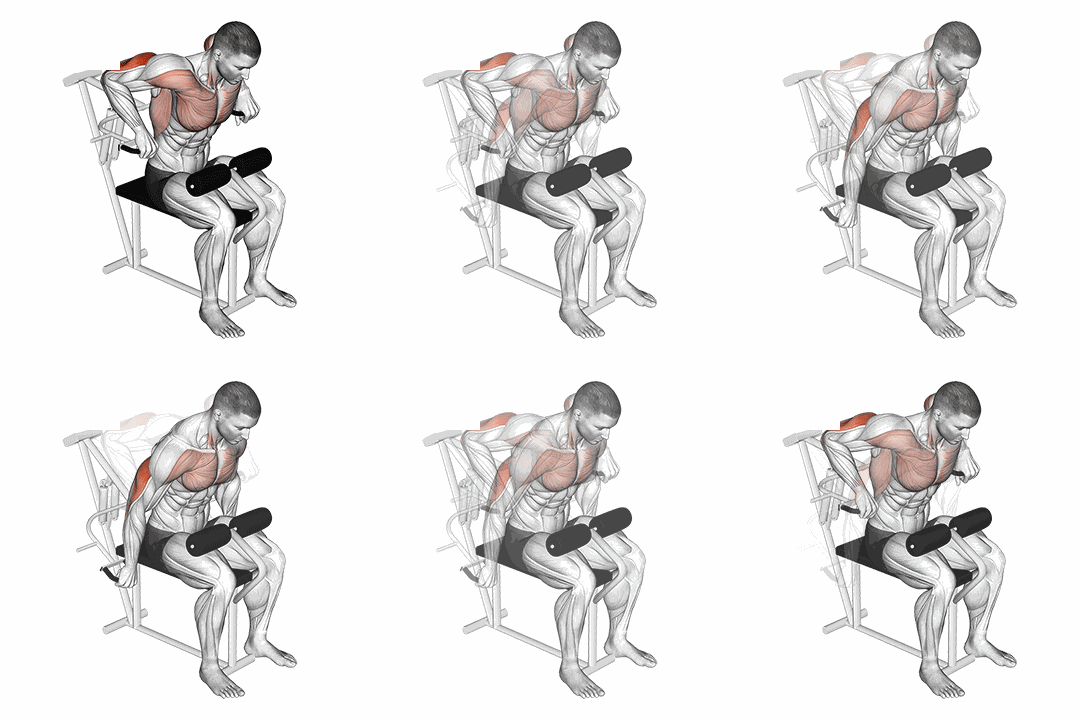
Seated dip machine
The seated version loads the same pressing pattern from a fixed seat, with no bodyweight in the equation at all. Useful for drop sets, for loading beyond bodyweight later on, or when the assisted machine is taken.
How to program it
Three protocols by goal. Pick one per cycle and aim for progression on load or distance.
| Goal | Sets × distance | Load | Rest |
|---|---|---|---|
| First free dip | 4 × 6-8 | Assistance leaving 2 reps in reserve; cut 2-5 kg each week | 2 min |
| Hypertrophy | 3 × 10-12 | Moderate assistance, RPE 8 | 90 s |
| High-rep finisher | 2 × 15-20 | Generous assistance, RPE 9 | 60 s |
Assisted Machine Dips FAQ
Does adding weight make this machine easier or harder?
Easier. The stack is a counterweight connected to the knee pad: every kilo you pin pushes you upward and subtracts itself from the bodyweight you have to press. It is the opposite of every other machine in the gym, which is why you will see beginners accidentally training with 5 kg of help and strong lifters confused about why the full stack feels like nothing.
How do I progress from the machine to a real dip?
Shrink the assistance on a schedule, not by feel: 2-5 kg less per week while keeping 3-4 sets of 6-8 full-depth reps. When the help is down to 10-15% of your bodyweight, start each session with a few slow negatives on the parallel bars, 3-5 seconds down, then finish the volume on the machine. Most lifters press their first clean free dip within a few weeks of that combination.
Is this more a chest or a triceps exercise?
You steer it with your torso. Staying upright with the elbows tracking back keeps the elbow joint doing most of the travelling, which hands the rep to the triceps. Leaning the chest forward and dipping slightly deeper stretches and loads the lower chest more. The machine makes experimenting cheap: pick one intention per set rather than averaging the two into a vague middle.
Knees or feet on the platform?
Use whichever your machine offers; the mechanics barely change. What matters is keeping the hips under the shoulders rather than letting them drift backward, which tips you into a head-first dive and strains the front of the shoulder. Kneeling tends to make that alignment automatic, standing makes getting on and off quicker: both are fine.