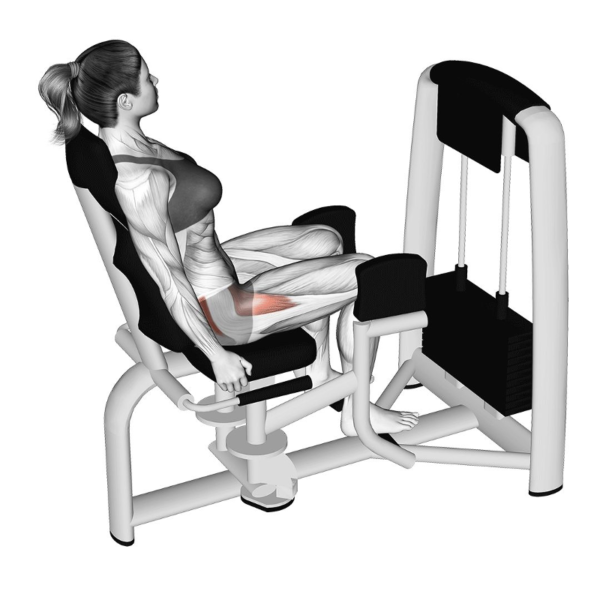
What is the seated hip abduction machine?
The hip abduction machine resists outward leg movement against pads pressed by your knees. The primary mover is the glute medius, with help from the upper fibers of the glute max and the tensor fasciae latae. A strong glute medius prevents knee valgus on squats, lunges and running, and is critical for runners and field-sport athletes. It's also one of the few exercises that targets this muscle with proper progressive load.
How to do the seated hip abduction machine
- 1
Set the pads narrow
Start with the pads at a comfortable narrow setting. You'll get more range and a stronger stretch.
- 2
Sit upright, lean slightly forward
Sitting upright biases the upper glute fibers. A slight forward lean shifts work toward the glute medius itself.
- 3
Push knees outward
Press outward with the knees, not the feet. Drive to a full, hard squeeze with a 1-second hold.
- 4
Return slow under tension
Resist the pads on a 3-second eccentric back to the start. Don't let the stack snap back.
Pro tip
Sit upright for upper-glute focus, lean forward 30 degrees for max glute medius. Use both positions across the week.
Common mistakes
Bouncing off the pads.
Using momentum cuts the stimulus and pinches the lower back. Slow, controlled reps.
Arching the lower back.
Excess lumbar arch shifts the work off the glutes. Keep the lower back in contact with the seat.
Half range.
Tiny opens skip the stretch. Start narrow, push to fully open.
Lifting hips off the seat.
If hips rise, the load is too heavy and your form just broke. Drop a plate.
Variations and progressions
Easier
Banded side step
Loop a mini-band above the knees and side-step in a half squat. Activates the glute medius without machine load.
Harder
1.5 reps with pause
Full open, halfway in, back to full open with a 2-second hold, then return. Brutal time under tension.
No machine?
Side-lying leg raise
Lie on your side, lift the top leg slowly through full range, with or without an ankle weight. Same muscle, no machine.
How to program it
Three protocols by goal. Pick one per cycle and aim for progression on load or distance.
| Goal | Sets × distance | Load | Rest |
|---|---|---|---|
| Glute medius hypertrophy | 4 × 15 | Moderate, RPE 8 | 60-75 s |
| Strength | 4 × 8-10 | 75-85% 1RM | 90 s |
| Knee-stability finisher | 3 × 20 with 2 s hold | Light, 40-50% 1RM | 45 s |
Seated Hip Abduction Machine FAQ
Will it actually help my running and squats?
Yes if your glute medius is weak. Weak abductors let the knees cave on landings and during heavy squats, and let the pelvis dip on every running stride, which kills efficiency and shoulders injuries. Train it directly two times a week and you'll feel the difference within a month.
Does it grow the side of the glute?
Yes, the upper-side shape of the glute (the "shelf") is driven mostly by the glute medius and upper glute max fibers, both heavily recruited here. Combined with hip thrusts and side-lying raises, it builds the full glute silhouette better than any single squat variation.
Sit upright or lean forward?
Both. Upright biases the upper glute fibers and tensor fasciae latae. Leaning forward 20 to 30 degrees shifts focus to the glute medius proper. Alternate within a session or across the week to hit the whole muscle.