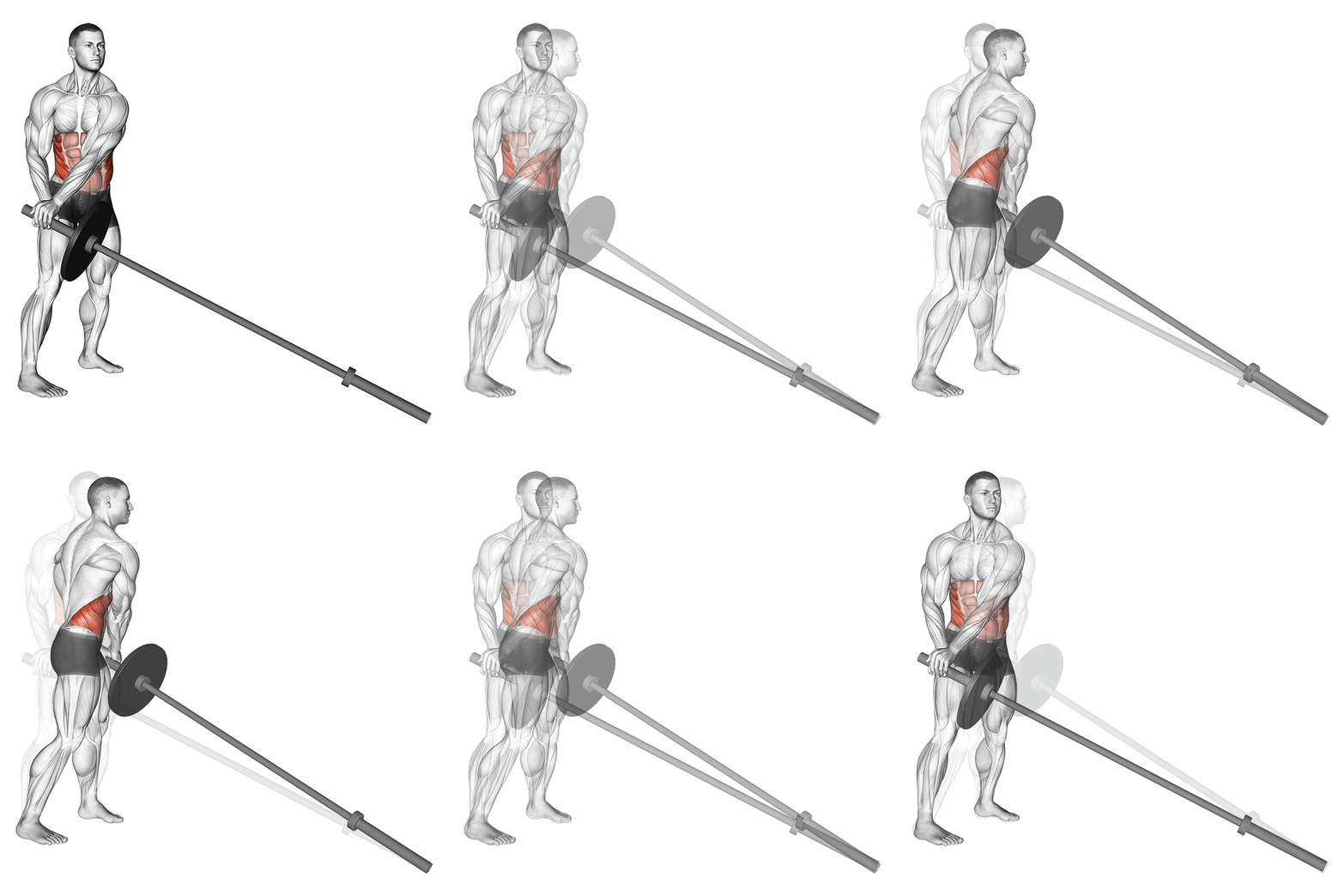
What is the landmine twist?
The landmine twist uses one end of a barbell anchored in a landmine attachment or a corner. You hold the free end with both hands, arms straight, and arc it side to side over your head. The torso rotates, the arms stay locked. It trains the obliques, deep core stabilisers and shoulders to produce and resist rotation, the exact quality that powers golf swings, throws, punches and change-of-direction sports. It also exposes weak hip-to-shoulder coordination quickly.
How to do the landmine twist
- 1
Anchor the bar
Set one end of a barbell in a landmine attachment or wedged in a corner. Load the free end with a plate.
- 2
Set your base
Stand with feet wider than shoulder width, knees soft. Grip the free end with both hands, arms straight overhead.
- 3
Arc the bar in a half-circle
Rotate your torso and shift weight onto one foot as the bar arcs down to hip height on that side. Keep arms straight.
- 4
Reverse smoothly
Bring the bar back overhead and arc it down to the other side. Smooth, controlled, no jerking at the bottom.
Pro tip
Drive the rotation from the hips, not the shoulders. If your spine is twisting while your hips stay locked, you're loading your discs.
Common mistakes
Twisting only the spine.
Locking the hips and torquing the spine puts shear on the lumbar discs. The pelvis must rotate with the bar.
Bending the arms.
Arms shorten the lever and steal load from the core. Keep elbows straight throughout.
Loading too heavy.
Heavy plates force speed and momentum. Use moderate weight you can pause at every position.
Flat feet, locked knees.
Stiff legs block the hip rotation. Let the back-side heel pivot up as the bar travels.
Variations and progressions
Easier
Half-kneeling pallof press
Anti-rotation hold from a half-kneeling position. Builds the same core stability with no overhead load.
Harder
Standing rotational throw
Add explosive intent or release the bar into a med ball throw for true rotational power output.
No landmine?
Cable woodchopper
A high-to-low cable chop trains the same diagonal core pattern with no barbell.
How to program it
Three protocols by goal. Pick one per cycle and aim for progression on load or distance.
| Goal | Sets × distance | Load | Rest |
|---|---|---|---|
| Core stability | 3 × 8/side | Light | 60 s |
| Rotational power | 4 × 5/side, explosive | Moderate | 90 s |
| Conditioning | 3 × 30 s | Light | 30 s |
Landmine Twist FAQ
Is the landmine twist safe for my back?
Yes when done well. The danger comes from twisting the lumbar spine under load. If the hips rotate with the bar and the pelvis turns freely, the lumbar stays neutral and the load travels through the obliques. Anyone with active disc issues should clear it with a clinician first.
How much weight should I use?
Start with a 10 kg plate. The lever is much longer than it looks because the bar is roughly 1.8 m, so 10 kg at the end can feel like a 25 kg dumbbell. Build to 20 kg only if hip-driven rotation stays clean.
What sports does this carry over to?
Anything with a rotational power output: golf, tennis, baseball, throwing sports, boxing, MMA, hockey, and team sports with change of direction. It also helps endurance athletes who want a more stable trunk under fatigue. It does not replace heavy sagittal core work like loaded carries.